
Judge, 1937-04 · page 9 of 36
Judge — April 1937 — page 9: what you’re looking at
What you’re looking at
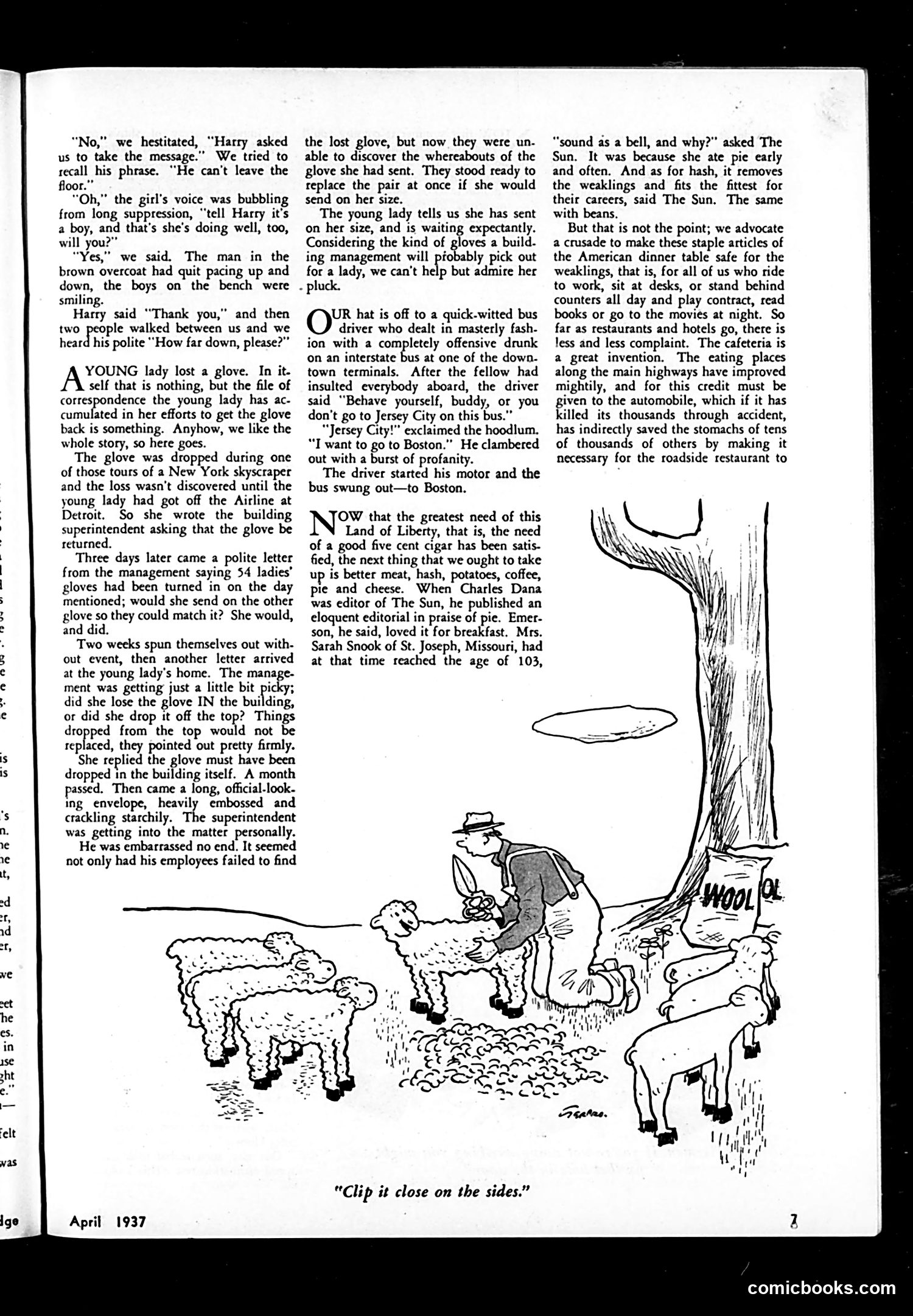
# Judge Magazine, April 1937 - Page Analysis The page contains two distinct pieces: **Top section**: A humorous narrative about a young woman who lost a glove during a New York skyscraper visit. The story satirizes bureaucratic inefficiency—the airline, building management, and various authorities all struggle to locate or replace the lost item, creating absurd correspondence and delays. **Bottom cartoon**: Shows a man shearing sheep while addressing them to "Clip it close on the sides." The joke appears to target wool production or possibly labor practices, likely referencing economic or agricultural concerns of 1937 Depression-era America. Both pieces use gentle, domestic humor typical of Judge's satirical approach—mocking everyday frustrations and institutional red tape rather than attacking specific political figures. The overall tone is light social commentary.
📄 Transcribed text from this page (OCR, searchable)
Machine-transcribed from the original scan — historical spelling and the odd misread are preserved.
i A a ae B C € . e “No,” we hestitated, “Harry asked us to take the message.” We tried to recall his phrase. “He can't leave the floor.” “Oh,” the girl's voice was bubbling from long suppression, “tell Harry it's a boy, and that’s she’s doing well, too, will you?” “Yes,” we said. The man in the brown overcoat had quit pacing up and down, the boys on the bench were smiling. Harry said “Thank you,” and then two people walked between us and we heard his polite How far down, please?” YOUNG lady lost a glove. In it. self that is nothing, but the file of correspondence the young lady has ac- cumulated in her efforts to get the glove back is something. Anyhow, we like the whole story, so here goes. The glove was dropped during one of those tours of a New York skyscraper and the loss wasn’t discovered until the young lady had got off the Airline at Detroit. So she wrote the building superintendent asking that the glove be returned. Three days later came a polite letter from the management saying 54 ladies’ gloves had been turned in on the day mentioned; would she send on the other glove so they could match it? She would, and did, Two weeks spun themselves out with- out event, then another letter arrived at the young lady's home. The manage. ment was getting just a little bit pie did she lose the glove IN the building, or did she drop it off the top? Things dropped from the top would not be replaced, they pointed out pretty firmly. She replied the glove must have been dropped in the building itself. A month passed. Then came a long, official-look- ing envelope, heavily embossed and crackling starchily. The superintendent was getting into the matter personally. He was embarrassed no end. It seemed not only had his employees failed to find April, 1937 the lost glove, but now they were un- able to discover the whereabouts of the glove she had sent. They stood ready to replace the pair at once if she would send on her size. The young lady tells us she has sent on her size, and is waiting expectantly. Considering the kind of gloves a build- ing management will piobably pick out for a lady, we can’t help but admire her - pluck. OF hat is off to a quick-witted bus driver who dealt in masterly fash- ion with a complete'y offensive drunk on an interstate bus at one of the down- town terminals. After the fellow had insulted everybody aboard, the driver said “Behave yourself, buddy, or you don’t go to Jersey City on this bus.” “Jersey City!” exclaimed the hoodlum. “TI want to go to Boston.” He clambered out with a burst of profanity. The driver started his motor and the bus swung out—to Boston. N°& that the greatest need of this Land of Liberty, that is, the need of a good five cent cigar has been satis- fied, the next thing that we ought to take up is better meat, hash, potatoes, coffee, pie and cheese. When Charles Dana was editor of The Sun, he published an eloquent editorial in praise of pie. Emer- son, he said, loved it for breakfast. Mrs. Sarah Snook of St. Joseph, Missouri, had at that time reached the age of 103, "Clip it close on the sides.” “sound as a bell, and why?” asked The Sun. It was because she ate pie early and often. And as for hash, it removes the weaklings and fits the fittest for their careers, said The Sun. The same with beans. But that is not the point; we advocate a crusade to make these staple articles of the American dinner table safe for the weaklings, that is, for all of us who ride to work, sit at desks, or stand behind counters all day and play contract, read books or go to the movies at night. So far as restaurants and hotels go, there is less and less complaint. The cafeteria is a great invention. The eating places along the main highways have improved mightily, and for this credit must be given to the automobile, which if it has killed its thousands through accident, has indirectly saved the stomachs of tens of thousands of others by making it necessary for the roadside restaurant to comicbooks.com