
Judge, 1937-04 · page 8 of 36
Judge — April 1937 — page 8: what you’re looking at
What you’re looking at
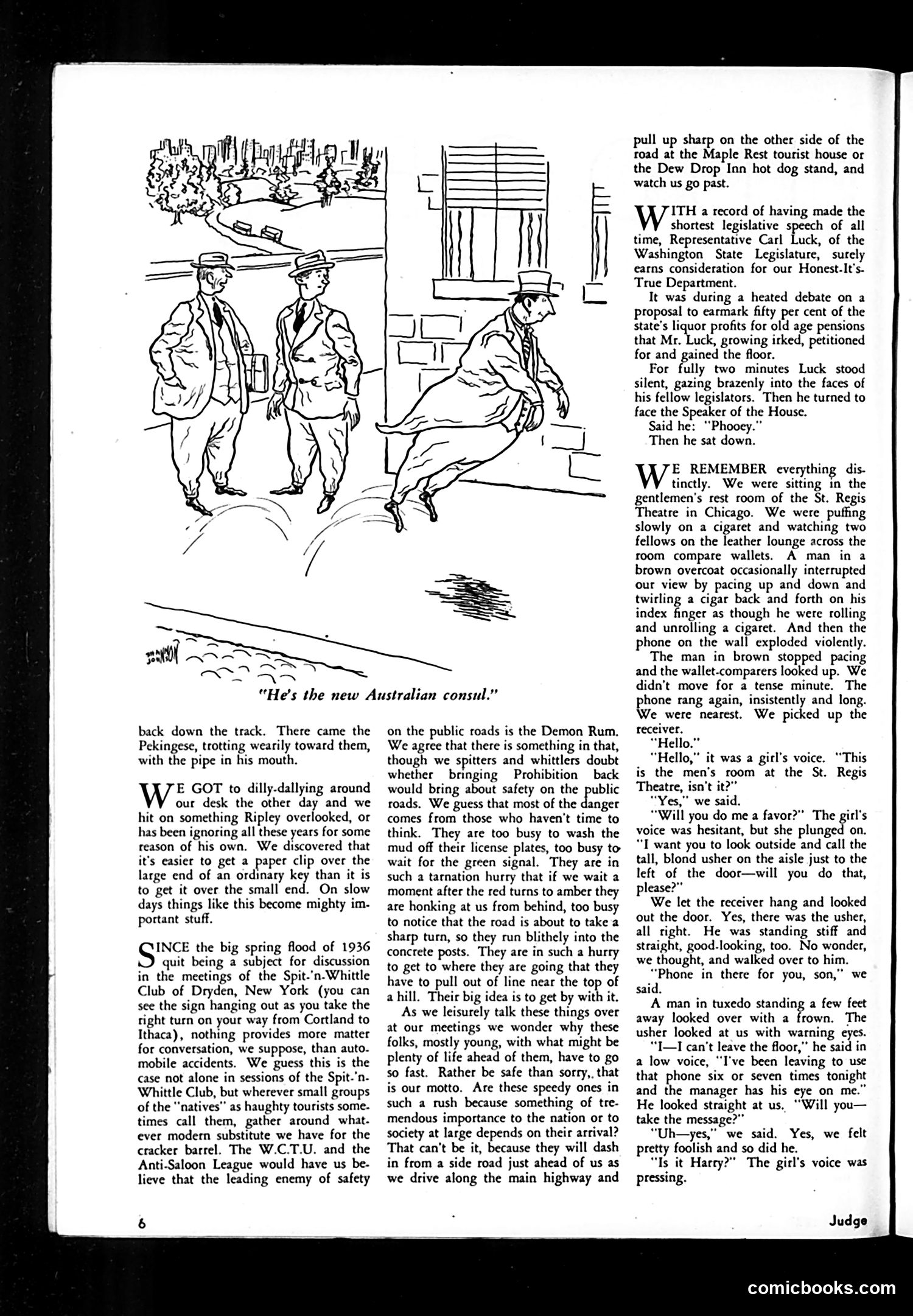
# Political Cartoon Analysis: "He's the new Australian consul" The cartoon depicts two men in suits encountering a kangaroo on a city street, with one man remarking "He's the new Australian consul." **The Satire:** This is a joke about diplomatic appointments, suggesting someone (presumably an actual Australian consul appointee of the era) is incompetent or unsuitable for the role—by humorously implying a kangaroo would be equally qualified. It's a dismissive commentary on either the specific appointment or Australian diplomacy generally. **Context:** Without identifying the specific consul referenced, the satire relies on stereotyping Australians through their most recognizable animal export. The joke assumes readers would find the substitution absurd yet somehow fitting—a common satirical technique questioning official competence or political favoritism in diplomatic postings.
📄 Transcribed text from this page (OCR, searchable)
Machine-transcribed from the original scan — historical spelling and the odd misread are preserved.
“He's the new Australian consul.” back down the track. There came the Pekingese, trotting wearily toward them, with the pipe in his mouth. E GOT to dilly-dallying around our desk the other day and we hit on something Ripley overlooked, or has been ignoring all these years for some reason of his own. We discovered that it’s easier to get a paper clip over the large end of an ordinary key than it is to get it over the small end. On slow days things like this become mighty im. portant stuff. SNt the big spring flood of 1936 quit being a subject for discussion in the meetings of the Spit-'n-Whittle Club of Dryden, New York (you can see the sign hanging out as you take the right turn on your way from Cortland to Ithaca), nothing provides more matter for conversation, we suppose, than auto. mobile accidents. We guess this is the case not alone in sessions of the Spit-’n- Whittle Club, but wherever small groups of the “natives” as haughty tourists some- times call them, gather around what. ever modern substitute we have for the cracker barrel. The W.C.T.U. and the Anti-Saloon League would have us be- lieve that the leading enemy of safety on the public roads is the Demon Rum. We agree that there is something in that, though we spitters and whittlers doubt whether bringing Prohibition back would bring about safety on i poe roads. We guess that most of the danger comes from those who haven't time to think. They are too busy to wash the mud off their license plates, too busy to wait for the green signal. They are in such a tarnation hurry that if we wait a moment after the red turns to amber they are honking at us from behind, too busy to notice that the road is about to take a sharp turn, so they run blithely into the concrete posts. They are in such a hurry to get to where they are going that they have to pull out of line near the top of a hill. Their big idea is to get by with it. As we leisurely talk these things over at our meetings we wonder why these folks, mostly young, with what might be plenty of life ahead of them, have to go so fast. Rather be safe than sorry,, that is our motto. Are these speedy ones in such a rush because something of tre- mendous importance to the nation or to society at large depends on their arrival? That can’t be it, because they will dash in from a side road just ahead of us as we drive along the main highway and pull up sharp on the other side of the road at the Maple Rest tourist house or the Dew Drop Inn hot dog stand, and watch us go past. Wie a record of having made the shortest legislative speech of all time, Representative Carl Luck, of the Washington State Legislature, surely earns consideration for our Honest-It's- True Department. It was during a heated debate on a proposal to earmark fifty per cent of the state's liquor profits for old age pensions that Mr. Luck, growing irked, petitioned for and gained the floor. For fully two minutes Luck stood silent, gazing brazenly into the faces of his fellow legislators. Then he turned to face the Speaker of the House. Said he: “Phooey.” Then he sat down. E REMEMBER everything dis- tinctly. We were sitting in the gentlemen's rest room of the St. Regis Theatre in Chicago. We were puffing slowly on a cigaret and watching two fellows on the leather lounge across the room compare wallets. A man in a brown overcoat occasionally interrupted our view by pacing up and down and twirling a cigar back and forth on his index finger as though he were rolling and unrolling a cigaret. And then the phone on the wall exploded violently. The man in brown stopped pacing and the wallet-comparers looked up. We didn’t move for a tense minute. The phone rang again, insistently and long. We were nearest. We picked up the receiver. “Hello.” “Hello,” it was a girl's voice. “This is the men’s room at the St. Regis Theatre, isn’t it?” “Yes,” we said. “Will you do me a favor?” The girl's voice was hesitant, but she plunged on. “I want you to look outside and call the tall, blond usher on the aisle just to the left of the door—will you do that, lease?” We let the receiver hang and looked out the door. Yes, there was the usher, all right. He was standing stiff and straight, good-looking, too. No wonder, we thought, and walked over to him. “Phone in there for you, son,” we said. A man in tuxedo standing a few feet away looked over with a frown. The usher looked at us with warning eyes. “I—I can't leave the floor,” he said in a low voice, “I've been leaving to use that phone six or seven times tonight and the manager has his eye on me.” He looked straight at us. “Will you— take the message?” “Uh—yes,” we said. Yes, we felt pretty foolish and so did he. “Is it Harry?” The girl's voice was pressing. Judge comicbooks.com