
Judge, 1937-04 · page 16 of 36
Judge — April 1937 — page 16: what you’re looking at
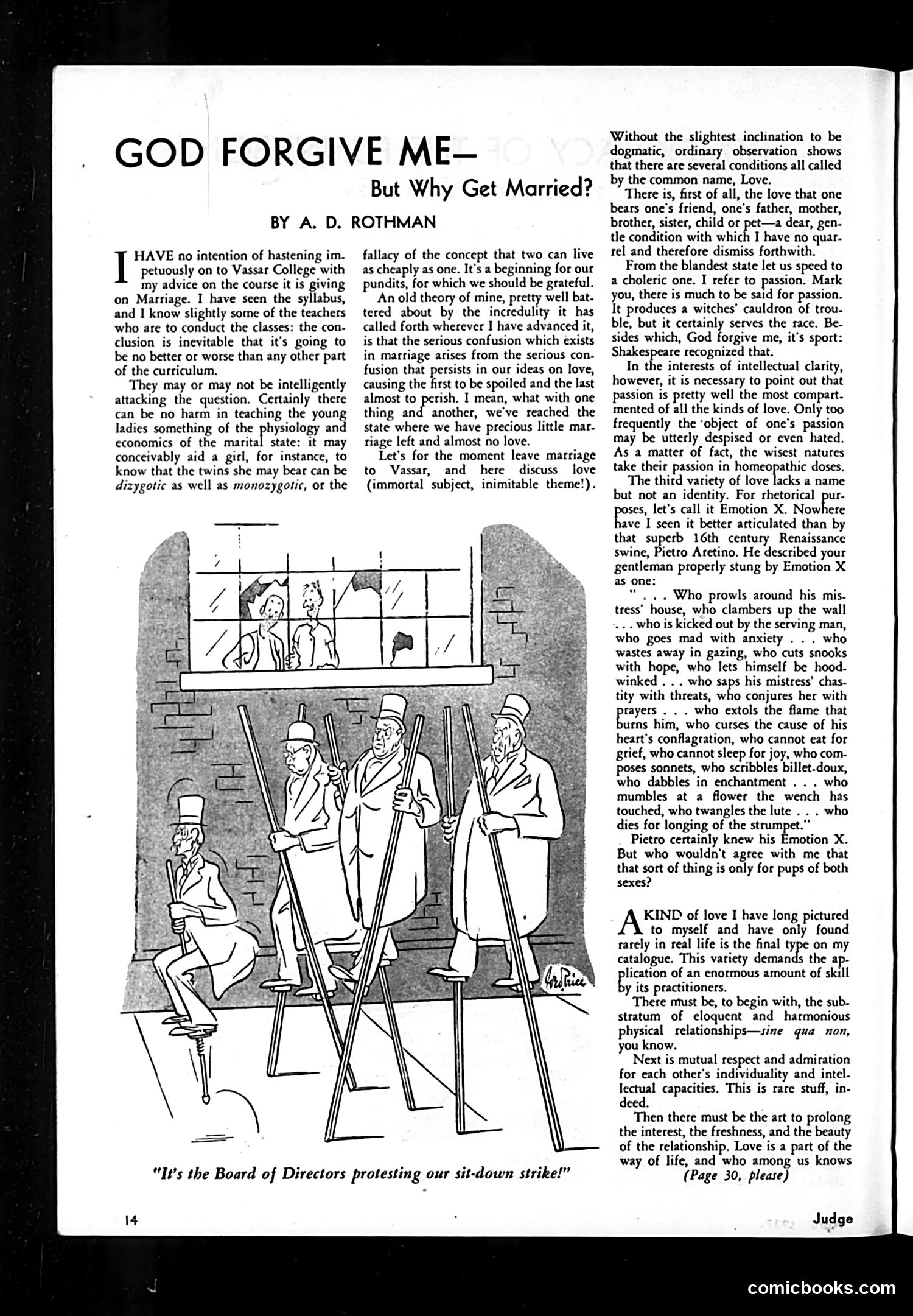
A restored page from Judge, 1937-04. Page through the whole issue in the reader above.
📄 Transcribed text from this page (OCR, searchable)
Machine-transcribed from the original scan — historical spelling and the odd misread are preserved.
GOD FORGIVE ME-— But Why Get Married? BY A. D. ROTHMAN HAVE no intention of hastening im. petuously on to Vassar College with my advice on the course it is giving on Marriage. I have seen the syllabus, and I know slightly some of the teachers who are to conduct the classes: the con- clusion is inevitable that it’s going to be no better or worse than any other part of the curriculum. They may or may not be intelligently attacking the question. Certainly there can be no harm in teaching the young ladies something of the physiology and economics of the marital state: it may conceivably aid a girl, for instance, to know that the twins she may bear can be dizygotic as well as monozygotic, or the fallacy of the concept that two can live as cheaply as one. It's a beginning for our pundits, for which we should be grateful. An old theory of mine, pretty well bat- tered about by the incredulity it has called forth wherever I have advanced it, is that the serious confusion which exists in marriage arises from the serious con- fusion that persists in our ideas on love, causing the first to be spoiled and the last almost to perish. I mean, what with one thing and another, we've reached the state where we have precious little mar. riage left and almost no love. Let's for the moment leave marriage to Vassar, and here discuss love (immortal subject, inimitable theme!). "It’s the Board of Directors protesting our sit-down strike!” Without the slightest inclination to be dogmatic, ordinary observation shows that there are several conditions all called by the common name, Love. There is, first of all, the love that one bears one’s friend, one’s father, mother, brother, sister, child or pet—a dear, gen- tle condition with which I have no quar- rel and therefore dismiss forthwith. From the blandest state let us speed to a choleric one. I refer to passion. Mark you, there is much to be said for passion. It produces a witches’ cauldron of trou- ble, but it certainly serves the race. Be- sides which, God forgive me, it’s sport: Stubepare recognized that. In the interests of intellectual clarity, however, it is necessary to point out that passion is pretty well the most compart. mented of all the kinds of love. Only too frequently the ‘object of one's ion may be utterly despised or even hated. As a matter of fact, the wisest natures take their passion in homeopathic doses. The third variety of love lacks a name but not an identity. For rhetorical pur- ses, let's call it Emotion X. Nowhere ve I seen it better articulated than by that superb 16th century Renaissance swine, Pietro Aretino. He described your gentleman properly stung by Emotion X as one: “... Who prowls around his mis- tress’ house, who clambers up the wall . .. who is kicked out by the serving man, who goes mad with anxiety . . . who wastes away in gazing, who cuts snooks with hope, who lets himself be hood. winked . . . who saps his mistress’ chas- tity with threats, who conjures her with prayers +. . who extols the flame that urns him, who curses the cause of his heart's conflagration, who cannot eat for grief, who cannot sleep for joy, who com- poses sonnets, who scribbles billet-doux, who dabbles in enchantment . . . who mumbles at a flower the wench has touched, who twangles the lute . . . who dies for longing of the i ae Pietro certainly knew his Emotion X. But who wouldn't agree with me that that sort of thing is only for pups of both sexes? AXNte of love I have long pictured to myself and have only found rarely in real life is the final type on my catalogue. This variety demands the ap- lication of an enormous amount of skill By its practitioners. There must be, to begin with, the sub- stratum of eloquent and harmonious physical relationships—sine qua non, you know. Next is mutual respect and admiration for each other's individuality and intel- lectual capacities. This is rare stuff, in- deed. Then there must be the art to prolong the interest, the freshness, and the beauty of the relationship. Love is a part of the way of life, and who among us knows (Page 30, please) Judge comicbooks.com