
Judge, 1937-04 · page 15 of 36
Judge — April 1937 — page 15: what you’re looking at
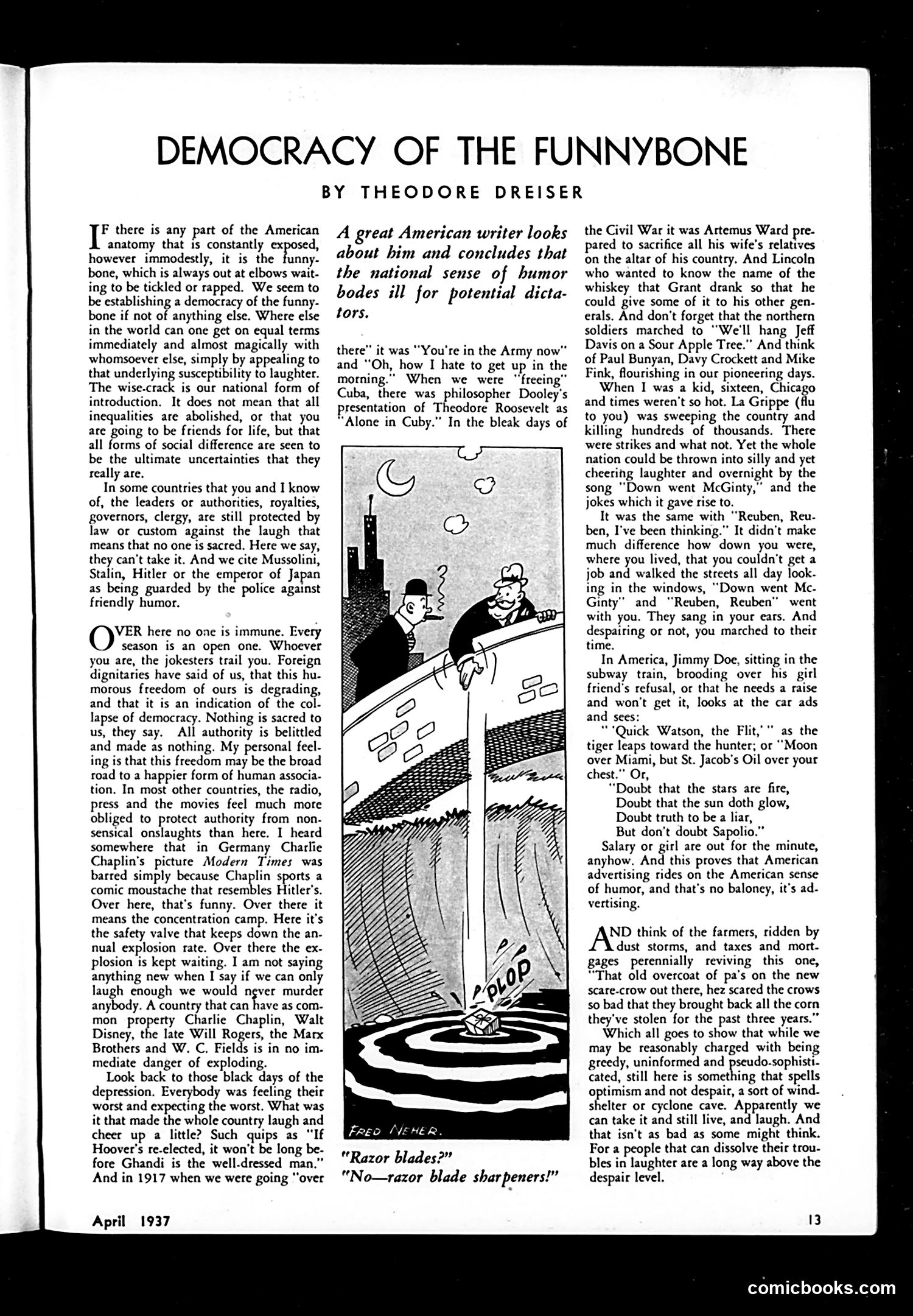
A restored page from Judge, 1937-04. Page through the whole issue in the reader above.
📄 Transcribed text from this page (OCR, searchable)
Machine-transcribed from the original scan — historical spelling and the odd misread are preserved.
DEMOCRACY OF THE FUNNYBONE F there is any part of the American anatomy that is constantly sxpased, however immodestly, it is the funny- bone, which is always out at elbows wait- ing to be tickled or rapped. We seem to be establishing a democracy of the funny. bone if not of anything else. Where else in the world can one get on equal terms immediately and almost magically with whomsoever else, simply by appealing to that underlying susceptibility to laughter. The wise-crack is our national form of introduction. It does not mean that all inequalities are abolished, or that you are going to be friends for life, but that all forms of social difference are seen to be the ultimate uncertainties that they really are, In some countries that you and I know of, the leaders or authorities, royalties, governors, clergy, are still protected by law or custom against the laugh that means that no one is sacred. Here we say, they can’t take it. And we cite Mussolini, Stalin, Hitler or the emperor of Japan as being guarded by the police against friendly humor. VER here no one is immune. Every season is an open one. Whoever you are, the jokesters trail you. Foreign dignitaries have said of us, that this hu. morous freedom of ours is degrading, and that it is an indication of the col- lapse of democracy. Nothing is sacred to us, they say. All authority is belittled and made as nothing. My personal feel- ing is that this freedom may be the broad road to a happier form of human associa- tion. In most other countries, the radio, press and the movies feel much more obliged to protect authority from non- sensical onslaughts than here. I heard somewhere that in Germany Charlie Chaplin's picture Modern Times was barred simply because opin sports a comic moustache that resembles Hitler's. Over here, that's funny. Over there it means the concentration camp. Here it’s the safety valve that keeps down the an. nual explosion rate. Over there the ex- plosion is kept waiting. I am not saying anything new when I say if we can only laugh enough we would ngver murder anybody. A country that can have as com- mon property Charlie Chaplin, Walt Disney, the late Will Rogers, the Marx Brothers and W. C. Fields is in no im. mediate danger of exploding. Look back to those black days of the depression. Everybody was feeling their worst and expecting the worst. What was it that made the whole country laugh and cheer up a little? Such quips as “If Hoover's re-elected, it won't be long be- fore Ghandi is the well-dressed man.” And in 1917 when we were going “over April 1937 BY THEODORE DREISER A great American writer looks about him and concludes that the national sense of humor bodes ill for potential dicta- tors. there’ it was “You're in the Army now” and “Oh, how I hate to get up in the morning.” When we were “freeing” Cuba, there was philosopher Dooley's presentation of Theodore Roosevelt as “Alone in Cuby.” In the bleak days of "Razor blades?” "No—razor blade sharpeners!” the Civil War it was Artemus Ward pre- pared to sacrifice all his wife's relatives on the altar of his country. And Lincoln who wanted to know the name of the whiskey that Grant drank so that he could give some of it to his other gen- erals, And don’t forget that the northern soldiers marched to “We'll hang Jeff Davis on a Sour Apple Tree.” And think of Paul Bunyan, Davy Crockett and Mike Fink, flourishing in our pioneering days. When I was a kid, sixteen, Chicago and times weren't so hot. La Grippe (flu to you) was sweeping the country and killing hundreds of thousands. There were strikes and what not. Yet the whole nation could be thrown into silly and yet cheering laughter and overnight by the song “Down went McGinty,” and the jokes which it gave rise to. It was the same with "Reuben, Reu- ben, I've been thinking.” It didn’t make much difference how down you were, where you lived, that you couldn't get a job and walked the streets all day look- ing in the windows, “Down went Mc- Ginty”” and “Reuben, Reuben" went with you. They sang in your ears. And despairing or not, you marched to their time. In America, Jimmy Doe, sitting in the subway train, brooding over his girl friend’s refusal, or that he needs a raise and won't get it, looks at the car ads and sees: “ "Quick Watson, the Flit,’"" as the tiger leaps toward the hunter; or “Moon over Miami, but St. Jacob's Oil over your chest.”’ Or, “Doubt that the stars are fire, Doubt that the sun doth glow, Doubt truth to be a liar, But don’t doubt Sapolio.” Salary or girl are out for the minute, anyhow. And this proves that American advertising rides on the American sense of humor, and that's no baloney, it’s ad- vertising. ND think of the farmers, ridden by dust storms, and taxes and mort. gages perennially reviving this one, “That old overcoat of pa’s on the new scare-crow out there, hez scared the crows so bad that they brought back all the corn they've stolen for the past three years.” Which all goes to show that while we may be reasonably charged with being greedy, uninformed and peeude sophia cated, still here is something that spells optimism and not despair, a sort of wind. shelter or cyclone cave. Apparently we can take it and still live, and laugh. And that isn’t as bad as some might think. For a people that can dissolve their trou- bles in laughter are a long way above the despair level. comicbooks.com