
Judge, 1937-04 · page 11 of 36
Judge — April 1937 — page 11: what you’re looking at
What you’re looking at
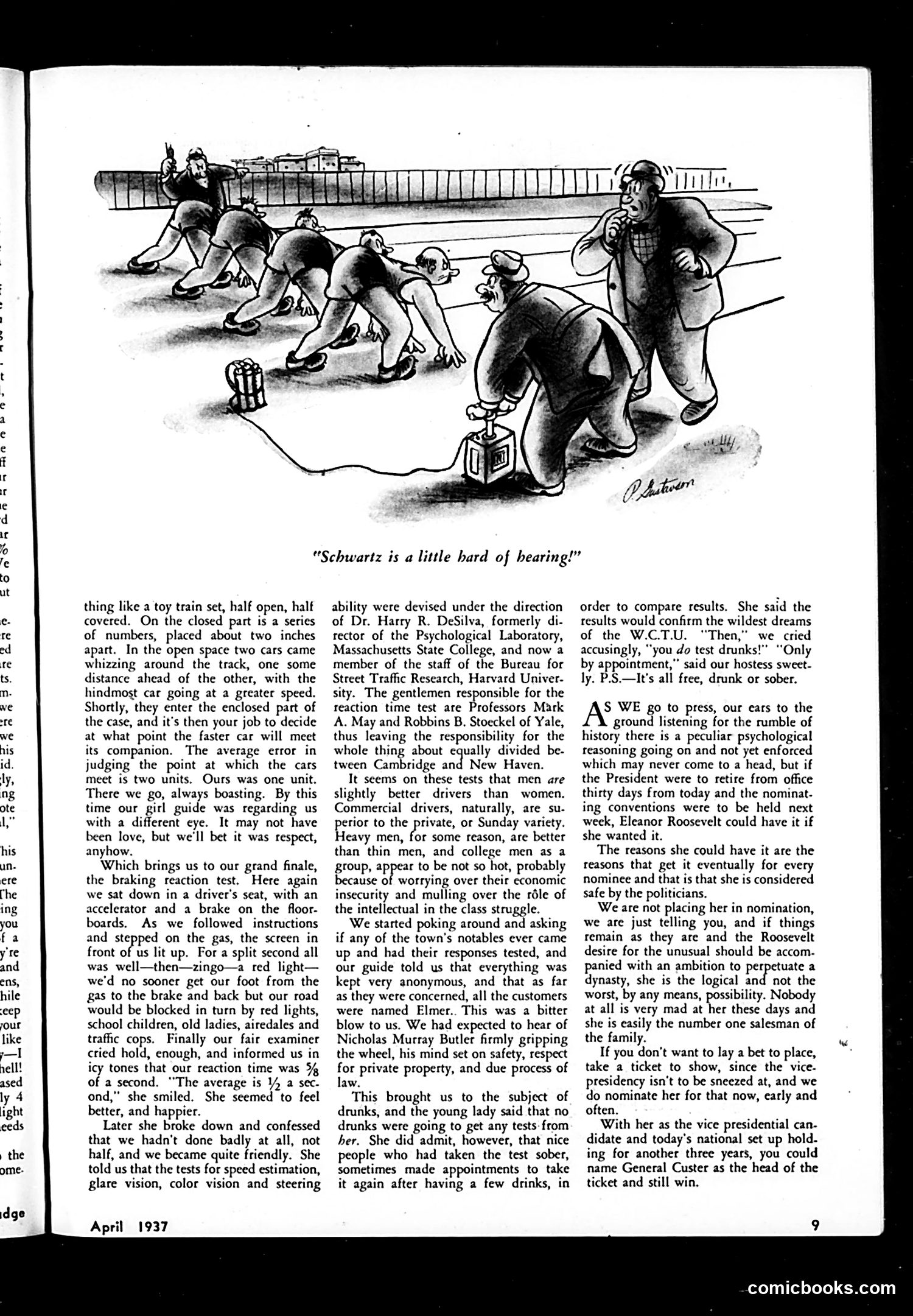
# "Schwartz is a Little Hard of Hearing" This cartoon satirizes driving tests and automobile safety research being conducted at universities (Harvard and Yale are mentioned in the accompanying text). The image shows a man in a suit appearing to direct or coach a line of men in crouched positions—likely depicting a "reaction time test" where drivers' response speeds are measured. The caption's joke is unclear from the image alone, but the article discusses various driving ability tests (reaction time, vision, steering) developed by psychologists to measure driver competency. The accompanying text humorously describes the author's experience taking these tests and notes that results show men drive slightly better than women, and that college men surprisingly perform poorly—attributed to worrying about economic insecurity and their intellectual role in society. The satire targets both the pseudo-scientific nature of early automotive psychology research and broader social anxieties of 1937.
📄 Transcribed text from this page (OCR, searchable)
Machine-transcribed from the original scan — historical spelling and the odd misread are preserved.
"Schwartz is a little hard of bearing!” thing like a toy train set, half open, half covered. On the closed part is a series of numbers, placed about two inches apart. In the open space two cars came whizzing around the track, one some distance ahead of the other, with the hindmost car going at a greater speed. Shortly, they enter the enclosed part of the case, and it’s then your job to decide at what point the faster car will meet its companion. The average error in judging the point at which the cars meet is two units. Ours was one unit. There we go, always boasting. By this time our girl guide was regarding us with a different eye. It may not have been love, but we'll bet it was respect, anyhow. Which brings us to our grand finale, the braking reaction test. Here again we sat down in a driver's seat, with an accelerator and a brake on the floor- boards. As we followed instructions and stepped on the gas, the screen in front of as lit up. For a split second all was well—then—zingo—a red light— we'd no sooner get our foot from the gas to the brake and back but our road would be blocked in turn by red lights, school children, old ladies, airedales and traffic cops. Finally our fair examiner cried hold, enough, and informed us in icy tones that our reaction time was 54 of a second. “The average is 4 a sec. ond,” she smiled. She seemed to feel better, and happier. Later she broke down and confessed that we hadn't done badly at all, not half, and we became quite friendly. She told us that the tests for speed estimation, glare vision, color vision and steering April 1937 ability were devised under the direction of Dr. Harry R. DeSilva, formerly di- rector of the Psychological Laboratory, Massachusetts State College, and now a member of the staff of the Bureau for Street Traffic Research, Harvard Univer- sity. The gentlemen responsible for the reaction time test are Professors Mark A. May and Robbins B. Stoeckel of Yale, thus leaving the responsibility for the whole thing about equally divided be- tween Cambridge and New Haven. It seems on these tests that men are slightly better drivers than women. Commercial drivers, naturally, are su- perior to the private, or Sunday variety. Heavy men, for some reason, are better than thin men, and college men as a group, appear to be not so hot, probably because of worrying over their economic insecurity and mulling over the réle of the intellectual in the class struggle. We started poking around and asking if any of the town’s notables ever came up and had their responses tested, and our guide told us that everything was kept very anonymous, and that as far as they were concerned, all the customers were named Elmer.. This was a bitter blow to us. We had expected to hear of Nicholas Murray Butler firmly gripping the wheel, his mind set on safety, respect for private property, and due process of law. This brought us to the subject of drunks, and the young lady said that no drunks were going to get any tests-from her. She did admit, however, that nice people who had taken the test sober, sometimes made appointments to take it again after having a few drinks, in order to compare results. She said the results would confirm the wildest dreams of the W.C.T.U. “Then,” we cried accusingly, “you do test drunks!" “Only by appointment,” said our hostess sweet- ly. P.S.—It’s all free, drunk or sober. AS WE go to press, our cars to the ground listening for the rumble of history there is a peculiar psychological reasoning going on and not yet enforced which may never come to a head, but if the President were to retire from office thirty days from today and the nominat- ing conventions were to be held next week, Eleanor Roosevelt could have it if she wanted it. The reasons she could have it are the reasons that get it eventually for every nominee and that is that she is considered safe by the politicians. We are not placing her in nomination, we are just telling you, and if things remain as they are and the Roosevelt desire for the unusual should be accom. panied with an ambition to perpetuate a dynasty, she is the logical and not the worst, by any means, possibility. Nobody at all is very mad at her these days and she is easily the number one salesman of the family. If you don’t want to lay a bet to place, take a ticket to show, since the vice- presidency isn’t to be sneezed at, and we do nominate her for that now, early and often. With her as the vice presidential can- didate and today's national set up hold. ing for another three years, you could name General Custer as the head of the ticket and still win. comicbooks.com