
Judge, 1937-02 · page 9 of 45
Judge — February 1937 — page 9: what you’re looking at
What you’re looking at
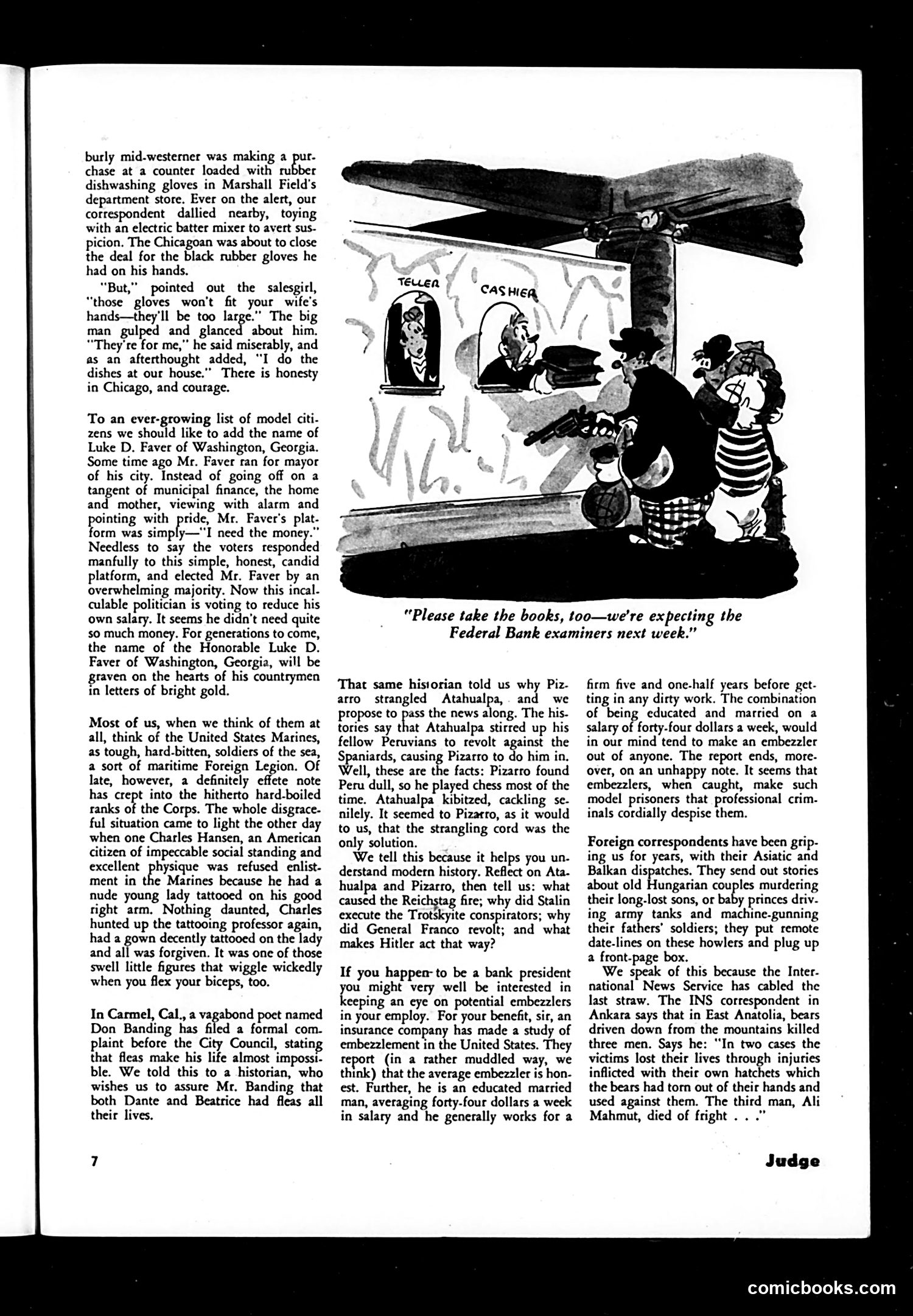
# Analysis of Judge Magazine Page The main cartoon depicts a bank teller and cashier looking at books while a nervous customer (likely an embezzler) stands nearby. The caption reads: "Please take the books, too—we're expecting the Federal Bank examiners next week." **The satire:** This joke mocks banking corruption and embezzlement during the era when Federal Bank examiners conducted inspections. The bank employees are so confident in their dishonesty that they're offering to hide the account books—suggesting they've cooked the records so thoroughly that examiners can't discover the fraud. The surrounding text discusses various public figures and historical anecdotes, including references to Marines, Luke D. Faver of Washington Georgia, Pizarro, Atahualpa, and banking industry embezzlement scandals—all supporting Judge's theme of exposing corruption in government and business institutions.
📄 Transcribed text from this page (OCR, searchable)
Machine-transcribed from the original scan — historical spelling and the odd misread are preserved.
burly mid-westerner was making a pur- chase at a counter loaded with rubber dishwashing gloves in Marshall Field’s department store. Ever on the alert, our correspondent dallied nearby, toying with an electric batter mixer to avert sus- picion. The Chicagoan was about to close the deal for the black rubber gloves he had on his hands. “But,” pointed out the salesgirl, “those gloves won't fit your wife's hands—they'll be too large.” The big man gulped and glanced about him. “They're for me,” he said miserably, and as an afterthought added, “I do the dishes at our house.” There is honesty in Chicago, and courage. To an ever-growing list of model citi- zens we should like to add the name of Luke D. Faver of Washington, Georgia. Some time ago Mr. Faver ran for mayor of his city. Instead of going off on a tangent of municipal finance, the home and mother, viewing with alarm and pointing with pride, Mr. Faver's plat- form was simply—"I need the money.” Needless to say the voters responded manfully to this simple, honest, candid platform, and elected Mr. Faver by an overwhelming majority. Now this incal- culable politician is voting to reduce his own salary. It seems he didn’t need quite so much money. For generations to come, the name of the Honorable Luke D. Faver of Washington, Georgia, will be raven on the hearts of his countrymen in letters of bright gold. Most of us, when we think of them at all, think of the United States Marines, as tough, hard-bitten, soldiers of the sea, a sort of maritime Foreign Legion. Of late, however, a definitely effete note has crept into the hitherto hard-boiled tanks of the Corps. The whole disgrace- ful situation came to light the other day when one Charles Hansen, an American citizen of impeccable social standing and excellent physique was refused enlist. ment in the Marines because he had a nude young lady tattooed on his good right arm. Nothing daunted, Charles hunted up the tattooing professor again, had a gown decently tattooed on the lady and all was forgiven. It was one of those swell little figures that wiggle wickedly when you flex your biceps, too. In Carmel, Cal., a vagabond poet named Don Banding has filed a formal com. plaint before the City Council, stating that fleas make his life almost impossi- ble. We told this to a historian, who wishes us to assure Mr. Banding that both Dante and Beatrice had fleas all their lives. “Please take the books, too—we're expecting the Federal Bank examiners next week.” That same historian told us why Piz- arro strangled Atahualpa,. and we Propose to ps the news along. The his- tories say that Atahualpa stirred up his fellow Peruvians to revolt against the Spaniards, causing Pizarro to do him in. Well, these are the facts: Pizarro found Peru dull, so he played chess most of the time. Atahualpa kibitzed, cackling se- nilely. It seemed to Pizarro, as it would to us, that the strangling cord was the only solution. We tell this because it helps you un- derstand modern history. Reflect on Ata- hualpa and Pizarro, then tell us: what caused the Reichstag fire; why did Stalin execute the Trotskyite conspirators; why did General Franco revolt; and what makes Hitler act that way? If you happen-to be a bank president you might very well be interested in keeping an eye on potential embezzlers in your employ. For your benefit, sir, an insurance company has made a study of embezzlement in the United States. They report (in a rather muddled way, we think) that the average embezzler is hon- est. Further, he is an educated married man, averaging forty-four dollars a week in salary and he generally works for a firm five and one-half years before get- ting in any dirty work. The combination of being educated and married on a salary of forty-four dollars a week, would in our mind tend to make an embezzler out of anyone. The report ends, more- over, on an unhappy note. It seems that embezzlers, when caught, make such model prisoners that professional crim. inals cordially despise them. Foreign correspondents have been grip- ing us for years, with their Asiatic and Balkan dispatches. They send out stories about old Hungarian couples murdering their long-lost sons, or baby princes driv. ing aay, tanks and machine-gunning their fathers’ soldiers; they put remote date-lines on these howlers and plug up a front-page box. We speak of this because the Inter- national News Service has cabled the last straw. The INS correspondent in Ankara says that in East Anatolia, bears driven down from the mountains killed three men. Says he: “In two cases the victims lost their lives through injuries inflicted with their own hatchets which the bears had torn out of their hands and used against them. The third man, Ali Mahmut, died of fright . . .” Judge comicbooks.com