
Judge, 1937-01 · page 8 of 52
Judge — January 1937 — page 8: what you’re looking at
What you’re looking at
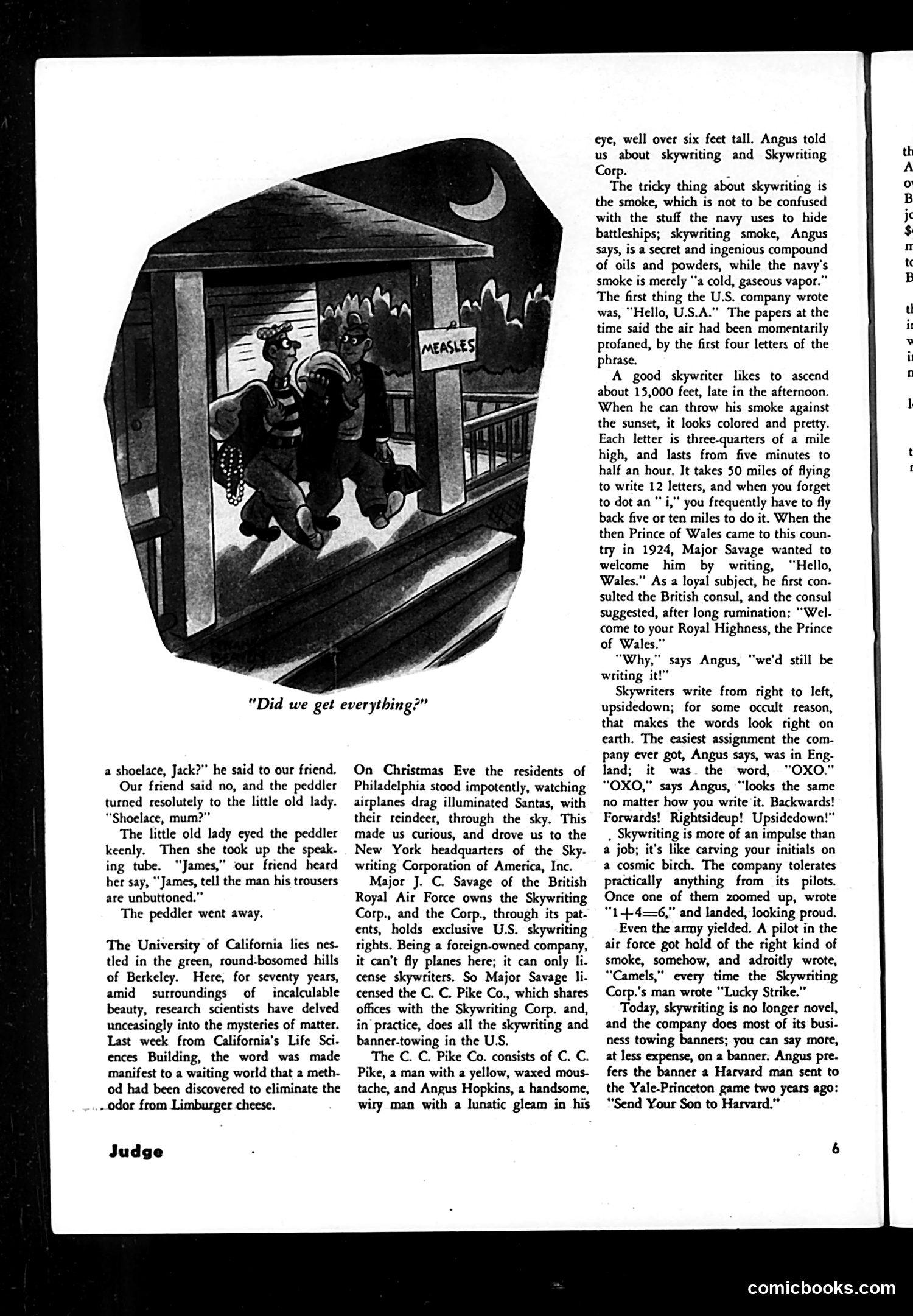
# "Did we get everything?" This cartoon satirizes skywriting—a then-novel aerial advertising method. The image shows a storefront labeled "MEASLES" with figures inside appearing sick, while skywriters operate above. The joke hinges on a dark pun: skywriters have just "written" measles in the sky, and the store's occupants anxiously ask whether they've advertised everything needed. The satire mocks how skywriting was being used for commercial promotion, imagining it applied absurdly to disease rather than legitimate products. The accompanying text discusses skywriting's actual mechanics and early high-profile uses (including a 1924 greeting to the Prince of Wales). The cartoonist ridicules both the novelty of aerial advertising and its indiscriminate commercial applications, suggesting even epidemics might be "marketed" via this new technology.
📄 Transcribed text from this page (OCR, searchable)
Machine-transcribed from the original scan — historical spelling and the odd misread are preserved.
en "Did we get everything?” a shoelace, Jack?” he said to our friend. Our friend said no, and the peddler turned resolutely to the little old lady. “Shoelace, mum?” The little old lady eyed the peddler keenly. Then she took up the speak. ing tube. “James,” our friend heard her say, “James, tell the man his trousers are unbuttoned.” The peddler went away. The University of California lies nes- tled in the green, round-bosomed hills of Berkeley. Here, for seventy years, amid surroundings of _ incalculable beauty, research scientists have delved unceasingly into the mysteries of matter. Last week from California’s Life Sci- ences Building, the word was made manifest to a waiting world that a meth- od had been discovered to eliminate the ~odor from Limburger cheese. Judge On Christmas Eve the residents of Philadelphia stood impotently, watching airplanes drag illuminated Santas, with their reindeer, through the sky. This made us curious, and drove us to the New York headquarters of the Sky- writing Corporation of America, Inc. Major J. C. Savage of the British Royal Air Force owns the Skywriting Corp., and the Corp., through its pat- ents, holds exclusive U.S. skywriting rights. Being a foreign-owned company, it can’t fly planes here; it can only li- cense skywriters. So Major Savage li- censed the C. C. Pike Co., which shares offices with the Skywriting Corp. and, in practice, does all the skywriting and banner-towing in the U.S. The C. C. Pike Co. consists of C. C. Pike, a man with a yellow, waxed mous- tache, and Angus Hopkins, a handsome, wiry man with a lunatic gleam in his eye, well over six feet tall. Angus told us about skywriting and Skywriting Corp. A The tricky thing about skywriting is the smoke, which is not to be confused with the stuff the navy uses to hide battleships; skywriting smoke, Angus says, is a secret and ingenious compound of oils and powders, while the navy's smoke is merely “a cold, gaseous vapor.” The first thing the U.S. company wrote was, “Hello, U.S.A.” The papers at the time said the air had been momentarily profaned, by the first four letters of the phrase. A good skywriter likes to ascend about 15,000 feet, late in the afternoon. When he can throw his smoke against the sunset, it looks colored and pretty. Each letter is three-quarters of a mile high, and lasts from five minutes to half an hour. It takes 50 miles of flying to write 12 letters, and when you forget to dot an “i,” you frequently have to fly back five or ten miles to do it. When the then Prince of Wales came to this coun- try in 1924, Major Savage wanted to welcome him by writing, ‘Hello, Wales.” As a loyal subject, he first con. sulted the British consul, and the consul suggested, after long rumination: “Wel- come to your Royal Highness, the Prince of Wales.” “Why,” says Angus, “we'd still be writing it!" Skywriters write from right to left, upsidedown; for some occult reason, that makes the words look right on earth. The easiest assignment the com- pany ever got, Angus says, was in Eng- land; it was. the word, “OXO.” “OXO,” says Angus, “looks the same no matter how you write it. Backwards! Forwards! Rightsideup! Upsidedown!” . Skywriting is more of an impulse than a job; it’s like carving your initials on a cosmic birch. The company tolerates practically anything from its pilots. Once one of them zoomed up, wrote “144=6,” and landed, looking proud. Even the army yielded. A pilot in the air force got hold of the right kind of smoke, somehow, and adroitly wrote, “Camels,” every time the Skywriting Corp.’s man wrote “Lucky Strike.”” Today, skywriting is no longer novel, and the company does most of its busi- ness towing banners; you can say more, at less expense, on a banner. Angus pre- fers the banner a Harvard man sent to the Yale.Princeton game two years ago: “Send Your Son to Harvard.” comicbooks.com