
Judge, 1937-01 · page 7 of 52
Judge — January 1937 — page 7: what you’re looking at
What you’re looking at
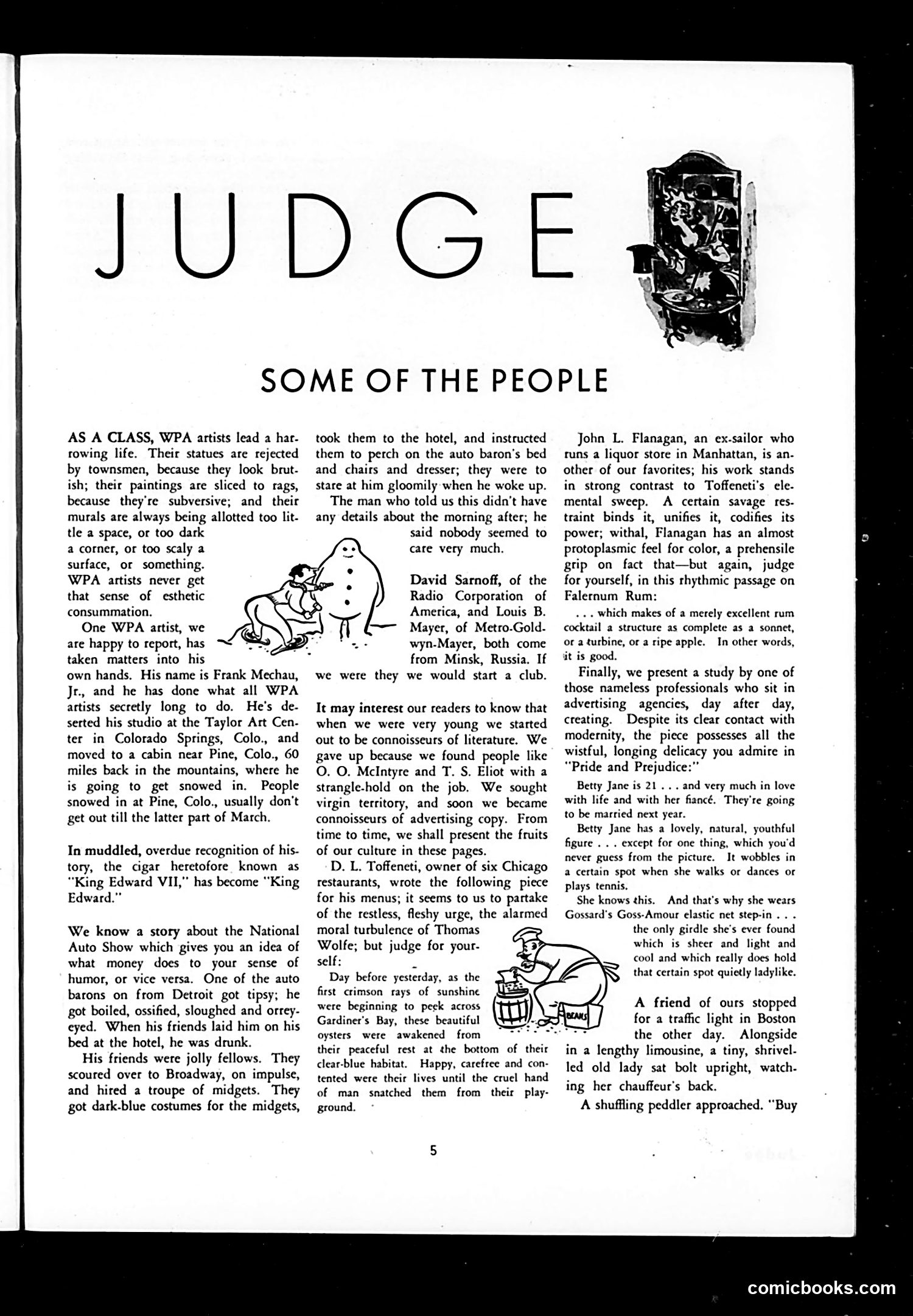
# Analysis of "Judge" Page: "Some of the People" This page satirizes WPA (Works Progress Administration) artists and various public figures through anecdotal sketches. The main cartoon depicts a rotund man with a large palette, likely representing a WPA artist—the Depression-era program that employed artists whose work was often dismissed as derivative or inadequate by establishment critics. The text mocks several targets: WPA artists as a class ("their statues are rejected by townsmen"), a story about an auto baron's humiliating prank on hotel staff, and profiles of figures like John L. Flanagan (liquor store owner) and advertising professionals. The overall tone is dismissive toward both struggling WPA artists and various working professionals, reflecting the magazine's satirical stance toward Depression-era cultural and economic conditions. The page relies on period-specific references requiring historical context to fully appreciate.
📄 Transcribed text from this page (OCR, searchable)
Machine-transcribed from the original scan — historical spelling and the odd misread are preserved.
SU Se SOME OF THE PEOPLE AS A CLASS, WPA artists lead a har. rowing life. Their statues are rejected by townsmen, because they look brut- ish; their paintings are sliced to rags, because they're subversive; and their murals are always being allotted too lit- tle a space, or too dark a corner, or too scaly a surface, or something. WPA artists never get that sense of esthetic consummation. One WPA artist, we are happy to report, has taken matters into his own hands. His name is Frank Mechau, Jr, and he has done what all WPA artists secretly long to do. He's de- serted his studio at the Taylor Art Cen- ter in Colorado Springs, Colo., and moved to a cabin near Pine, Colo., 60 miles back in the mountains, where he is going to get snowed in. People snowed in at Pine, Colo., usually don’t get out till the latter part of March. In muddled, overdue recognition of his- tory, the cigar heretofore known as “King Edward VII," has become “King Edward.” We know a story about the National Auto Show which gives you an idea of what money does to your sense of humor, or vice versa. One of the auto barons on from Detroit got tipsy; he got boiled, ossified, sloughed and orrey- eyed. When his friends laid him on his bed at the hotel, he was drunk. His friends were jolly fellows. They scoured over to Broadway, on impulse, and hired a troupe of midgets. They got dark-blue costumes for the midgets, took them to the hotel, and instructed them to perch on the auto baron’s bed and chairs and dresser; they were to stare at him gloomily when he woke up. The man who told us this didn’t have any details about the morning after; he said nobody seemed to care very much. David Sarnoff, of the Radio Corporation of America, and Louis B. Mayer, of Metro-Gold- wyn-Mayer, both come from Minsk, Russia, If we were they we would start a club. It may interest our readers to know that when we were very young we started out to be connoisseurs of literature. We gave up because we found people like O. O. McIntyre and T. S. Eliot with a strangle-hold on the job, We sought virgin territory, and soon we became connoisseurs of advertising copy. From time to time, we shall present the fruits of our culture in these pages. D. L. Toffeneti, owner of six Chicago restaurants, wrote the following piece for his menus; it seems to us to partake of the restless, fleshy urge, the alarmed moral turbulence of Thomas Wolfe; but judge for your- self: . Day before yesterday, as the first crimson rays of sunshine were beginning to peek across Gardiner's Bay, these beautiful oysters were awakened from their peaceful rest at the bottom of their clear-blue habitat. Happy, carefree and con- tented were their lives until the cruel hand of man snatched them from their play- ground. John L. Flanagan, an ex-sailor who runs a liquor store in Manhattan, is an- other of our favorites; his work stands in strong contrast to Toffeneti’s ele. mental sweep. A certain savage res- traint binds it, unifies it, codifies its power; withal, Flanagan has an almost protoplasmic feel for color, a prehensile gtip on fact that—but again, judge for yourself, in this rhythmic passage on Falernum Rum: .. which makes of a merely excellent rum cocktail a structure as complete as a sonnet, or a turbine, or a ripe apple. In other words, it is good. Finally, we present a study by one of those nameless professionals who sit in advertising agencies, day after day, creating. Despite its clear contact with modernity, the piece possesses all the wistful, longing delicacy you admire in “Pride and Prejudice:” Betty Jane is 21... and very much in love with life and with her fiancé. They're going to be married next year. Betty Jane has a lovely, natural, youthful figure . . . except for one thing, which you'd never guess from the picture. It wobbles in a certain spot when she walks or dances or plays tennis. She knows this. And that's why she wears Gossard’s Goss-Amour elastic net step-in . . . the only girdle she’s ever found which is sheer and light and cool and which really does hold that certain spot quietly ladylike. A friend of ours stopped for a traffic light in Boston the other day. Alongside in a lengthy limousine, a tiny, shrivel- led old lady sat bolt upright, watch. ing her chauffeur's back. A shuffling peddler approached. “Buy comicbooks.com