
Judge, 1937-01 · page 44 of 52
Judge — January 1937 — page 44: what you’re looking at
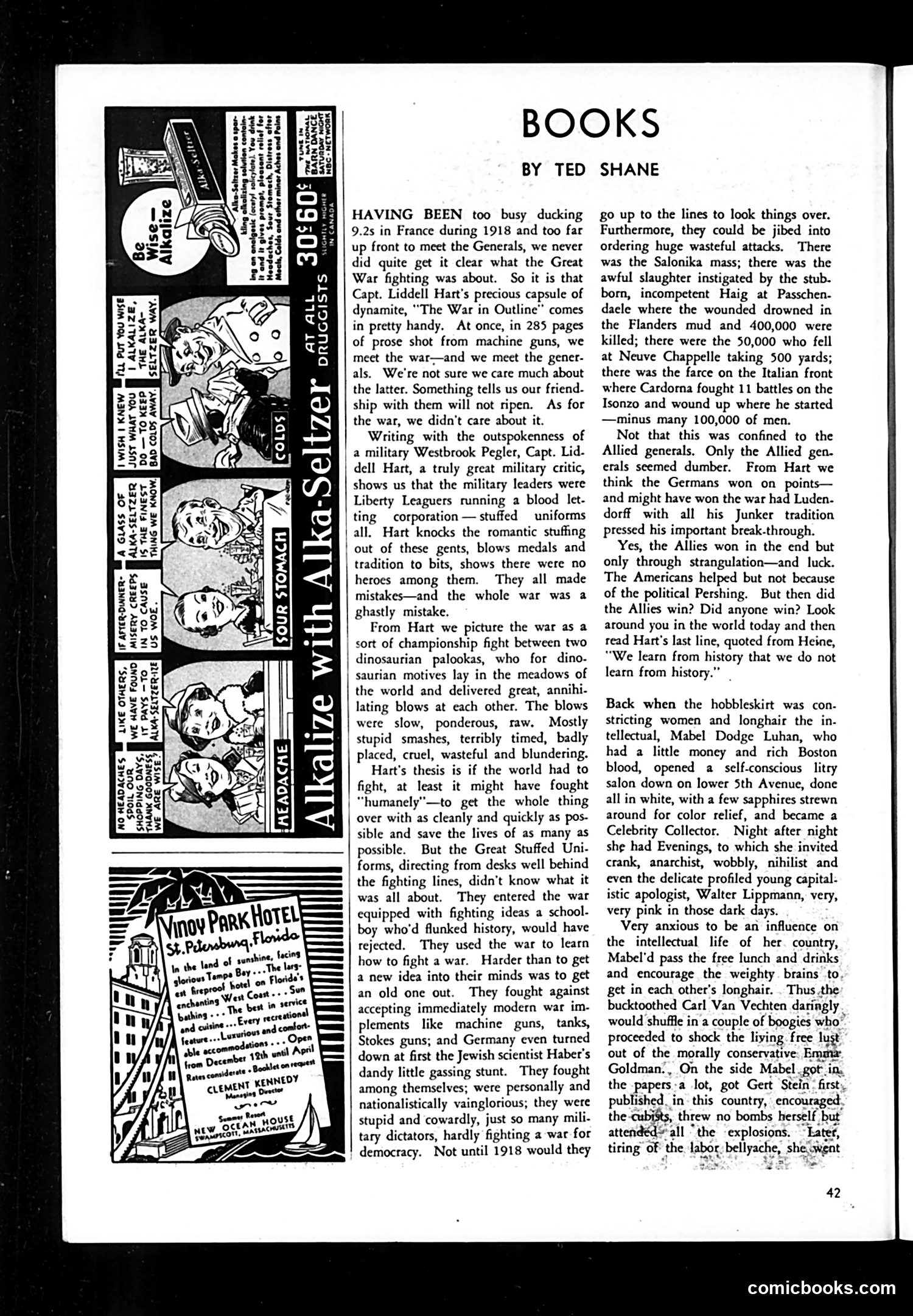
A restored page from Judge, 1937-01. Page through the whole issue in the reader above.
📄 Transcribed text from this page (OCR, searchable)
Machine-transcribed from the original scan — historical spelling and the odd misread are preserved.
ting etkcising saltion contain. ing on onalgesic (oce'y! salicylate). You drink it end Wt gives pro Heodeches, Sour 5 ‘Meals, Colds and othe Pu PuT You wise 1 ALKALIZE, THE ALKA- if | | MZ Y aN AC sHEADA He BOOKS BY TED HAVING BEEN too busy ducking 9.2s in France during 1918 and too far up front to meet the Generals, we never did quite get it clear what the Great War fighting was about. So it is that Capt. Liddell Hart's precious capsule of dynamite, "The War in Outline” comes in pretty handy. At once, in 285 pages of prose shot from machine guns, we meet the war—and we meet the gener- als. We're not sure we care much about the latter. Something tells us our friend- ship with them will not ripen. As for the war, we didn’t care about it. Writing with the outspokenness of a military Westbrook Pegler, Capt. Lid- dell Hart, a truly great military critic, shows us that the military leaders were Liberty Leaguers running a blood let- | ting corporation — stuffed uniforms | all, Hart knocks the romantic stuffing | out of these gents, blows medals and tradition to bits, shows there were no heroes among them. They all made mistakes—and the whole war was a ghastly mistake. From Hart we picture the war as a sort of championship fight between two dinosaurian palookas, who for dino- saurian motives lay in the meadows of the world and delivered great, annihi- lating blows at each other. The blows were slow, ponderous, raw. Mostly stupid smashes, terribly timed, badly placed, cruel, wasteful and blundering. Hart's thesis is if the world had to fight, at least it might have fought “humanely"—to get the whole thing over with as cleanly and quickly as pos- sible and save the lives of as many as possible. But the Great Stuffed Uni- forms, directing from desks well behind | the fighting lines, didn’t know what it was all about. They entered the war equipped with fighting ideas a school- boy who'd flunked history, would have rejected. They used the war to learn how to fight a war. Harder than to get a new idea into their minds was to get an old one out. They fought against accepting immediately modern war im- plements like machine guns, tanks, Stokes guns; and Germany even turned down at first the Jewish scientist Haber's dandy little gassing stunt. They fought among themselves; were personally and nationalistically vainglorious; they were stupid and cowardly, just so many mili- tary dictators, hardly fighting a war for democracy. Not until 1918 would they SHANE go up to the lines to look things over. Furthermore, they could be jibed into ordering huge wasteful attacks. There was the Salonika mass; there was the awful slaughter instigated by the stub. born, incompetent Haig at Passchen- daecle where the wounded drowned in the Flanders mud and 400,000 were killed; there were the 50,000 who fell at Neuve Chappelle taking 500 yards; there was the farce on the Italian front where Cardorma fought 11 battles on the Isonzo and wound up where he started —minus many 100,000 of men. Not that this was confined to the Allied generals. Only the Allied gen. erals seemed dumber. From Hart we think the Germans won on points— and might have won the war had Luden- dorff with all his Junker tradition pressed his important break-through. Yes, the Allies won in the end but only through strangulation—and luck. The Americans helped but not because of the political Pershing. But then did the Allies win? Did anyone win? Look around you in the world today and then read Hart's last line, quoted from Heine, “We learn from history that we do not learn from history.” Back when the hobbleskirt was con. stricting women and longhair the in. tellectual, Mabel Dodge Luhan, who had a little money and rich Boston blood, opened a_ self-conscious litry salon down on lower 5th Avenue, done all in white, with a few sapphires strewn around for color relief, and became a Celebrity Collector. Night after night she had Evenings, to which she invited crank, anarchist, wobbly, nihilist and even the delicate profiled young capital: istic apologist, Walter Lippmann, very, very pink in those dark days. Very anxious to be an influence on the intellectual life of her. country, Mabel'd pass the free lunch and drinks and encourage the weighty. brains to. get in each other's longhair. . Thus.the bucktoothed Carl Van Vechten daringly would shuffle in'a couple of boogies who” proceeded to shock the liying free lust out of the morally conservative. Emme. Goldman’, On the side Mabel .got- in. the -papers-a lot, got Gert Stein < first, published. in this country, encouraged. the-cubists, threw no bombs herself but attendéd all “the explosions. ter, tiring of the labor. bellyache, she went 42 comicbooks.com