
Judge, 1937-01 · page 43 of 52
Judge — January 1937 — page 43: what you’re looking at
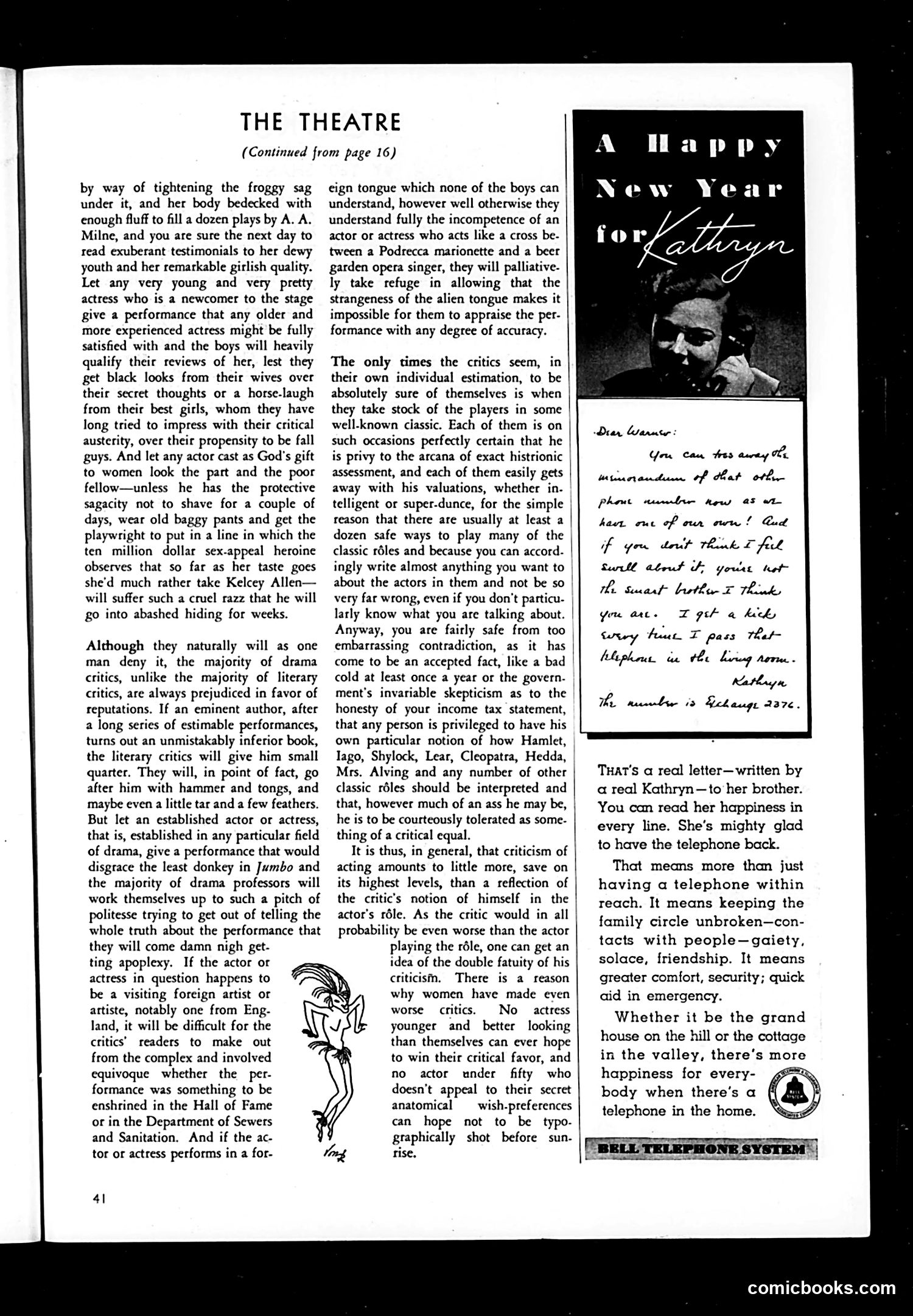
A restored page from Judge, 1937-01. Page through the whole issue in the reader above.
📄 Transcribed text from this page (OCR, searchable)
Machine-transcribed from the original scan — historical spelling and the odd misread are preserved.
by way of tightening the froggy sag under it, and her body bedecked with enough fluff to fill a dozen plays by A. A. Milne, and you are sure the next day to read exuberant testimonials to her dewy youth and her remarkable girlish quality. Let any very young and very pretty actress who is a newcomer to the stage give a performance that any older and more experienced actress might be fully satisfied with and the boys will heavily qualify their reviews of her, lest they get black looks from their wives over their secret thoughts or a horse-laugh from their best girls, whom they have long tried to impress with their critical austerity, over their propensity to be fall guys. And let any actor cast as God's gift to women look the part and the poor fellow—unless he has the protective sagacity not to shave for a couple of days, wear old baggy pants and get the playwright to put in a line in which the ten million dollar sex-appeal heroine observes that so far as her taste goes she'd much rather take Kelcey Allen— will suffer such a cruel razz that he will go into abashed hiding for weeks. Although they naturally will as one man deny it, the majority of drama critics, unlike the majority of literary critics, are always prejudiced in favor of reputations. If an eminent author, after a long series of estimable performances, turns out an unmistakably inferior book, the literary critics will give him small quarter. They will, in point of fact, go after him with hammer and tongs, and maybe even a little tar and a few feathers. But let an established actor or actress, that is, established in any particular field of drama, give a performance that would disgrace the least donkey in Jumbo and the majority of drama professors will work themselves up to such a pitch of politesse trying to get out of telling the whole truth about the performance that they will come damn nigh get- ting apoplexy. If the actor or actress in question happens to be a visiting foreign artist or artiste, notably one from Eng- land, it will be difficult for the critics’ readers to make out from the complex and involved equivoque whether the per- formance was something to be enshrined in the Hall of Fame or in the Department of Sewers and Sanitation. And if the ac- tor or actress performs in a for- 41 THE THEATRE (Continued from page 16) eign tongue which none of the boys can understand, however well otherwise they understand fully the incompetence of an actor or actress who acts like a cross be- tween a Podrecca marionette and a beer garden opera singer, they will palliative. ly take refuge in allowing that the strangeness of the alien tongue makes it impossible for them to appraise the per- formance with any degree of accuracy. The only times the critics seem, in their own individual estimation, to be absolutely sure of themselves is when they take stock of the players in some well-known classic. Each of them is on such occasions perfectly certain that he is privy to the arcana of exact histrionic | assessment, and each of them easily gets away with his valuations, whether in- telligent or super-dunce, for the simple | reason that there are usually at least a dozen safe ways to play many of the classic réles and because you can accord- ingly write almost anything you want to about the actors in them and not be so very far wrong, even if you don’t particu- larly know what you are talking about. Anyway, you are fairly safe from too embarrassing contradiction, as it has come to be an accepted fact, like a bad | cold at least once a year or the govern. ment’s invariable skepticism as to the honesty of your income tax statement, that any person is privileged to have his own particular notion of how Hamlet, Tago, Shylock, Lear, Cleopatra, Hedda, Mrs. Alving and any number of other classic réles should be interpreted and that, however much of an ass he may be, he is to be courteously tolerated as some- thing of a critical equal. It is thus, in general, that criticism of acting amounts to little more, save on its highest levels, than a reflection of the critic's notion of himself in the actor's rdle. As the critic would in all probability be even worse than the actor playing the rdle, one can get an idea of the double fatuity of his criticism, There is a reason why women have made even worse critics. No actress younger and better looking than themselves can ever hope to win their critical favor, and no actor under fifty who doesn’t appeal to their secret anatomical —_ wish-preferences can hope not to be typo- gtaphically shot before sun- rise. A Happ New Year for Diar Warner: Yoru Can thes anray Me. Mtmanduae of Hat ote Phaent tumebing Aew a5 ot hast onc of our own! Gad ff yor tet think £ fel Sunll brut Lo yours ket the Sucart buther ZF Think, Zeta hch ey Peet. TF pass that- Aliph ia the Lirug rerun. Kathay ne Th number is Gelauge 2376. yom are. THAT's a real letter—written by a real Kathryn—to her brother. You can read her happiness in every line. She’s mighty glad to have the telephone back. That means more than just having a telephone within reach. It means keeping the family circle unbroken—con- tacts with people—gaiety, solace, friendship. It means greater comfort, security; quick aid in emergency. Whether it be the grand house on the hill or the cottage in the valley, there’s more happiness for every- body when there’s a telephone in the home. NE SYSTEM | comicbooks.com