
Judge, 1937-01 · page 4 of 52
Judge — January 1937 — page 4: what you’re looking at
What you’re looking at
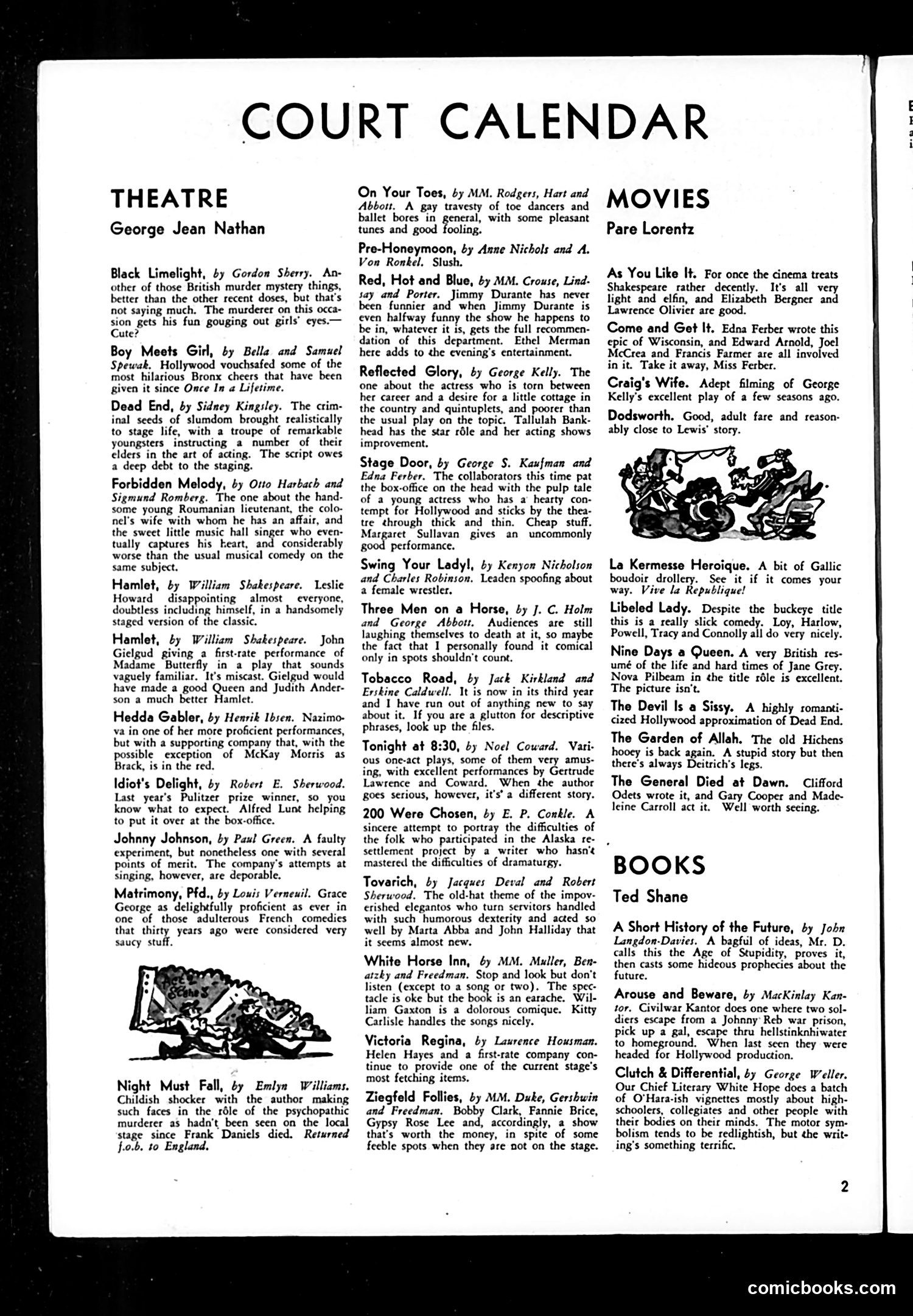
# Court Calendar Page Analysis This is primarily a **review and listing page** from Judge magazine, not a political cartoon page. It contains theater reviews (by George Jean Nathan), movie reviews (by Pare Lorentz), and book reviews (by Ted Shane). The only cartoon visible is a small **decorative illustration** in the lower left corner showing what appears to be a stylized figure in an exaggerated pose—likely meant as a humorous vignette rather than political satire. The page functions as entertainment criticism and cultural commentary typical of Judge's format. The reviews discuss contemporary Broadway shows, films, and literature without apparent political agenda. The cartoon, if satirical, is too small and unclear in this reproduction to determine its specific meaning or targets.
📄 Transcribed text from this page (OCR, searchable)
Machine-transcribed from the original scan — historical spelling and the odd misread are preserved.
COURT CALENDAR THEATRE George Jean Nathan Black Limelight, 6y Gordon Sherry. An- other of those British murder mystery things, better than the other recent doses, but that's not saying much. The murderer on this occa- oa gets his fun gouging out girls’ eyes.— ute? Boy Meets Girl, by Bella and Samuel Spewak, Hollywood vouchsafed some of the most hilarious Bronx cheers that have been given it since Once In a Lifetime. Dead End, by Sidney Kingsley. The ctim- inal seeds of slumdom brought realistically to stage life, with a troupe of remarkable youngsters instructing a num of their elders in the art of acting. The script owes a deep debt to the staging. Forbidden Melody, by Osto Harbach and Sigmund Romberg. The one about the hand- some young Roumanian lieutenant, the colo- nel’s wife with whom he has an affair, and the sweet little music hall singer who even- tually captures his heart, and considerably worse than the usual musical comedy on the same subject, Hamlet, by William Shakespeare. Leslie Howard disappointing almost everyone, doubtless including himself, in a handsomely staged version of the classic. Hamlet, ty William Shakespeare. John Gielgud giving a first-rate performance of Madame Butterfly in a play that sounds vaguely familiar. It’s miscast. Gielgud would have made a good Queen and Judith Ander- son a much better Hamlet. Hedda Gabler, by Henrik Ibsen. Nazimo- va in one of her more proficient performances, but with a supporting company that, with the possible exception of McKay Morris as Brack, is in the red, Idiot's Delight, by Robert E. Sherwood. Last year's Pulitzer prize winner, so you know what to expect. Alfred Lunt helping to put it over at the box-office. Johnny Johnson, by Paul Green. A faulty experiment, but nonetheless one with several points of merit. The company’s attempts at singing, however, are deporable. Matrimony, Pfd., by Louis Verneuil. Grace George as delightfully proficient as ever in one of those adulterous French comedies that thirty years ago were considered very saucy stuff. Night Must Fall, dy Emlyn Williams. Childish shocker with the author making such faces in the réle of the psychopathic murderer as hadn't been seen on the local stage since Frank Daniels died. Returned f.o.b. t0 England. On Your Toes, by MM. Rodgers, Hart and Abbott. A gay travesty of toe dancers and ballet bores in general, with some pleasant tunes and good fooling. Pre-Honeymoon, by Anne Nichols and A. Von Ronkel. Slush. Red, Hot and Blue, 4y MM. Crouse, Lind- say and Porter. Jimmy Durante has never been funnier and when Jimmy Durante is even halfway funny the show he happens to be in, whatever it is, gets the full recommen- dation of this department. Ethel Merman here adds to the evening's entertainment. Reflected Glory, 4y George Kelly. The one about the actress who is torn between her career and a desire for a little cottage in the country and quintuplets, and poorer than the usual play on the topic. Tallulah Bank- head has the star réle and her acting shows improvement. Stage Door, by George S. Kaufman and Edna Ferber. The collaborators this time pat the box-office on the head with the pulp tale of a young actress who has a hearty con- tempt for Hollywood and sticks by the thea- tre ¢hrough thick and thin. Cheap stuff. Margaret Sullavan gives an uncommonly performance. Swing Your Ladyl, by Kenyon Nicholson and Charles Robinson. Leaden spoofing about a female wrestler. Three Men on a Horse, by J. C. Holm and George Abbott. Audiences are still laughing themselves to death at it, so maybe the fact that I personally found it comical only in spots shouldn't count. Tobacco Road, by Jack Kirkland and Erskine Caldwell. It is now in its third year and I have run out of anything new to say about it. If you are a glutton for descriptive phrases, look up the files. Tonight at 8:30, 6y Noel Coward. Vari- ous one-act plays, some of them very amus- ing, with excellent performances by Certrude Lawrence and Coward, When the author goes serious, however, it’s’ a different story. 200 Were Chosen, ty E. P. Conkle. A sincere attempt to portray the difficulties of the folk who participated in the Alaska re- settlement project by a writer who hasn't mastered the difficulties of dramaturgy. Tovarich, by Jacques Deval and Robert Sherwood. The old-hat theme of the impov- erished elegantos who turn servitors handled with such humorous dexterity and acted so well by Marta Abba and John Halliday that it seems almost new. White Horse Inn, ty MM. Muller, Ben- atzky and Freedman. Stop and look but don't listen (except to a song or two). The spec- tacle is oke but the book is an earache. Wil- liam Gaxton is a dolorous comique. Kitty Carlisle handles the songs nicely. Victoria Regina, by Laurence Housman. Helen Hayes and a first-rate company con- tinue to provide one of the current stage’s most fetching items. Ziegfeld Follies, by MM. Duke, Gershwin and Freedman. Bobby Clark, Fannie Brice, Gypsy Rose Lee and, accordingly, a show that’s worth the money, in spite of some feeble spots when they are not on the stage. MOVIES Pare Lorentz As You Like It. For once the cinema treats Shakespeare rather decently. It's all very light and elfin, and Elizabeth Bergner and Lawrence Olivier are good. Come and Get It. Edna Ferber wrote this epic of Wisconsin, and Edward Arnold, Joel McCrea and Francis Farmer are all involved in it. Take it away, Miss Ferber. Craig's Wife. Adept filming of George Kelly's excellent play of a few seasons ago. Dodsworth. Good, adult fare and reason- ably close to Lewis’ story. La Kermesse Heroique. A bit of Gallic boudoir drollery. See it if it comes your way. Vive la Republique! Libeled Lady. Despite the buckeye title this is a really slick comedy. Loy, Harlow, Powell, Tracy and Connolly all do very nicely. Nine Days a Queen. A very British res- umé of the life and hard times of Jane Grey. Nova Pilbeam in ¢he title réle is excellent. The picture isn’t. The Devil Is a Sissy. A highly romanti- cized Hollywood approximation of Dead End. The Garden of Allah. The old Hichens hooey is back again. A stupid story but then there's always Deitrich’s legs. The General Died at Dawn. Clifford Odets wrote it, and Gary Cooper and Made- leine Carroll act it. Well worth seeing. ‘BOOKS Ted Shane A Short History of the Future, by Jobn Langdon-Davies. A bagful of ideas, Mr. D. calls this the Age of Stupidity, proves it, then casts some hideous prophecies about the future. Arouse and Beware, by MacKinlay Kan- tor. Civilwar Kantor does one where two sol- diers escape from a Johnny’ Reb war prison, pick up a gal, escape thru hellstinknhiwater to homeground. When last seen they were headed for Hollywood production. Clutch & Differential, by George Weller. Our Chief Literary White Hope does a batch of O'Hara-ish vignettes mostly about high- schoolers, collegiates and other people with their bodies on their minds. The motor sym- bolism tends to be redlightish, but the writ- ing’s something terrific, comicbooks.com