
Judge, 1937-01 · page 36 of 52
Judge — January 1937 — page 36: what you’re looking at
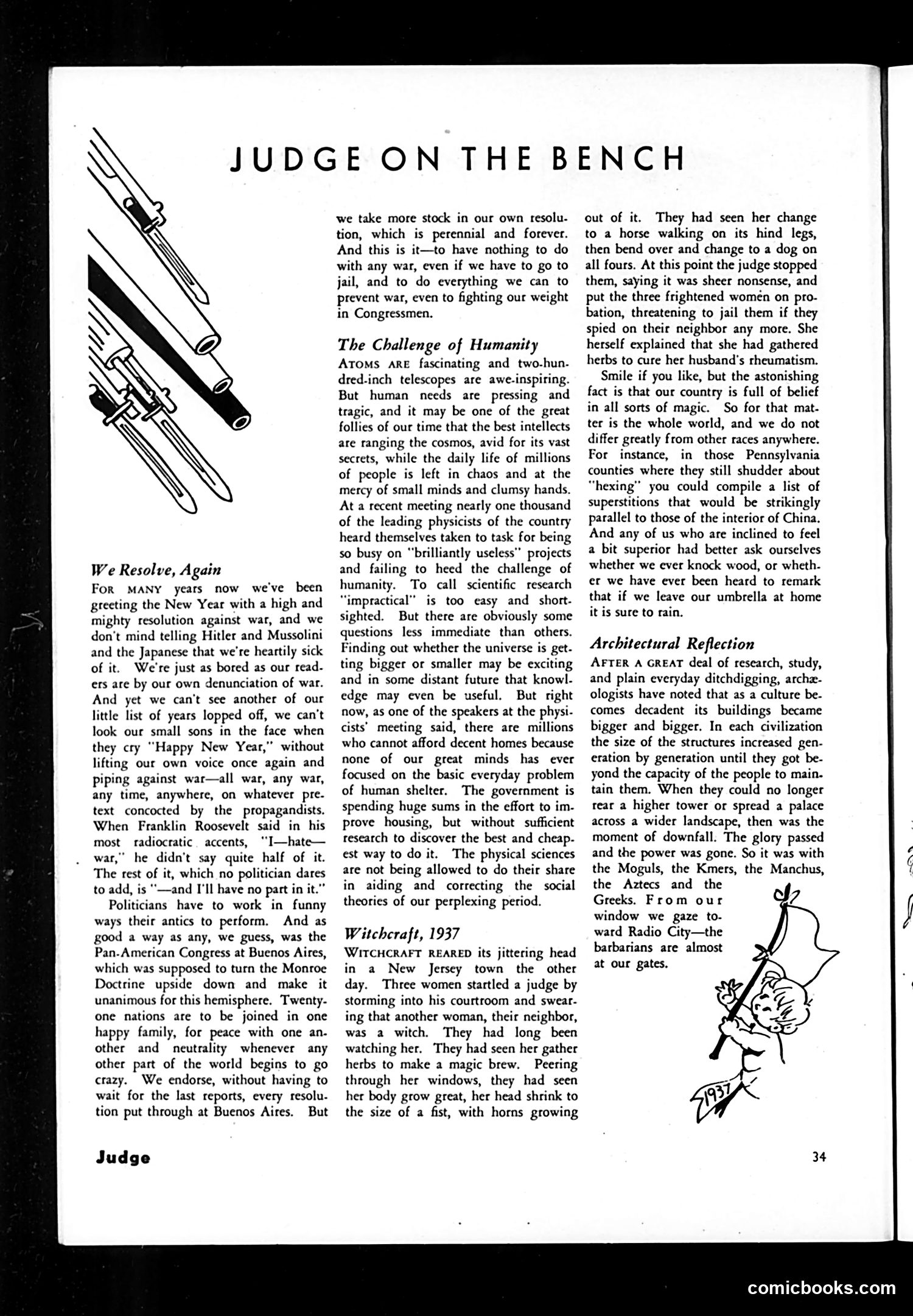
A restored page from Judge, 1937-01. Page through the whole issue in the reader above.
📄 Transcribed text from this page (OCR, searchable)
Machine-transcribed from the original scan — historical spelling and the odd misread are preserved.
JUDGE ON THE BENCH We Resolve, Again For MANY years now we've been greeting the New Year with a high and mighty resolution against war, and we don’t mind telling Hitler and Mussolini and the Japanese that we're heartily sick of it. We're just as bored as our read- ers are by our own denunciation of war. And yet we can't see another of our little list of years lopped off, we can’t look our small sons in the face when they cry “Happy New Year,” without lifting our own voice once again and piping against war—all war, any war, any time, anywhere, on whatever pre- text concocted by the propagandists. When Franklin Roosevelt said in his most radiocratic. accents, ‘I—hate— war,” he didn’t say quite half of it. The rest of it, which no politician dares to add, is —and I'll have no part in it.” Politicians have to work in funny ways their antics to perform. And as good a way as any, we guess, was the Pan-American Congress at Buenos Aires, which was supposed to turn the Monroe Doctrine upside down and make it unanimous for this hemisphere. Twenty- one nations are to be joined in one happy family, for peace with one an. other and neutrality whenever any other part of the world begins to go crazy. We endorse, without having to wait for the last reports, every resolu. tion put through at Buenos Aires. But Judge we take more stock in our own resolu- tion, which is perennial and forever. And this is it—to have nothing to do with any war, even if we have to go to jail, and to do everything we can to prevent war, even to fighting our weight in Congressmen. The Challenge of Humanity ATOMS ARE fascinating and two-hun. dred-inch telescopes are awe-inspiring. But human needs are pressing and tragic, and it may be one of the great follies of our time that the best intellects are ranging the cosmos, avid for its vast secrets, while the daily life of millions of people is left in chaos and at the mercy of small minds and clumsy hands. At a recent meeting nearly one thousand of the leading physicists of the country heard themselves taken to task for being so busy on “brilliantly useless” projects and failing to heed the challenge of humanity. To call scientific research “impractical” is too easy and short- sighted. But there are obviously some questions less immediate than others. Finding out whether the universe is get- ting bigger or smaller may be exciting and in some distant future that knowl- edge may even be useful. But right now, as one of the speakers at the physi- cists’ meeting said, there are millions who cannot afford decent homes because none of our great minds has ever focused on the basic everyday problem of human shelter. The government is spending huge sums in the effort to im- prove housing, but without sufficient research to discover the best and cheap- est way to do it. The physical sciences are not being allowed to do their share in aiding and correcting the social theories of our perplexing period. Witchcraft, 1937 WITCHCRAFT REARED its jittering head in a New Jersey town the other day. Three women startled a judge by storming into his courtroom and swear- ing that another woman, their neighbor, was a witch. They had long been watching her. They had seen her gather herbs to make a magic brew. Peering through her windows, they had seen her body grow great, her head shrink to the size of a fist, with horns growing out of it. They had seen her change to a horse walking on its hind legs, then bend over and change to a dog on all fours. At this point the judge stopped them, saying it was sheer nonsense, and put the three frightened women on pro- bation, threatening to jail them if they spied on their neighbor any more. She herself explained that she had gathered herbs to cure her husband’s rheumatism. Smile if you like, but the astonishing fact is that our country is full of belief in all sorts of magic. So for that mat- ter is the whole world, and we do not differ greatly from other races anywhere. For instance, in those Pennsylvania counties where they still shudder about “hexing” you could compile a list of superstitions that would be strikingly parallel to those of the interior of China. And any of us who are inclined to feel a bit superior had better ask ourselves whether we ever knock wood, or wheth. er we have ever been heard to remark that if we leave our umbrella at home it is sure to rain. Architectural Reflection AFTER A GREAT deal of research, study, and plain everyday ditchdigging, archx- ologists have noted that as a culture be- comes decadent its buildings became bigger and bigger. In each civilization the size of the structures increased gen- eration by generation until they got be- yond the capacity of the people to main. tain them. When they could no longer tear a higher tower or spread a palace across a wider landscape, then was the moment of downfall. The glory passed and the power was gone. So it was with the Moguls, the Kmers, the Manchus, the Aztecs and the Greeks. From our window we gaze to- ward Radio City—the barbarians are almost at our gates. comicbooks.com