
Judge, 1937-01 · page 18 of 52
Judge — January 1937 — page 18: what you’re looking at
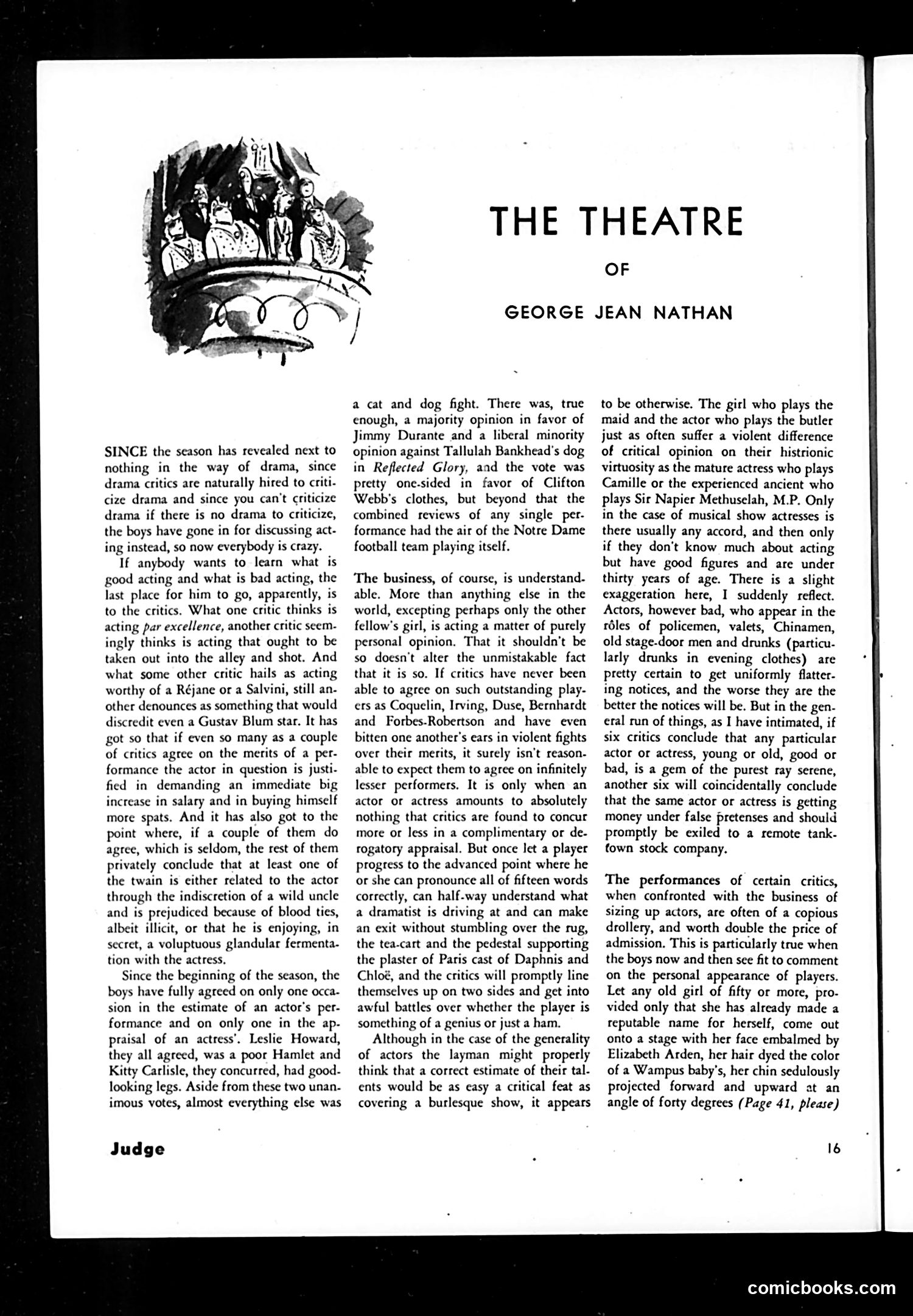
A restored page from Judge, 1937-01. Page through the whole issue in the reader above.
📄 Transcribed text from this page (OCR, searchable)
Machine-transcribed from the original scan — historical spelling and the odd misread are preserved.
SINCE the season has revealed next to nothing in the way of drama, since drama critics are naturally hired to criti- cize drama and since you can't criticize drama if there is no drama to criticize, the boys have gone in for discussing act- ing instead, so now everybody is crazy. If anybody wants to learn what is good acting and what is bad acting, the last place for him to go, apparently, is to the critics. What one critic thinks is acting par excellence, another critic seem- ingly thinks is acting that ought to be taken out into the alley and shot. And what some other critic hails as acting worthy of a Réjane or a Salvini, still an- other denounces as something that would discredit even a Gustav Blum star. It has got so that if even so many as a couple of critics agree on the merits of a per- formance the actor in question is justi- fied in demanding an immediate big increase in salary and in buying himself more spats. And it has also got to the point where, if a couple of them do agree, which is seldom, the rest of them privately conclude that at least one of the twain is either related to the actor through the indiscretion of a wild uncle and is prejudiced because of blood ties, albeit illicit, or that he is enjoying, in secret, a voluptuous glandular fermenta- tion with the actress, Since the beginning of the season, the boys have fully agreed on only one occa- sion in the estimate of an actor's per- formance and on only one in the ap- praisal of an actress’. Leslie Howard, they all agreed, was a poor Hamlet and Kitty Carlisle, they concurred, had good- looking legs. Aside from these two unan- imous votes, almost everything else was Judge THE THEATRE OF GEORGE JEAN NATHAN a cat and dog fight. There was, true enough, a majority opinion in favor of Jimmy Durante and a liberal minority opinion against Tallulah Bankhead’s dog in Reflected Glory, and the vote was pretty one-sided in favor of Clifton Webb's clothes, but beyond that the combined reviews of any single per- formance had the air of the Notre Dame football team playing itself. The business, of course, is understand- able. More than anything else in the world, excepting perhaps only the other fellow’s girl, is acting a matter of purely personal opinion. That it shouldn't be so doesn’t alter the unmistakable fact that it is so. If critics have never been able to agree on such outstanding play- ers as Coquelin, Irving, Duse, Bernhardt and Forbes-Robertson and have even bitten one another's ears in violent fights over their merits, it surely isn’t reason. able to expect them to agree on infinitely lesser performers. It is only when an actor or actress amounts to absolutely nothing that critics are found to concur more or less in a complimentary or de- rogatory appraisal. But once let a player progress to the advanced point where he or she can pronounce all of fifteen words correctly, can half-way understand what a dramatist is driving at and can make an exit without stumbling over the rug, the tea-cart and the pedestal supporting the plaster of Paris cast of Daphnis and Chloé, and the critics will promptly line themselves up on two sides and get into awful battles over whether the player is something of a genius or just a ham. Although in the case of the generality of actors the layman might properly think that a correct estimate of their tal- ents would be as easy a critical feat as covering a burlesque show, it appears to be otherwise. The girl who plays the maid and the actor who plays the butler just as often suffer a violent difference of critical opinion on their histrionic virtuosity as the mature actress who plays Camille or the experienced ancient who plays Sir Napier Methuselah, M.P. Only in the case of musical show actresses is there usually any accord, and then only if they don't know much about acting but have good figures and are under thirty years of age. There is a slight exaggeration here, I suddenly reflect. Actors, however bad, who appear in the réles of policemen, valets, Chinamen, old stage-door men and drunks (particu- larly drunks in evening clothes) are pretty certain to get uniformly flatter- ing notices, and the worse they are the better the notices will be. But in the gen- eral run of things, as I have intimated, if six critics conclude that any particular actor or actress, young or old, good or bad, is a gem of the purest ray serene, another six will coincidentally conclude that the same actor or actress is getting money under false pretenses and should promptly be exiled to a remote tank- own stock company. The performances of certain critics, when confronted with the business of sizing up actors, are often of a copious drollery, and worth double the price of admission. This is particularly trae when the boys now and then see fit to comment on the personal appearance of players. Let any old girl of fifty or more, pro- vided only that she has already made a reputable name for herself, come out onto a stage with her face embalmed by Elizabeth Arden, her hair dyed the color of a Wampus baby’s, her chin sedulously projected forward and upward at an angle of forty degrees (Page 41, please) 16 comicbooks.com