
Judge, 1937-01 · page 17 of 52
Judge — January 1937 — page 17: what you’re looking at
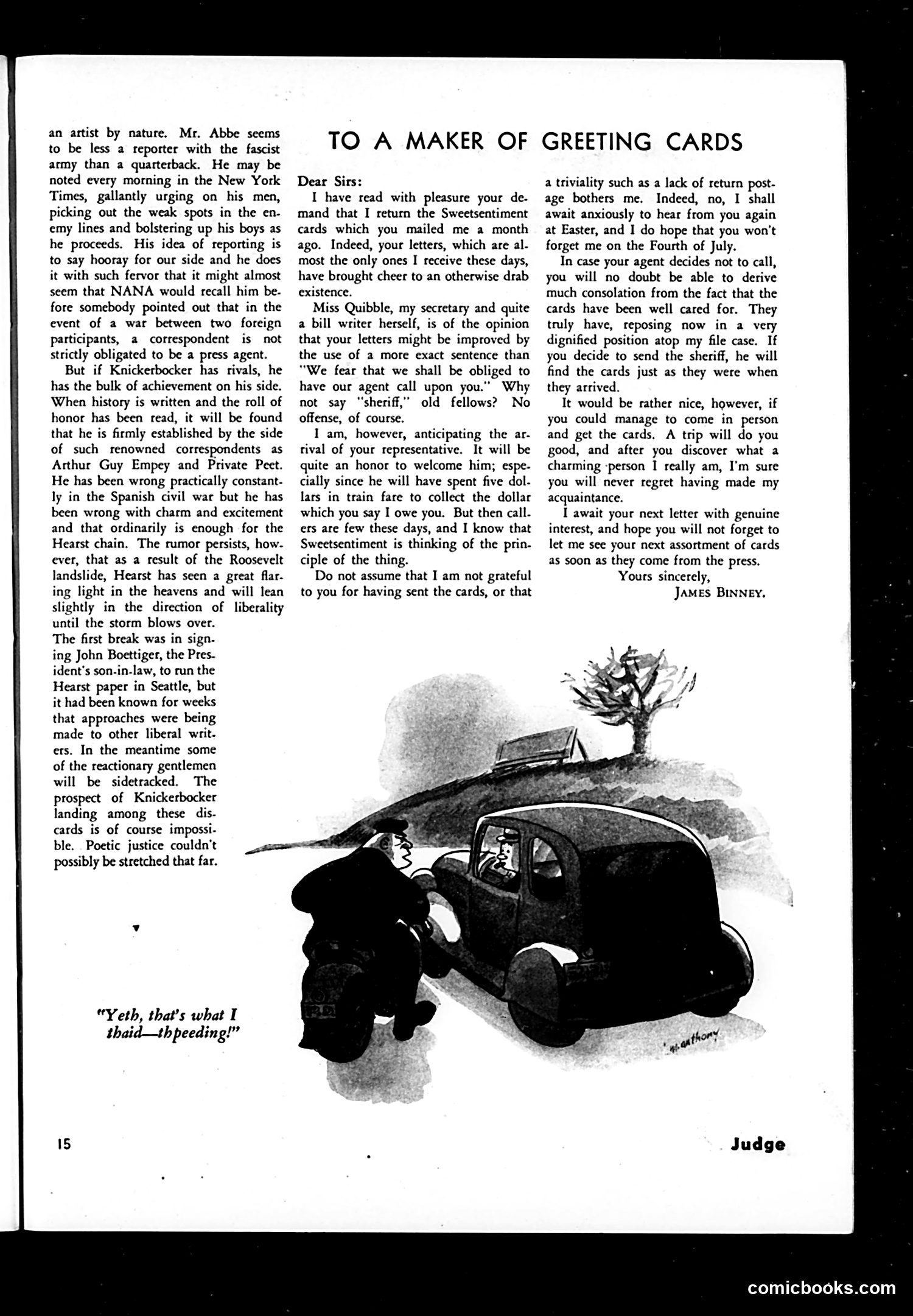
A restored page from Judge, 1937-01. Page through the whole issue in the reader above.
📄 Transcribed text from this page (OCR, searchable)
Machine-transcribed from the original scan — historical spelling and the odd misread are preserved.
an artist by nature. Mr. Abbe seems to be less a reporter with the fascist army than a quarterback. He may be noted every morning in the New York Times, gallantly urging on his men, picking out the weak spots in the en- emy lines and bolstering up his boys as he proceeds. His idea of reporting is to say hooray for our side and he does it with such fervor that it might almost seem that NANA would recall him be- fore somebody pointed out that in the event of a war between two foreign participants, a correspondent is not strictly obligated to be a press agent. But if Knickerbocker has rivals, he has the bulk of achievement on his side. When history is written and the roll of honor has been read, it will be found that he is firmly established by the side of such renowned correspondents as Arthur Guy Empey and Private Peet. He has been wrong practically constant- ly in the Spanish civil war but he has been wrong with charm and excitement and that ordinarily is enough for the Hearst chain. The rumor persists, how- ever, that as a result of the Roosevelt landslide, Hearst has seen a great flar- ing light in the heavens and will lean slightly in the direction of liberality until the storm blows over. The first break was in sign- ing John Boettiger, the Pres. ident's son-in-law, to run the Hearst paper in Seattle, but it had been known for weeks that approaches were being made to other liberal writ- ers. In the meantime some of the reactionary gentlemen will be sidetracked. The prospect of Knickerbocker landing among these dis- cards is of course impossi- ble. Poetic justice couldn't possibly be stretched that far. "Yeth, that’s what I thaid—th peeding!” TO A MAKER OF Dear Sirs: I have read with pleasure your de- mand that I return the Sweetsentiment cards which you mailed me a month ago. Indeed, your letters, which are al- most the only ones I receive these days, have brought cheer to an otherwise drab existence. Miss Quibble, my secretary and quite a bill writer herself, is of the opinion that your letters might be improved by the use of a more exact sentence than “We fear that we shall be obliged to have our agent call upon you.” Why not say “sheriff,” old fellows? No offense, of course. I am, however, anticipating the ar- rival of your representative. It will be quite an honor to welcome him; espe- cially since he will have spent five dol- lars in train fare to collect the dollar which you say I owe you. But then call. ers are few these days, and I know that Sweetsentiment is thinking of the prin. ciple of the thing. Do not assume that I am not grateful to you for having sent the cards, or that GREETING CARDS a triviality such as a lack of return post- age bothers me. Indeed, no, I shall await anxiously to hear from you again at Easter, and I do hope that you won't forget me on the Fourth of July. In case your agent decides not to call, you will no doubt be able to derive much consolation from the fact that the cards have been well cared for. They truly have, reposing now in a very dignified position atop my file case. If you decide to send the sheriff, he will find the cards just as they were when they arrived. It would be rather nice, however, if you could manage to come in person and get the cards. A trip will do you good, and after you discover what a charming -person I really am, I'm sure you will never regret having made my acquaintance. I await your next letter with genuine interest, and hope you will not forget to let me see your next assortment of cards as soon as they come from the press. Yours sincerely, James BINNEY. comicbooks.com