
Judge, 1937-01 · page 11 of 52
Judge — January 1937 — page 11: what you’re looking at
What you’re looking at
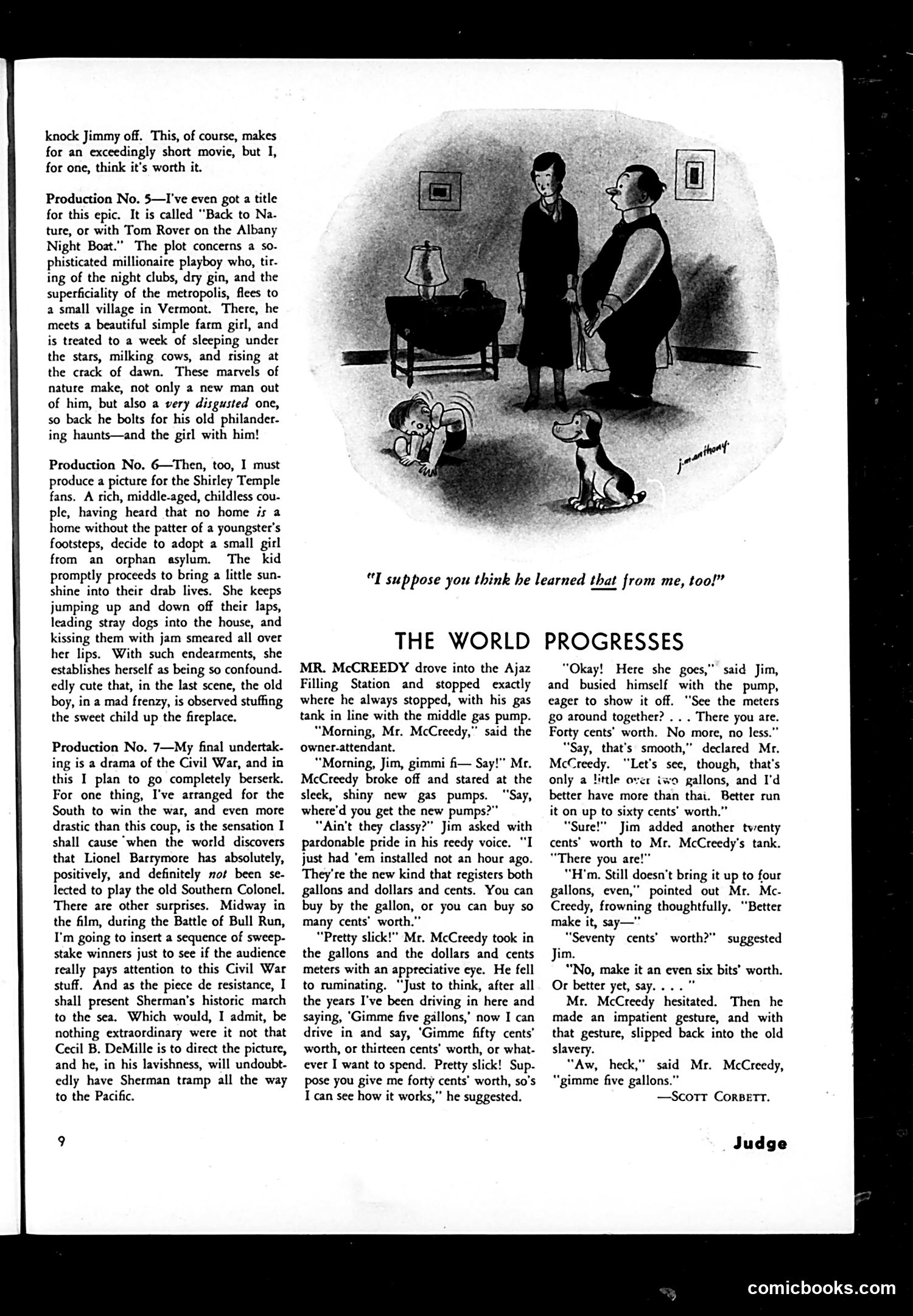
# "The World Progresses" Cartoon Analysis This single-panel cartoon satirizes consumer behavior and the illusion of progress. Mr. McCreedy visits a gas station featuring new pumps that display both gallons *and* dollars/cents simultaneously. Impressed by this "modern" technology, he requests forty cents' worth of gas—ostensibly to test the mechanism. The satire lies in the joke's caption and setup: McCreedy believes he's making a sophisticated choice by purchasing gas by *price* rather than *volume*. However, the new pump simply provides an additional display option; it doesn't fundamentally change the transaction. The cartoon mocks how consumers mistake superficial "improvements" or new marketing presentations for genuine progress or meaningful choice. This reflects 1920s-30s American consumer culture anxieties about whether modern conveniences and advertising genuinely benefited consumers or merely repackaged existing products.
📄 Transcribed text from this page (OCR, searchable)
Machine-transcribed from the original scan — historical spelling and the odd misread are preserved.
knock Jimmy off. This, of course, makes for an exceedingly short movie, but I, for one, think it’s worth it. Production No. 5—I've even got a title for this epic. It is called “Back to Na- ture, or with Tom Rover on the Albany Night Boat.” The plot concerns a so- phisticated millionaire playboy who, tir- ing of the night clubs, dry gin, and the superficiality of the metropolis, flees to a small village in Vermont. There, he meets a beautiful simple farm girl, and is treated to a week of sleeping under the stars, milking cows, and rising at the crack of dawn. These marvels of nature make, not only a new man out of him, but also a very disgusted one, so back he bolts for his old philander- ing haunts—and the girl with him! Production No. 6—Then, too, I must produce a picture for the Shirley Temple fans. A rich, middle-aged, childless cou- ple, having heard that no home is a home without the patter of a youngster’s footsteps, decide to adopt a small girl from an orphan asylum. The kid promptly proceeds to bring a little sun- shine into their drab lives. She keeps jumping up and down off their laps, leading stray dogs into the house, and kissing them with jam smeared all over her lips. With such endearments, she establishes herself as being so confound. edly cute that, in the last scene, the old boy, in a mad frenzy, is observed stuffing the sweet child up the fireplace. Production No. 7—My final undertak- ing is a drama of the Civil War, and in this I plan to go completely berserk. For one thing, I've arranged for the South to win the war, and even more drastic than this coup, is the sensation I shall cause when the world discovers that Lionel Barrymore has absolutely, positively, and definitely not been se- lected to play the old Southern Colonel. There are other surprises. Midway in the film, during the Battle of Bull Run, I'm going to insert a sequence of sweep- stake winners just to see if the audience really pays attention to this Civil War stuff. And as the piece de resistance, I shall present Sherman's historic march to the sea. Which would, I admit, be nothing extraordinary were it not that Cecil B. DeMille is to direct the picture, and he, in his lavishness, will undoubt- edly have Sherman tramp all the way to the Pacific. "I suppose you think he learned that from me, too!” THE WORLD MR. McCREEDY drove into the Ajaz Filling Station and stopped exactly where he always stopped, with his gas tank in line with the middle gas pump. “Morning, Mr. McCreedy,” said the owner-attendant. “Morning, Jim, gimmi fi— Say!" Mr. McCreedy broke off and stared at the sleek, shiny new gas pumps. “Say, where'd you get the new pumps?” “Ain't they classy?” Jim asked with pardonable pride in his reedy voice. “I just had ‘em installed not an hour ago. They're the new kind that registers both gallons and dollars and cents. You can buy by the gallon, or you can buy so many cents’ worth.” “Pretty slick!” Mr. McCreedy took in the gallons and the dollars and cents meters with an appreciative eye. He fell to ruminating. “Just to think, after all the years I've been driving in here and saying, ‘Gimme five gallons,’ now I can drive in and say, ‘Gimme fifty cents’ worth, or thirteen cents’ worth, or what- ever I want to spend. Pretty slick! Sup. pose you give me forty cents’ worth, so’s I can see how it works,” he suggested. PROGRESSES “Okay! Here she goes,” said Jim, and busied himself with the pump, eager to show it off. “See the meters go around together? . . . There you are. Forty cents’ worth. No more, no less.” “Say, that's smooth,” declared Mr. McCreedy. “Let's see, though, that’s only a little over iwo gallons, and I'd better have more than thai. Better run it on up to sixty cents’ worth,” “Sure! Jim added another twenty cents’ worth to Mr. McCreedy’s tank. “There you are!” “H'm. Still doesn’t bring it up to four gallons, even,” pointed out Mr. Mc- Creedy, frowning thoughtfully. “Better make it, say—" “Seventy cents’ worth?” suggested Jim. “No, make it an even six bits’ worth. Or better yet, say...” Mr. McCreedy hesitated. Then he made an impatient gesture, and with that gesture, slipped back into the old slavery. “Aw, heck,” said Mr. McCreedy, “gimme five gallons.” —Scorr Corsett. Judge comicbooks.com