
Judge, 1937-01 · page 10 of 52
Judge — January 1937 — page 10: what you’re looking at
What you’re looking at
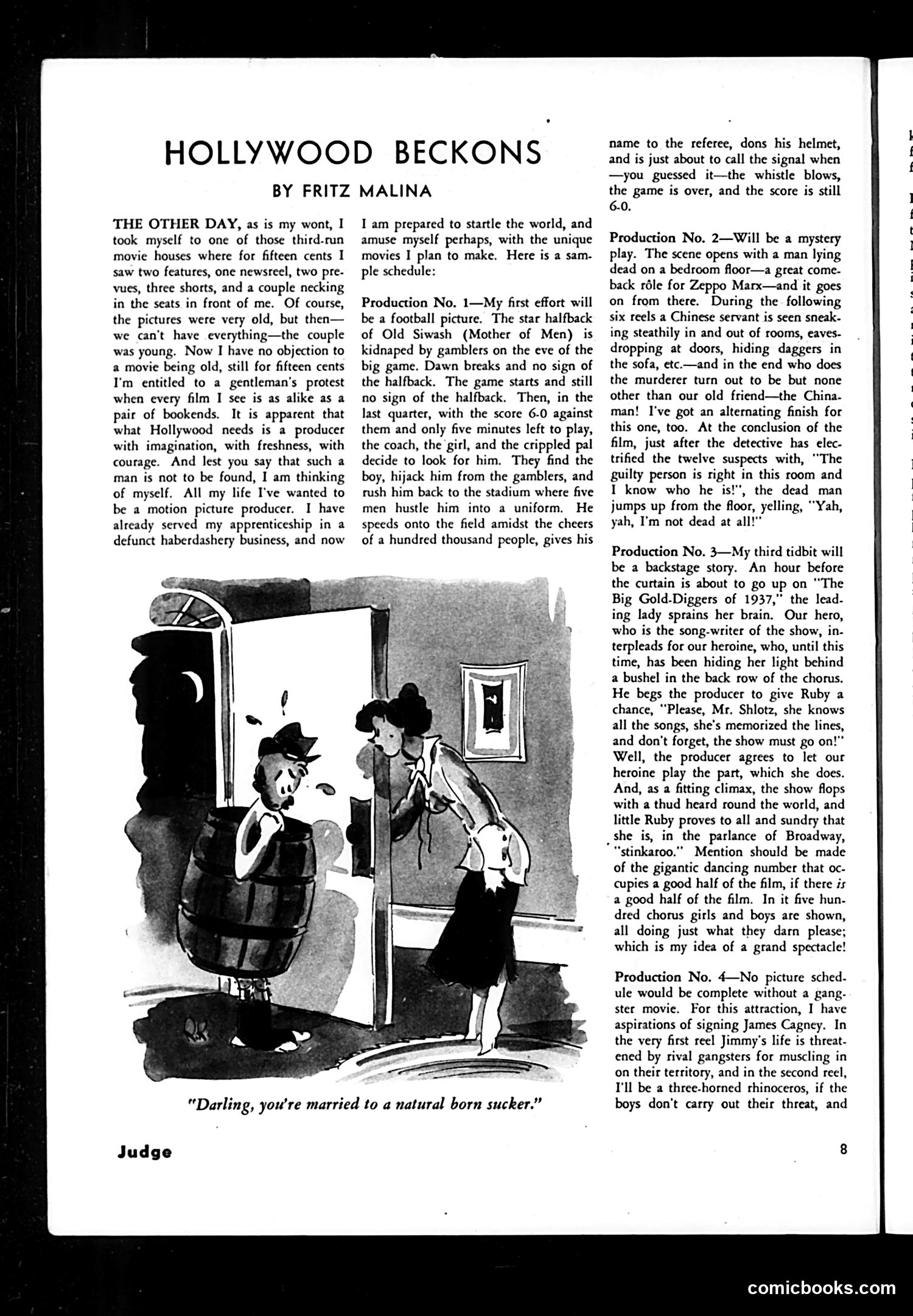
# "Hollywood Beckons" by Fritz Malina This is a satirical essay mocking formulaic Hollywood screenwriting. The author, posing as an aspiring producer, outlines four hilariously clichéd movie pitches that parody common studio tropes of the 1930s: **Production 1** ridicules sports movies: a kidnapped football star mysteriously reappears mid-game, only to have it end anticlimactically. **Production 2** mocks mystery films: Chinese servants skulk mysteriously, the supposedly dead man was alive all along. **Production 3** parodies backstage musicals: an unknown chorus girl ("Ruby") gets her big chance when the star is injured, the show flops anyway—a reference to the "Gold Diggers" series. The single cartoon below illustrates marital naiveté: a woman calls her husband "a natural born sucker," a dig at male gullibility. Malina's satire targets Hollywood's creative bankruptcy—recycled plots, stereotypical characters (the "Zeppo Marx" reference), and predictable outcomes. The piece is both criticism and self-aware comedy about tinseltown's formula-driven productions.
📄 Transcribed text from this page (OCR, searchable)
Machine-transcribed from the original scan — historical spelling and the odd misread are preserved.
HOLLYWOOD BECKONS BY FRITZ MALINA THE OTHER DAY, as is my wont, I took myself to one of those third-run movie houses where for fifteen cents I saw two features, one newsreel, two pre- vues, three shorts, and a couple necking in the seats in front of me. Of course, the pictures were very old, but then— we can't have everything—the couple was young. Now I have no objection to a movie being old, still for fifteen cents I'm entitled to a gentleman's protest when every film I see is as alike as a pair of bookends. It is apparent that what Hollywood needs is a producer with imagination, with freshness, with courage. And lest you say that such a man is not to be found, I am thinking of myself. All my life I've wanted to be a motion picture producer. I have already served my apprenticeship in a defunct haberdashery business, and now I am prepared to startle the world, and amuse myself perhaps, with the unique movies I plan to make. Here is a sam- ple schedule: Production No. 1—My first effort will be a football picture. The star halfback of Old Siwash (Mother of Men) is kidnaped by gamblers on the eve of the big game. Dawn breaks and no sign of the halfback. The game starts and still no sign of the halfback. Then, in the last quarter, with the score 6-0 against them and only five minutes left to play, the coach, the girl, and the crippled pal decide to look for him. They find the boy, hijack him from the gamblers, and rush him back to the stadium where five men hustle him into a uniform. He speeds onto the field amidst the cheers of a hundred thousand people, gives his “Darling, you're married to a natural born sucker.” Judge name to the referee, dons his helmet, and is just about to call the signal when —you guessed it—the whistle blows, the game is over, and the score is still 6.0. Production No. 2—Will be a mystery play. The scene opens with a man lying dead on a bedroom floor—a great come- back réle for Zeppo Marx—and it goes on from there. During the following six reels a Chinese servant is seen sneak- ing steathily in and out of rooms, eaves- dropping at doors, hiding daggers in the sofa, etc.—and in the end who does the murderer turn out to be but none other than our old friend—the China. man! I've got an alternating finish for this one, too. At the conclusion of the film, just after the detective has elec- trified the twelve suspects with, “The guilty person is right in this room and I know who he is!", the dead man jumps up from the floor, yelling, “Yah, yah, I'm not dead at all!" Production No. 3—My third tidbit will be a backstage story. An hour before the curtain is about to go up on “The Big Gold-Diggers of 1937,” the lead. ing lady sprains her brain. Our hero, who is the song-writer of the show, in- terpleads for our heroine, who, until this time, has been hiding her light behind a bushel in the back row of the chorus. He begs the producer to give Ruby a chance, “Please, Mr. Shlotz, she knows all the songs, she’s memorized the lines, and don’t forget, the show must go on!” Well, the producer agrees to let our heroine play the part, which she does. And, as a fitting climax, the show flops with a thud heard round the world, and little Ruby proves to all and sundry that _ She is, in the parlance of Broadway, “'stinkaroo.”” Mention should be made of the gigantic dancing number that oc- cupies a good half of the film, if there is a good half of the film. In it five hun- dred chorus girls and boys are shown, all doing just what they darn please; which is my idea of a grand spectacle! Production No. 4—No picture sched- ule would be complete without a gang- ster movie. For this attraction, I have aspirations of signing James Cagney. In the very first reel Jimmy's life is threat- ened by rival gangsters for muscling in on their territory, and in the second reel, I'll be a three-horned rhinoceros, if the boys don’t carry out their threat, and comicbooks.com