
Judge, 1936-12 · page 34 of 53
Judge — December 1936 — page 34: what you’re looking at
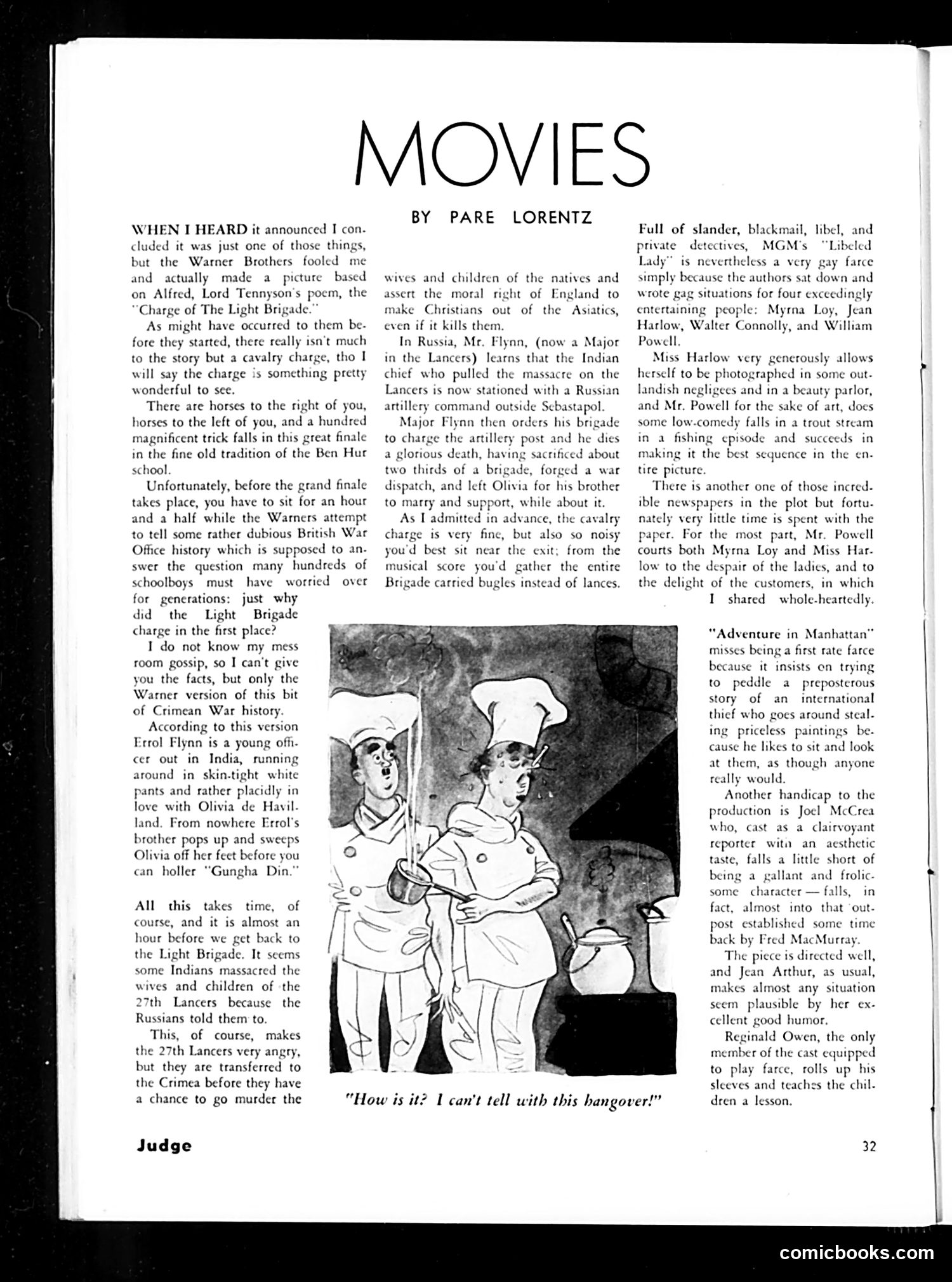
A restored page from Judge, 1936-12. Page through the whole issue in the reader above.
📄 Transcribed text from this page (OCR, searchable)
Machine-transcribed from the original scan — historical spelling and the odd misread are preserved.
WHEN I HEARD it announced I con. cluded it was just one of those things, but the Warner Brothers fooled me and actually made a picture based on Alfred, Lord Tennyson's poem, the “Charge of The Light Brigade.” As might have occurred to them be- fore they started, there really isn’t much to the story but a cavalry charge, tho I will say the charge is something pretty wonderful to see, There are horses to the right of you, horses to the left of you, and a hundred magnificent trick falls in this great finale in the fine old tradition of the Ben Hur school. Unfortunately, before the grand finale takes place, you have to sit for an hour and a half while the Warners attempt to tell some rather dubious British War Office history which is supposed to an- swer the question many hundreds of schoolboys over for generations: just why did the Light Brigade charge in the first place? I do not know my mess room gossip, so I can’t give you the facts, but only the Warner version of this bit of Crimean War history. According to this version Errol Flynn is a young off. cer out in India, running around in skin-tight white pants and rather placidly in love with Olivia de Havil- land. From nowhere Errol’s brother pops up and sweeps Olivia off her feet before you can holler “Gungha Din.” must have worried All this takes time, of course, and it is almost an hour before we get back to the Light Brigade. It seems some Indians massacred the wives and children of the 27th Lancers because the Russians told them to. This, of course, makes the 27th Lancers very angry, but they are transferred to the Crimea before they have a chance to go murder the Judge MOVIES BY PARE LORENTZ wives and children of the natives and assert the moral right of England to make Christians out of the Asiatics, even if it kills them. In Russia, Mr, Flynn, (now a Major in the Lancers) learns that the Indian chief who pulled the massacre on the Lancers is now stationed with a Russian artillery command outside Sebastapol. Major Flynn then orders his brigade to charge the artillery post and he dies a glorious death, having sacrificed about two thirds of a brigade, forged a war dispatch, and left Olivia for his brothee to marry and support, while about it. As L admitted in advance, the cavalry charge is very fine, but also so noisy from the musical score you'd gather the entire Brigade carried bugles instead of lances. you'd best sit near the exit “How is it? 1 can't tell with this hangover!” Full of slander, blackmail, libel, and private MGM's Lady” is nevertheless a very gay farce simply because the authors sat down and wrote gag situations for four exceedingly entertaining people: Myrna Loy, Jean Harlow, Walter Connolly, and William Powell. pcled detectives, Miss Harlow very generously allows herself to be photographed in some out- landish negligees and in a beauty parlor, and Mr. Powell for the sake of art, does some low-comedy falls in a trout stream in a fishing episode and succeeds in making it the best sequence in the en- ure picture. There is another one of those incred. ible newspapers in the plot but fortu- nately very little time is spent with the paper. For the most part, Mr. Powell courts both Myrna Loy and Miss Har- low to the despair of the ladies, and to the delight of the customers, in which I shared whole-heartedly. “Adventure in Manhattan” misses being a first rate farce because it insists on trying to peddle a preposterous story of an_ international thief who goes around steal- ing priceless paintings be- cause he likes to sit and look at them, as though anyone really would. Another handicap to the production is Jocl McCrea who, cast as a clairvoyant reporter wita an aesthetic taste, falls a little short of being a gallant and frolic- character — falls, in that post established some time back by Fred MacMurray. The piece is directed well, and Jean Arthur, as usual, makes almost any situation seem plausible by her ex- cellent good humor. Reginald Owen, the only member of the cast equipped some fact, almost into out. to play farce, rolls up his sleeves and teaches the chil- dren a lesson, comicbooks.com