
Judge, 1935-11 · page 16 of 36
Judge — November 1935 — page 16: what you’re looking at
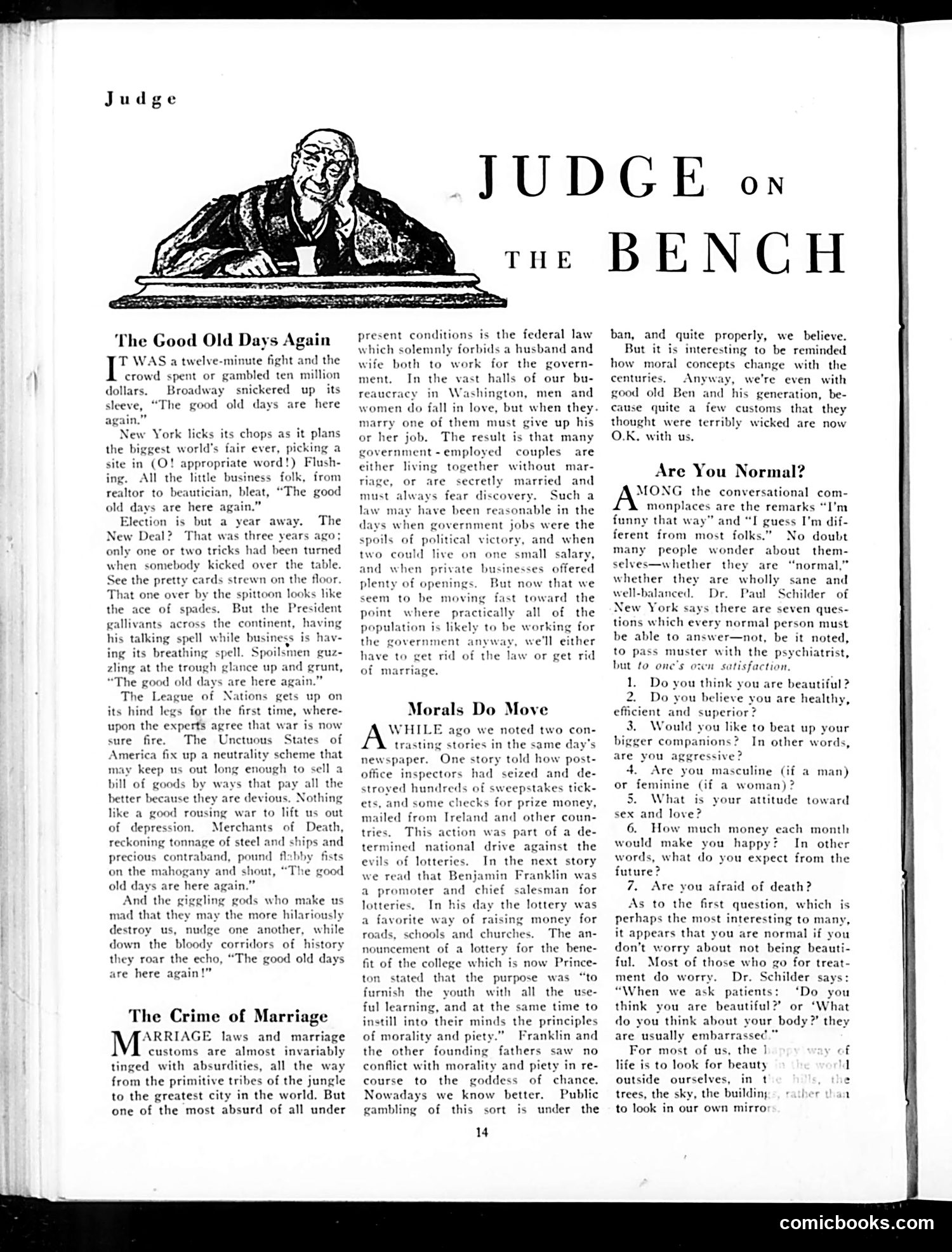
A restored page from Judge, 1935-11. Page through the whole issue in the reader above.
📄 Transcribed text from this page (OCR, searchable)
Machine-transcribed from the original scan — historical spelling and the odd misread are preserved.
Judge The Good Old Days Again T WAS a twelve-minute fight and the crowd spent or gambled ten million dollars. Broadway snickered up_ its sleeve, “The good old days are here again.” New York licks its chops as it plans the biggest world’s fair ever, picking a site in (O! appropriate word!) Flush- ing. All the little business folk, from realtor to beautician, bleat, “The good old days are here again.” Election is but a year away. The New Deal? That was three years ago; only one or two tricks had been turned when somebody kicked over the table. See the pretty cards strewn on the floor. That one over by the spittoon looks like the ace of spades. But the President gallivants across the continent, having his talking spell while business is hav- ing its breathing spell. Spoilsmen guz- zling at the trough glance up and grunt, “The good old days are here again.” The League of Nations gets up on its hind legs for the first time, where- upon the experts agree that war is now sure fire. The Unctuous States of America fix up a neutrality scheme that may keep us out long enough to sell a bill of goods by ways that pay all the better because they are devious like a good rousing war to lift us out of depression. Merchants of Death, reckoning tonnage of steel and ships and precious contraband, pound flabby fists on the mahogany and shout, “Th 0d old days are here again.” And the giggling gods who make us mad that they may the more hilariously destroy us, nudge one another, while down the bloody corridors of history they roar the echo, “The good old days are here again!” Nothing The Crime of Marriage ARRIAGE laws and marriage customs are almost invariably tinged with absurdities, all the way from the primitive tribes of the jungle to the greatest city in the world. But one of the most absurd of all under present conditions is the federal law which solemnly forbids a husband and wife both to work for the govern- ment. In the vast halls of our bu- reaucracy in Washington, men and women do fall in love, but when they. marry one of them must give up his or her job. The result is that many government-employed couples are either living together without mar- riage, or are secretly married and must always fear discovery. Such a law may have been reasonable in the days when government jobs were the spoils of political victory, and when two could live on one small salary, and when private businesses offered plenty of openings, But now that we seem to be moving fast toward the point where practically all of the population is likely to be working for the gove yent y, we'll either have to get rid of the law or get rid of marriage. anyw Morals Do Move WHILE trasting newspaper. offic we noted two con- stories in the same day's One story told how post- inspectors had seized and de- stroyed hundreds of sweepstakes tick- ets, and some checks for prize money, mailed from Ireland and other coun- tries, This action was part of a de- termined national drive against the evils of lotteries. In the next story we read that Benjamin Franklin was promoter and chief salesman for tteri In his day the lottery was a favorite way of raising money for roads, schools and churches. The an- nouncement of a lottery for the bene- fit of the college which is now Prince- ton stated that the purpose was “to furnish the youth with all the use- ful learning, and at the same time to instill into their minds the principles of morality and piety.” Franklin and the other founding fathers saw no conflict with morality and piety in re- course to the goddess of chance. Nowada we know better. Public gambling of this sort is under the 14 ban, and quite properly, we believe. But it is interesting to be reminded how moral concepts change with the centuries. Anyway, we're even with good old Ben and his generation, be- cause quite a few customs that they thought were terribly wicked are now O.K. with us. Are You Normal? MONG the conversational com- monplaces are the remarks “I’m funny that way” and “I guess I'm dif- ferent from most folks.” No doubt many people wonder about them- selves—whether they are “normal,” whether they are wholly sane and well-balanced. Dr. Paul Schilder of ‘ew York says there are seven ques- tions which every normal person must be able to answer—not, be it noted, to pass muster with the psychiatrist, but fo one’s own isfaction, 1. Do you think you are beautiful? 2. Do you believe you are healthy, efficient and superior? : 3. Would you like to beat up your bigger companions? In other words, are you aggressive? 4.” Are you masculine (if a man) or feminine (if a woman)? 5. What is your attitude toward sex and love? 6. How much money each month would make you happy? In other words, what do you expect from the future? 7. Are you afraid of death? As to the first question, which is perhaps the most interesting to many, it appears that you are normal if you don’t worry about not being beauti- ful. Most of those who go for treat- ment do worry. Dr. Schilder “When we ask patients: ‘Do you think you are beautiful?’ or ‘What do you think about your body?’ they are usually em! sec For most of us, the ] c ife is to look for beauty outside ourselves, in t trees, the sky, the buildin; her to look in our own mirro: comicbooks.com