
Judge, 1935-09 · page 16 of 36
Judge — September 1935 — page 16: what you’re looking at
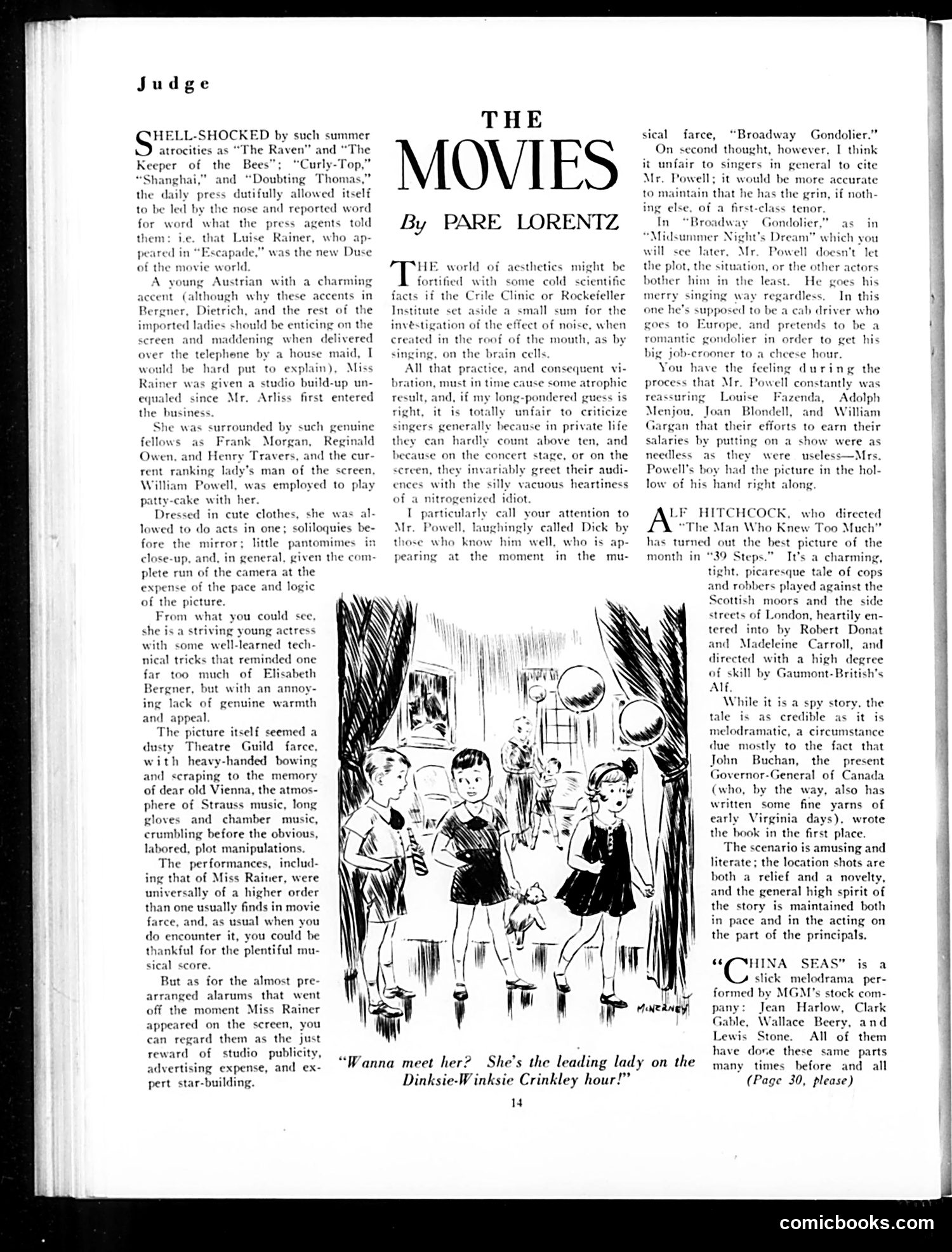
A restored page from Judge, 1935-09. Page through the whole issue in the reader above.
📄 Transcribed text from this page (OCR, searchable)
Machine-transcribed from the original scan — historical spelling and the odd misread are preserved.
Judge HELL-SHOCKED by such summer atrocities as “The Raven” and “The Keeper of the Bees"; “Curly-Top, “Shanghai,” and “Doubting Thomas,” the daily press dutifully allowed itself to be led by the nose and reported word for word what the told that Luise Rainer, who ap press agents them: ie. peared in‘ was the new Duse of the movie world A young Austrian with a charming accent (although why these accents in Bergner, Dietrich, and the rest of the imported ladies should be enticing on the en and maddening when delivered over the telephone by a house maid, I Miss Rainer was given a studio build-up un- equaled since Mr. Arliss first entered the business. would be hard put to explain), She was surrounded b; fellows as such genuine Frank Morgan, Reginald Owen, and Henry Travers, and the cur- rent ranking lady’s man of the screen, William Powell, was employed to play patty-cake with her Dressed in cute clothes, she was al- lowed to do acts in one; soliloquies be- fore the little pantomimes close-up, and, in general, given the com- plete run of the camera at the expense of the pac of the picture. ‘om what you could sce, she is a striving young actress with some well-learned tech- nical tricks that reminded one much of Elisabeth Bergner, but with an annoy- ing lack of genuine warmth and appeal The picture itself seemed a dusty Theatre Guild farce, with heavy-handed bowing and scraping to the memory of dear old Vienna, the atmos- phere of Strauss music, long gloves and chamber music, crumbling before the obvious, labored, plot manipulations. The performances, includ- ing that of Miss Rainer, were universally of a higher order than one usually finds in movie farce, and, as usual when you do encounter it, you could be thankful for the plentiful mu- sical score. But as for the almost pre- arums that went * the moment Miss Rainer appeared on the screen, you regard them as the just reward of studio publicit advertising expense, and ex pert star-building. mirror; and logic far too “Wanna meet her? THE OVIES PARE LORENTZ world of aesthetics might be h some ld scientific acts if the Crile Clinic or Rockefeller Institute set aside a all si investigation of the effect of noi for the ¢. When created in the roof of the mouth, as by ) the brain cells nd consequent vi- use some atrophic if my long-pondered guess is totally unfair to criticize singers generally hecause in private life they can hardly count above ten, and because on the concert stage, or on the screen, they invariably greet their audi- ences with the silly vacuous heartiness f genized idiot. particularly call your attention to »well, laughingly called Dick by who know him well, who is ap- pearing at moment in the bration, must in time c result, and. right, it i mu- Dinksie-W nksie Crinkley hour!” 14 the leading lady on the sical farce, “Broadw Gondolier.” On second thought, however, I think it unfair to singers in general to cite Mr. Powell; it would be more accurate to maintain that he has the grin, if noth- ig else, of a first-class tenor. In “Broadway Gondolier,” as in “Midsummer Night's Dream” which you will later, Mr. doesn’t let the plot, the situation, or the other bother hit ec merry sin, Powell tors He goes his ing way regardless, In this one he’s supposed to be a cab driver who goes to Europe. least nd pretends to be idolier in order to get big job-crooner to You have the romantic i cheese hour. feeling during the s that Mr. Powell constantly was uring Louise Fazenda, Adolph Blondell, and William Gargan that their efforts to earn their aries by putting on a show were 3 needless as th Powell's boy ha Menjou, Joan were useless—Mrs. the picture in the hol- low of his hand right along. AN HITCHCOCK, who directed “The Man Who Knew Too Much” has turned out the best picture of the month in “39 Steps.” It’s a charming, tight. picaresque tale of cops and robbers pla against the Scottish moors and the side streets of London, heartily en- tered into by Robert Donat and Madeleine Carroll, and directed with a high degree f skill by Gaumont-British’s While it is a spy story. the tale is as credible as it is melodramatic, a circumstance due mostly to the fact that John Buchan, the present Governor-General of Canada (who, by the way, also has written some fine yarns of early Virginia days), wrote the book in the first place. The scenario is amusing and literate; the location shots are both a relief and a novelty, and the general high spirit of the story is maintained both in pace and in the acting on the part of the principals. “s is a melodrama per- formed by MGM's stock com- pany: Jean Harlow, Clark Gable, Wallace Beery, and Lewis Stone. All of them have done these same parts many times before and all (Page 30, please) comicbooks.com