
Judge, 1935-07 · page 25 of 36
Judge — July 1935 — page 25: what you’re looking at
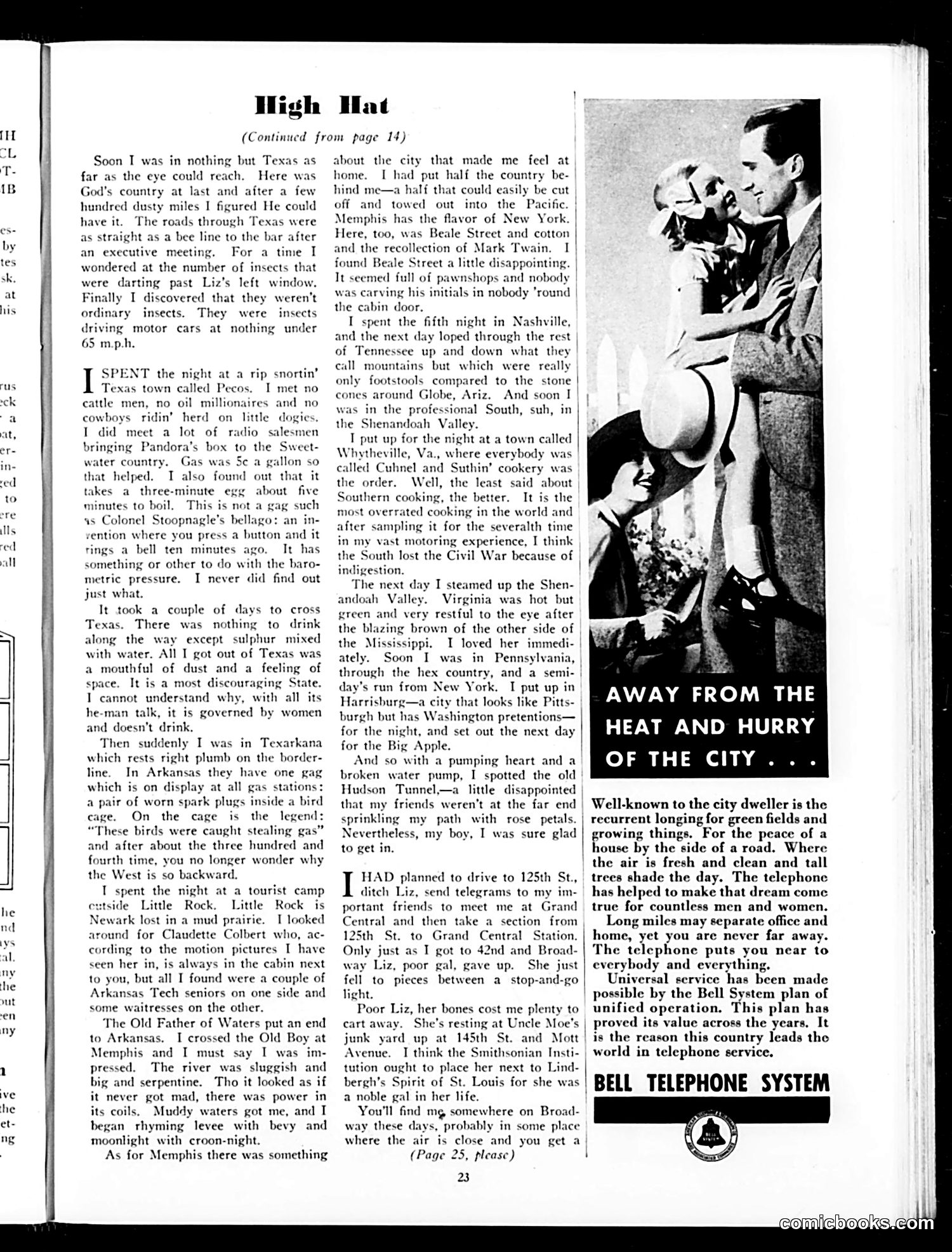
A restored page from Judge, 1935-07. Page through the whole issue in the reader above.
📄 Transcribed text from this page (OCR, searchable)
Machine-transcribed from the original scan — historical spelling and the odd misread are preserved.
JL gh Mat (Continued from page 14) Soon I was in nothing but Texas as far as the eye could reach. Here was God's country at last and after a few hundred dusty miles I figured He could have it. The roads through Texas were as straight as a bee line to the bar after an executive meeting. For a time I wondered at the number of insects that were darting past Li left ally I discovered that they weren't insects. They were insects driving motor cars at nothing under 65 m.p.h. window. SPENT the night at a rip snortin’ Texas town called Pecos. I met no cattle men, no oil millionaires and no cowboys ridin’ herd on little dogi I did meet a lot of radio. sales bringing Pandora’s box to the S water country. 1 weet- ec sas was Se a gallon so that helped. T also found out that it takes a three-minute egg about five utes to boil, This is not a gag such as Colonel Stoopnagle’s bellago: an in- vention where you press a button and it tings a bell ten minutes Tt has something or other to do with the baro- metric pressure. I never did find out just what. It took a couple of days to cross Texas. There was nothing to drink along the way except sulphur mixed with water. All I got out of Texas was a mouthful of dust and a feeling of space. It is a most discouraging State. I cannot understand why, with all its he-man talk, it is governed by women and doesn't drink, uO. Then suddenly I was in Texarkana which rests right plumb on the border- line. In Arkansas they have one gag which is on display at all stations: a pair of worn spark plugs inside a bird e. On the cage is the legend: hese birds were caught stealing gas” and after about the three hundred and fourth time, you no longer wonder why the West is so backward. I spent the night at a tourist camp eutside Little Rock. Little Rock is rk lost in a mud prairie. I looked around for Claudette Colbert who, ac- cording to the motion pictures I have seen her in, is ys in the cabin next to you, but all T found were a couple of Arkansas Tech seniors on one side and some waitresses on the other. The Old Father of Waters put an end to Arkansas. I crossed the Old Boy at Memphis and I must say I was im- pressed. The river was sluggish and big and serpentine. Tho it looked as if it never got mad, there was power in its coils. Muddy waters got me, and I began rhyming levee with bevy and moonlight with croon-night. As for Memphis there was something about the city that made me feel at home. [ had put half the country be- hind me—a half that could easily be cut off and towed out into the Pacific. Memphis has the flavor of New York. Here, too, was Beale Street and cotton and the recollection of Mark Twain. I found Beale ta little disappointing. It seemed full of pawnshops and nobody was carving his initials in nobody ’round the cabin door, I spent the fifth night in Nashville, and the next day loped through the rest of Tennessee up and down what they call mountains but which were really only footstools compared to the stone | cones around Globe, Ariz. And soon I was in the professional South, suh, in | the Shenandoah Valley. T put up for the night at a town called | Whytheville, Va., where everybody called Cuhnel and Suthin’ cookery was the order. Well, the least said about Southern cooking, the better. It is the most overrated cooking in the world and after sampling it for the severalth time in my vast motoring experience, I think the South lost the Civil War because of indigestion. | The next day I steamed up the Shen- andoah Valley. Virginia was hot but green and very restful to the eye after the blazing brown of the other side of the Mississippi. I loved her immedi- ately. Soon I was in Pennsylvania, through the hex country, and a semi- day's run from New York. I put up in Harrisburg—a city that looks like Pitts- burgh but Washington pretentions— for the night, and set out the next day for the Big Apple. And so with a pumping heart and a broken water pump, I spotted the old Hudson Tunnel,—a little disappointed that my friends weren't at the far end sprinkling my path with rose petals. Nevertheless, my boy, I was sure glad to get in. HAD planned to drive to 125th St. ditch Liz, send telegrams to my im- portant friends to meet me at Grand Central and then take a section from 125th St. to Grand Central Station. Only just as I got to 42nd and Broad- Liz, poor gal, gave up. She just fell to pieces between a stop-and-go light. Poor Liz, her bones cost me plenty to cart away. She's resting at Uncle Moe's junk yard up at 145th St. and Mott | Avenue. I think the Smithsonian Insti- tution ought to place her next to Lind- bergh’s Spirit of St. Louis for she was a noble gal in her life. You'll find mg somewhere on Broad- way these days, probably in some place where the air is close and you get a (Page 25, please) 23 | \ AWAY FROM THE HEAT AND HURRY OF THE CITY... Well-known to the city dweller is the recurrent longing for green fields and growing things. For the peace of a house by the side of a road. Where the air is fresh and clean and tall trees shade the day. The telephone has helped to make that dream come true for countless men and women. Long miles may separate office and home, yet you are never far away. The telephone puts you near to everybody and everything. Universal service has been made possible by the Bell System plan of unified operation. This plan has proved its value across the years, It is the reason this country leads tho world in telephone service. BELL TELEPHONE SYSTEM