
Judge, 1935-07 · page 24 of 36
Judge — July 1935 — page 24: what you’re looking at
A restored page from Judge, 1935-07. Page through the whole issue in the reader above.
📄 Transcribed text from this page (OCR, searchable)
Machine-transcribed from the original scan — historical spelling and the odd misread are preserved.
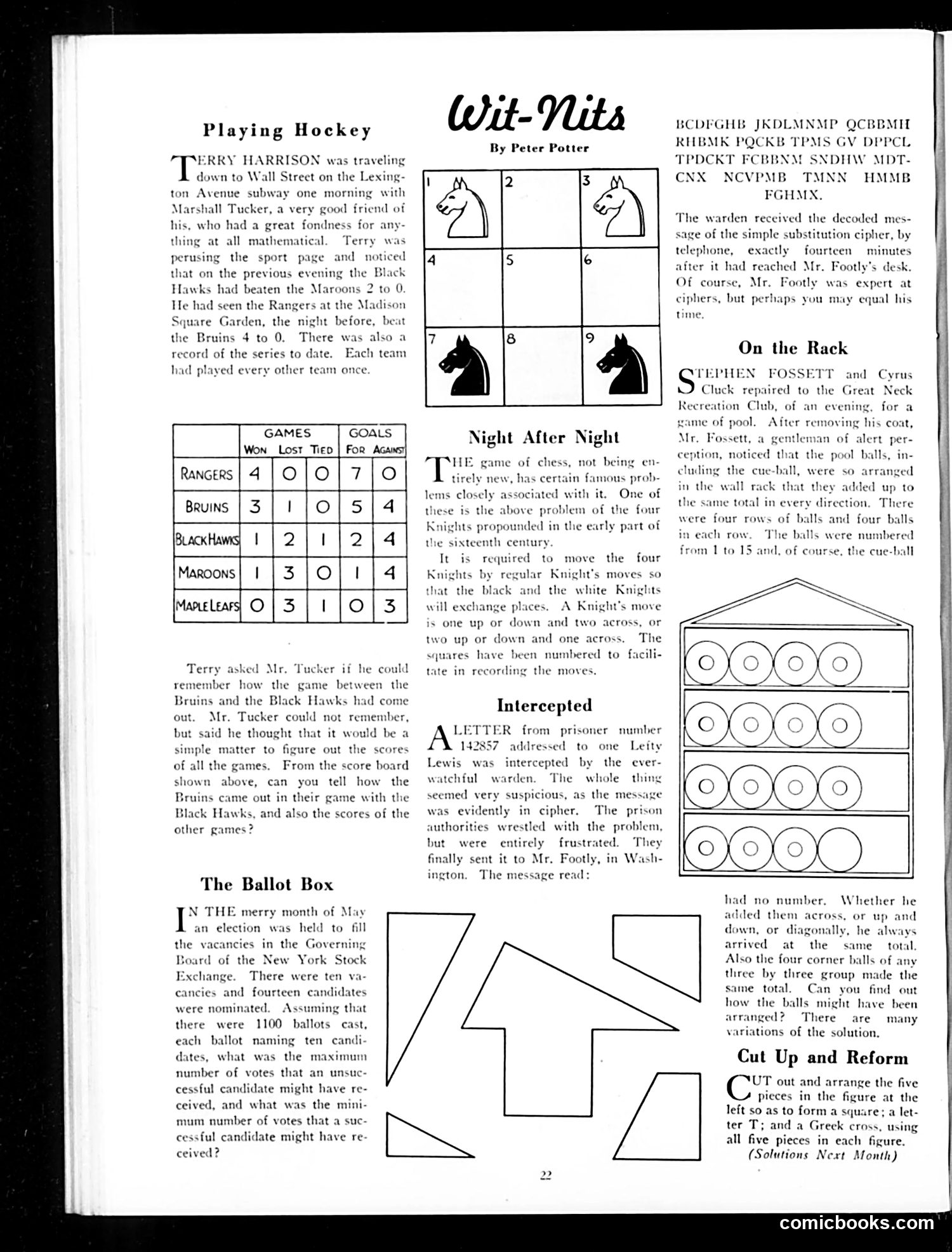
Playing Hockey ERRY HARRISON was traveling down to Wall Street on the Lexing- tor Marshall Tucker, a very good friend of Avenue subway one morning with his, who had a great fondness for any- thing at all mathematical the page that on the previous evening the Hawks had beaten the He had seen the Rangers at the Madison are Garden, the nig’ the Bruins 4 to 0. record of the series to date. Terry perusing sport and ‘oons 2 to 0. t before, beat There was also a team had played every other team once. GOALS ‘ 4 4 3 GAMES Won Lost Tico Rancers| 4 | O| O Terry asked Mr. Tucker if he could rer er how the game between the ‘k Hawks had come Mr. Tucker could not ren but said he thought that it would be a le matter to figure out the scores Bruins and the Bla out. From the score board tell the Bruins came out in their game with the Slack Hawks other games? of all the games. shown ove, can you how and also the scores of the The Ballot Box N THE an election was held to fill merry month of May the vacancies in the Governing ard of the New York Stock There were ten va- Exchange. s and fourteen candidates Assuming that ballots car were nominated. 1100 naming there were each ballot dates, what number of votes that an unsuc- cast, ten candi- was the maximum cessful candidate might have re- ceived, and what was the mini- mum number of votes that a suc- cessful candidate might have re- ceived? (it-Vuts By Peter Potter Night After Night HE game of chess, not being en- tirely new, has certain famous pro One of above problem of the four lems closely associated with it. these is the Knights proj the sixteenth It is the hts by regular Knight’s moves so pounded in the early part of to move four K that the black and the white Knights A Knigl s one up or down and two across, or The squares have been numbered to facili- will exchange places. 's move two up or down and one acre tate in record. g the moves, Intercepted LETTER from prisoner number 142857 Iressed to one Lefty Lewis was intercepted by the ever- The seemed very suspicious, as the message The authorities wrestled with the problem, entirely frustrated. They finally sent it to Mr. Footly, in Wash- ington. watchful warden. whole tl was evidently in cipher, prison but ow The message read: BCDIFGHB JKDLMNMP QCBBMIL RHBMK PQCKB TPMS GV DPPCL TPDCKT FCBBNM SNDHW MI CNX NCVPMB TMNN HMMB FGHMX,. The warden received the decoded mes- sage of the simple substitution cipher, by telephone, exac fourteen minutes after it had reached Mr. Footly’s desk. Of course, Mr. Footly was expert at ciphers, but perhaps you may equal his time. On the Rack rEPHEN Cluck re FOSSETT Cyrus aired to the Great N and Recreation Club, of an evening, for a game of pool. After removing his coat, Mr. Fossett, a gentleman of alert: per- ception, noticed that the pool balls, in- cluding the cue-ball, were so arranged in the wall rack that they added up to the same total in every direction, There were four rows of balls and four balls in each row The b: were numbered from 1 to 15 and, of course, the cue-ball had no number. Whether he added them across, or up and down, or diagonally, he always arrived at the same total. Also the four corner balls of any three by three group made the same total. Can you find out how the balls might have been arranged? There are variations of the solution. Cut Up and Reform UT out and arrange the five pieces in the figure at the left so as to form a square; a let- ter T; and a Greek cross, using all five pieces in each figure. (Solutions Next Month) many comicbooks.com