
Judge, 1935-07 · page 18 of 36
Judge — July 1935 — page 18: what you’re looking at
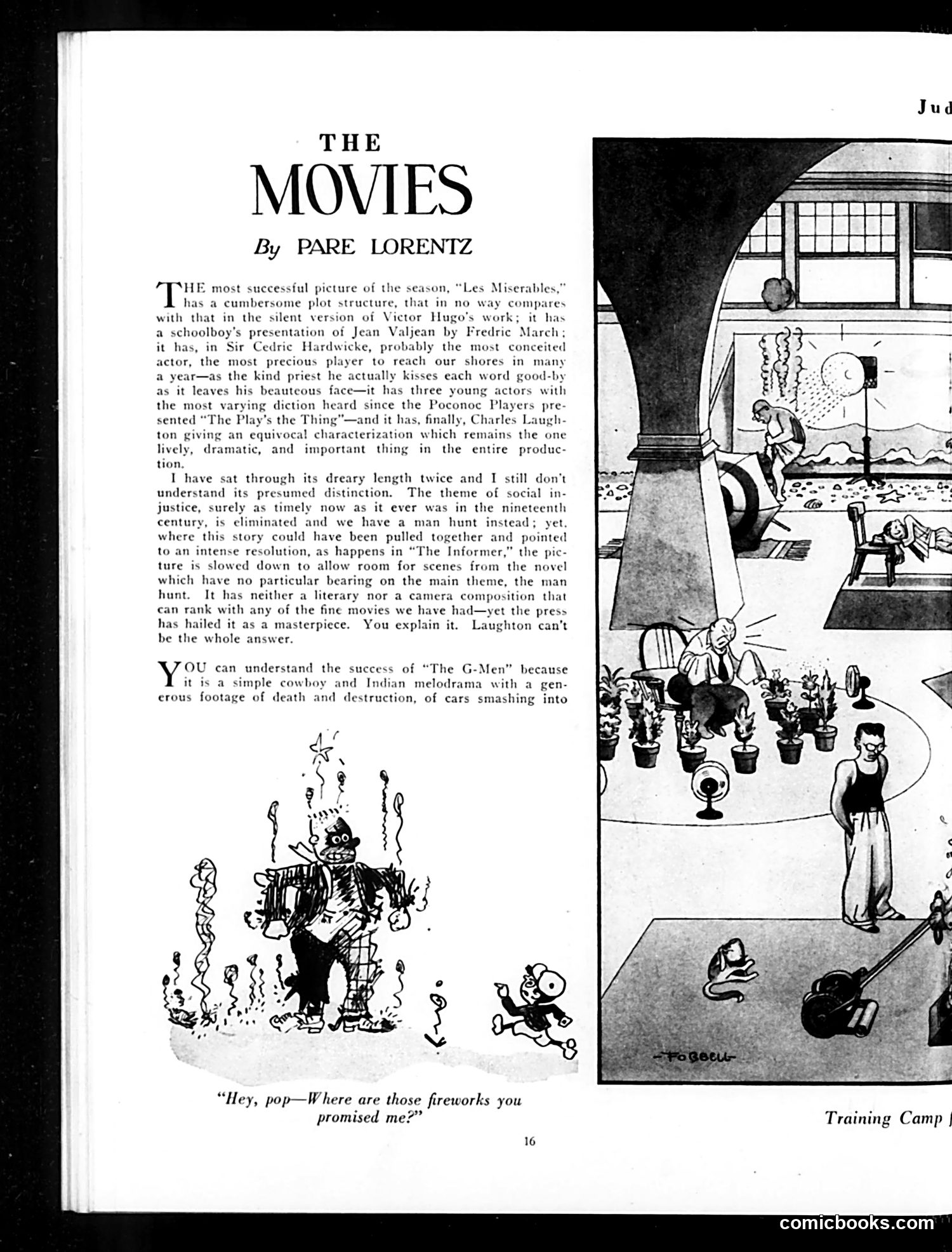
A restored page from Judge, 1935-07. Page through the whole issue in the reader above.
📄 Transcribed text from this page (OCR, searchable)
Machine-transcribed from the original scan — historical spelling and the odd misread are preserved.
THE MOVIES By PARE LORENTZ HE most successful picture of the season, “Les Miserable has a cumbersome plot structure, that in no way compares with that in the silent version of Victor Hugo’s work; it has a schoolboy’s presentation of Jean Valjean by Fredric March; it has, in Sir Cedric Hardwicke, probably the most conceited actor, the most precious player to reach our shores in many a year—as the kind priest he actually kisses each word good-by as it leaves his beauteous face—it has three your tors with the most varying diction heard since the Poconoc Players pre- sented “The Play’s the Thing"”—and it has, finally, Charles La ton giving an equivocal characterization which remains the one lively, dramatic, and important thing in the entire produc- tion, I have sat through its dreary length twice and I still don't understand its presumed distinction. The theme of social in- justice, surely as timely now as it ever was in the nineteenth century, is eliminated and we have a man hunt instead; yet. where this story could have been pulled together and pointed to an intense resolution, as happens in “The Informer,” the pic- ture is slowed down to allow room for scenes from the novel which have no particular bearing on the main theme, the man hunt. It has neither a literary nor a camera composition that can rank with any of the fine movies we have had—yet the press has hailed it as a masterpiece. You explain it. Laughton can't be the whole answer. OU can understand the success of “The G-Men” because it is a simple cowboy and Indian melodrama with a gen- erous footage of death and destruction, of cars smashing into “Hey, pop—Where are those fireworks you promised me?” Training Camp | comicbooks.com