
Judge, 1935-02 · page 3 of 36
Judge — February 1935 — page 3: what you’re looking at
What you’re looking at
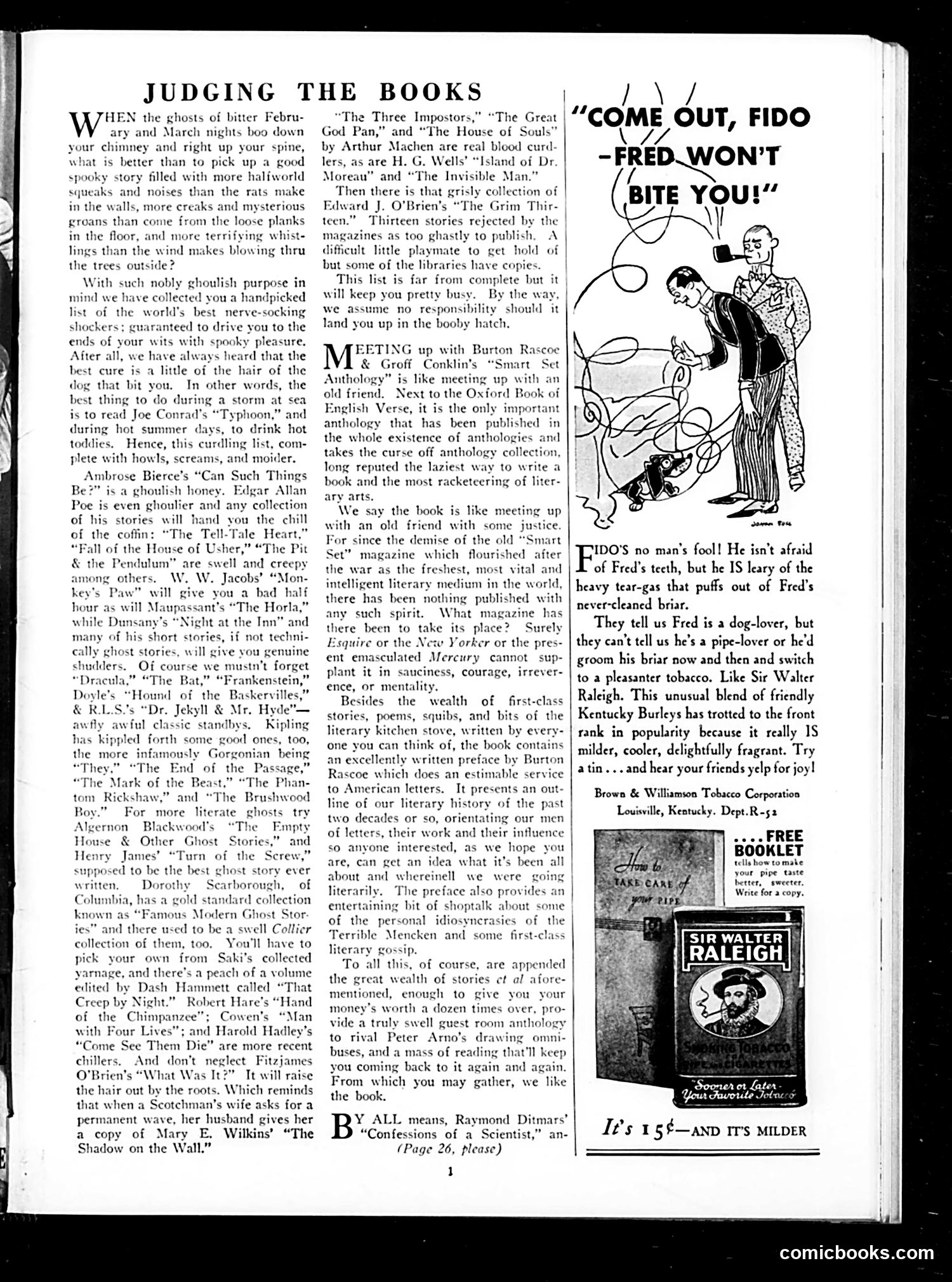
# "Come Out, Fido—Fred Won't Bite You!" This cartoon satirizes **Fred**, likely a public figure of the era, as someone so untrustworthy or menacing that even a dog fears him. The joke plays on social anxiety: the man must coax his own dog outdoors by reassuring it that "Fred" won't harm it, suggesting Fred has such a notorious reputation for aggression, deception, or untrustworthiness that he's become proverbial shorthand for danger. The accompanying text promotes **Sir Walter Raleigh tobacco**, emphasizing its reliability and popularity as a counterpoint—a product readers *can* trust, unlike the mysterious "Fred." Without additional context about who Fred specifically was in 1920s public discourse, the exact reference remains unclear, but the satire clearly mocks someone whose reputation was so poor it became a cultural byword for danger.
📄 Transcribed text from this page (OCR, searchable)
Machine-transcribed from the original scan — historical spelling and the odd misread are preserved.
JUDGING THE BOOKS HEN the ghosts of bitter Febru- ary and March nights boo down your chimney and right up your spine, what is better than to pick up a good spooky st filled with more haliworld squeaks and no} than the rats make in the walls, more creaks and mysterious groans than come from the loose planks in the floor, and more terrifying whist- lings than the wind makes blowing thru the trees outside? With such nobly ghoulish purpose in mind we have collected you a handpicked list of the world’s best nerve-socking shockers; guaranteed to drive you to the ends of your wits with spooky pleasure. After all, we have always heard that the best cure is a little of the hair of the dog that bit you. In other words, the best thing to do during a storm at sea is to read Joe Conrad's “Typhoon,” and during hot summer days, to drink hot toddies. Hence, this curdling list, com- plete with howls, screams, and moider. mbrose Bierce’s “Can Such Things Be?” is a ghoulis . Edgar Allan Poe is even ghoulier and any collection of his stories will hand you the chill of the coffin: “The Tell-Tale Heart,” “Fall of the House of Usher,” “The Pit & the Pendulum” are swell and creepy among others. W. W. Jacobs’ “Mon- key’s Paw” will give you a bad half hour as will May nt’s “The Horla,” while Dunsany’s “Night at the Inn” and many of his short stories, if not techni- cally ghost stories, will give you genuine shudders. Of course we mustn't forget “Dracula,” “The Bat,” “Frankenstein Doyle’s “Hound of the Baskerville S's “Dr. Jekyll & Mr, Hyde"— y awful classic standbys. Kipling kippled forth some good ones, too, the more infamously Gorgonian being y.” “The End of the Passage,” st,” “The Phan- a The Brushwood r more literate ghosts try Black “The Empty & Other Ghost ” and ry James’ “Turn of 1 to be the best ¢ Dorothy Alg House Her sup written, Columbia, h rnon host story ever of idard collection known as lern Ghost Stor: nd there used to be a swell Collier collection of them, too, You'll have to pick your own from Saki’s collected . and there's a peach of a volume Dash Hammett called “That ight.” Robert Hare's “Hand of the Chimpanzee”; Cowen’s “Man with Four Lives”; and Harold Hadley’s “Come See Them Die” are more recent chillers. And don’t neglect Fitzjames O'Brien’s “What Was It?” It will raise the hair out by the roots. Which reminds that when a Scotchman’s wife asks for a permanent wave, her husband gives her a copy of Mary E. Wilkins’ “The Shadow on the Wall.” Scarborough, “The Three Impostors,” “The Great God Pan,” and “The House of Souls” by Arthur Machen are real blood curd- lers, as are H. G. Wells’ Moreau” and “The Invisible Man.” Then there is that grisly collection of Edward J. O'Brien’s “The Grim Thir- Thirteen stories rejected by the azines as too ghastly to publish, A difficult little playmate to get hold of | but some of the libraries have copies. This list is far from complete but i will keep you pretty busy. By the wa we assume no responsibility should it land you up in the booby hatch. EETING up with Burton Rascoe & Groff Conklin’s Anthology” is like meeting v old friend. Next to the Oxford Book English Verse, it is the only important anthology that has been published in the whole existence of anthologies and takes the curse off anthology collection, long reputed the laziest way to wri book and the most racketeering of 1i ary arts, We say the book is like meeting up with an old friend with some justice. For since the demise of the old “Smart Set” magazine which flourished after the war as the freshest, most vital and intelligent literary medium in the world, there has been nothing published with any such spirit. What magazine h, there been to take its plac Surely Esquire or the New Yorker or the pri ent emasculated Mercury cannot sup- plant it in sauciness, courage, irrever- ence, or mentality. Besides the wealth of first-class stories, poems, squibs, and bits of the literary kitchen stove, written by every- one you can think of, the book contains an excellently written preface by Burton Rascoe which does an estimable service to American letters. It presents an out- line of our literary history of the past two decades or so, orientating our men of letters, their work 3 so anyone interested, are, can get an idea w about and whereinell literarily. The pr entertaining bit of shoptalk about of the personal idiosyncrasies Terrible Mencken and some firs literary gossip. To all this, of course, d their influence we hope you we were goin; ce also provides are appended the great wealth of stories ct al afore- | mentioned, enough to give you your money’s worth a dozen times over, pro- vide a truly swell guest room anthology to rival Peter Arno’s drawing buses, and a mass of reading that'll keep you coming back to it again and again. From which you may gather, we like the book. omni- Y ALL means, Raymond Ditmars’ “Confessions of a Scientist,” an- (Page 26, please) 1 “Island of Dr. | at it’s been all | | /\ / “COME OUT, FIDO -FRED_WON'T BITE YOU!” IDO'S no man’s fool! He isn’t afraid | LL of Fred's teeth, but he IS leary of the heavy tear-gas that puffs out of Fred’s never-cleaned briar. They tell us Fred is a dog-lover, but they can’t tell us he’s a pipe-lover or he'd groom his briar now and then and switch to a pleasanter tobacco. Like Sir Walter Raleigh. This unusual blend of friendly Kentucky Burleys has trotted to the front rank in popularity because it really IS milder, cooler, delightfully fragrant. Try atin... and hear your friends yelp for joy! Brown & Williamson Tobacco Corporation Louiwille, Kentucky. Dept.R-52 +++. FREE BOOKLET tells how to make your pipe taste better, sweeter. Write for a copy. “Sooner or Later Your Favorite Jotacs Ie’s 15#—anp rs MILDER comicbooks.com