
Judge, 1935-01 · page 27 of 40
Judge — January 1935 — page 27: what you’re looking at
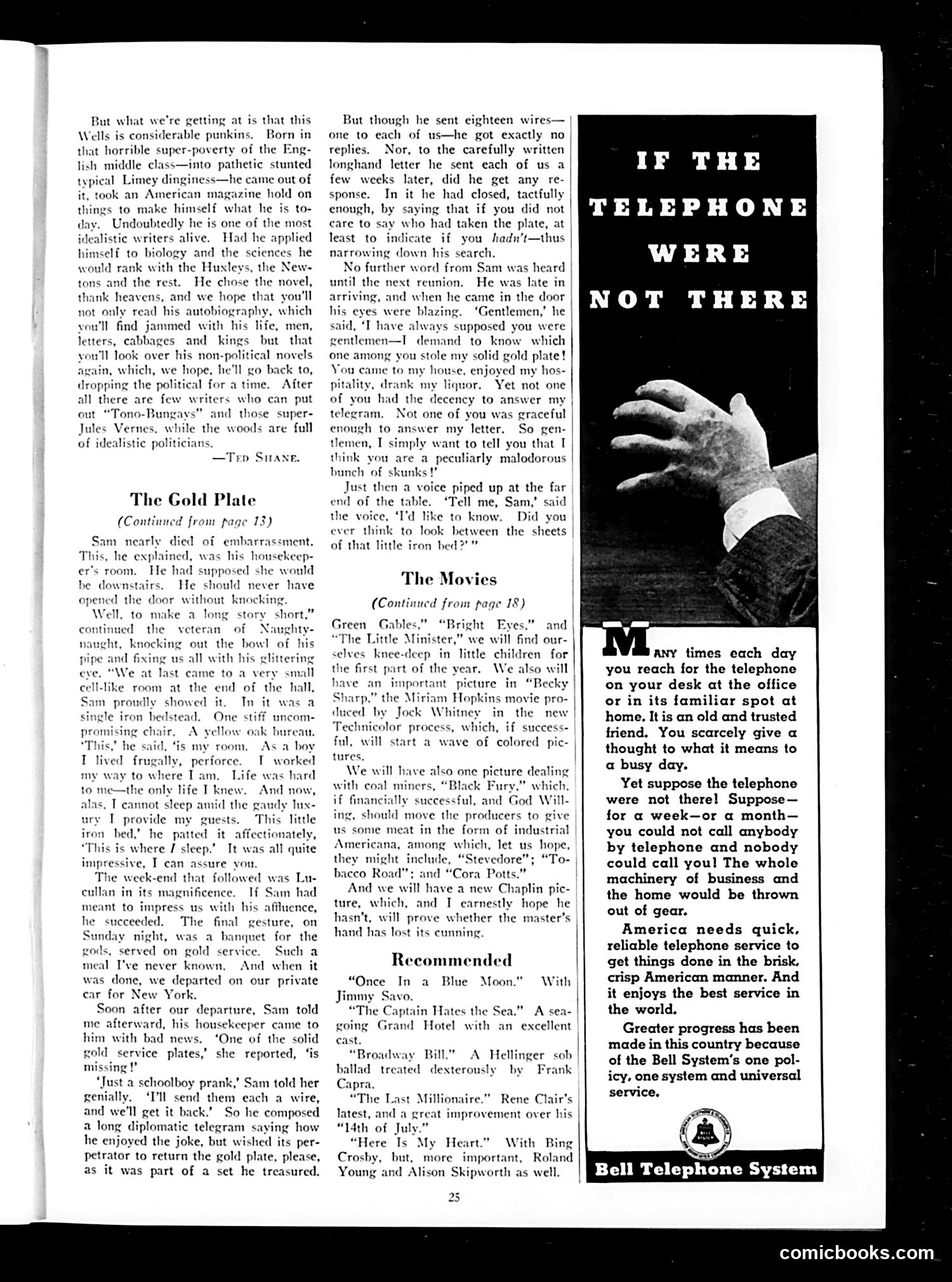
A restored page from Judge, 1935-01. Page through the whole issue in the reader above.
📄 Transcribed text from this page (OCR, searchable)
Machine-transcribed from the original scan — historical spelling and the odd misread are preserved.
But what we're getting at is that this Wells is considerable punkins. Born in that horrible super-poverty of the Eng- lish middle class—into pathetic stunted typical Limey dinginess—he came out of it, took an American magazine hold on things to make himself what he is to- Jay. Undoubtedly he is one of the most idealistic writers alive. Had he applied himself to biology and the sciences he would rank with the Huxleys, the New- J the rest. He chose the novel, thank heavens, and we hope that you'll tons not only read his autobiography, which you'll find jammed with his life, men, letters, cabbages and kings but that over his non-political novels you'll look gain, which, we hope, he'll go to, dropping the political for atime. After all there are few writers who put out “Tono-Bungays” and those super- Jules Vernes, while the woods are full of idealistic politicians. Teo SHANE. The Gold Plate (Continued from page 13) Sam nearly died of This, he explained, w er’s room. be downst. embarrassment. his housekeep- He had supposed she would airs. He should never have door without knocking Well, to make a long story. short,” continued the veteran of Naught t, knocking out the bowl of hi nd fixing us all with his glittering We at last came to a very small like room at the end of the hall. m proudly showed it. Tn it was a i d. One stiff uncom- A yellow oak bureau. . aid, ‘is my room. As a boy lived frugally, perforce. IT worked my way to where Tam. Life was hard to me—the only life I knew. And now, T cannot sleep amid the gaudy lux- ury I provide my guests. This little i bed,’ he patted it affectionately, ‘This is where J sleep.’ It was all quite impressive, I can assure you. e week-end that followed was Lu- cullan in its magnificence. If Sam had meant to impress us with his affluence, he succeeded. The final gesture, on Sunday night, was a banquet for the s, served on gold service. Such a meal I've never known. And when it was done, we departed on our private car for New York. Soon after our departure, Sam told me afterward, his housekeeper came to him with bad news. ‘One of the solid gold service plates,’ she reported, ‘is missing !" ‘Just a schoolboy prank,’ Sam told her genially. ‘I'll send them each a wire, and we'll get it back.’ So he composed a long diplomatic telegram saying how he enjoyed the joke, but wished its per- petrator to return the gold plate, please, as it was part of a set he treasured, opened 1 alas, But though he sent eighteen wires— one to each of us—he got exactly no replies. longhand letter he sent each of us a few weeks later, did he get any re sponse. In it he had closed, tactfully enough, by saying that if you did not care to say who had taken the plate, at least to indicate if you hadn’t—thus narrowing down his search. No further word from Sam was heard until the next reunion. He was late in arriving, and when he came in the door his eyes were blazing. ‘Gentlemen,’ he said, ‘I have always supposed you were gentlemen—I_ demand to know which one among you stole my solid gold plate! You came to my house, enjoyed my hos- pitality, drank my liquor. Yet not one of you had the decency to answer my telegram. Not one of you was graceful enough to answer my letter. So gen- tlemen, T simply want to tell you that I | think you are a peculiarly malodorous bunch of skunks!’ Just then a voice piped up at the far end of the table. ‘Tell me, Sam,’ said the voice, ‘I'd like to know. Did you ever think to look between the sheets of that little iron bed?” The Movies (Continued from page 18) Green Gable “Bright Eyes,” “The Little Minister,” we will find our- selves knee-deep in little children for the first part of the year. have an portant picture in “Becky Sharp,” the Miriam Hopkins movie pro- ed by Jock Whitney in the new Technicolor process, which, if success- ful, will start a wave of colored pic- tures, We will have also one picture dealing with coal miners, “Black Fury,” which, if financially successful, and God W: ing, should move the producers to give us some meat in the form of indust Americana, among which, let us hope, they might include, “Stevedore”; “To- bacco Road"; and “Cora Potts. And we will have a new Chaplin pic- ture, which, and I earnestly hope he hasn't, will prove whether the master’s hand has lost its cunning. Recommended “Once In a Blue Jimmy Savo. “The Captain Hates the § going Grand Hotel with Moon.” = With A sea- excellent an cast. “Broadway Bill.” A Hellinger sob | ballad treated dexterously by | Frank Capra. “The Last Millionaire.” Rene Clair’s est, and a great improvement over his 4th of July.” “Here Is My Heart.” With Bing Crosby, but, more important, Roland Young and Alison Skipworth as well. Nor, to the carefully written | and | We also will | IF THE TELEPHONE WERE NOT THERE any times each day you reach for the telephone on your desk at the office or in its familiar spot at home. It is an old and trusted friend. You scarcely give a thought to what it means to a busy day. Yet suppose the telephone were not there! Suppose— for a week—or a month— you could not call anybody by telephone and nobody could call you! The whole machinery of business and the home would be thrown out of gear. America needs quick, reliable telephone service to get things done in the brisk, crisp American manner. And it enjoys the best service in the world. Greater progress has been made in this country because of the Bell System’s one pol- icy, one system and universal service, comicbooks.com