
Judge, 1935-01 · page 26 of 40
Judge — January 1935 — page 26: what you’re looking at
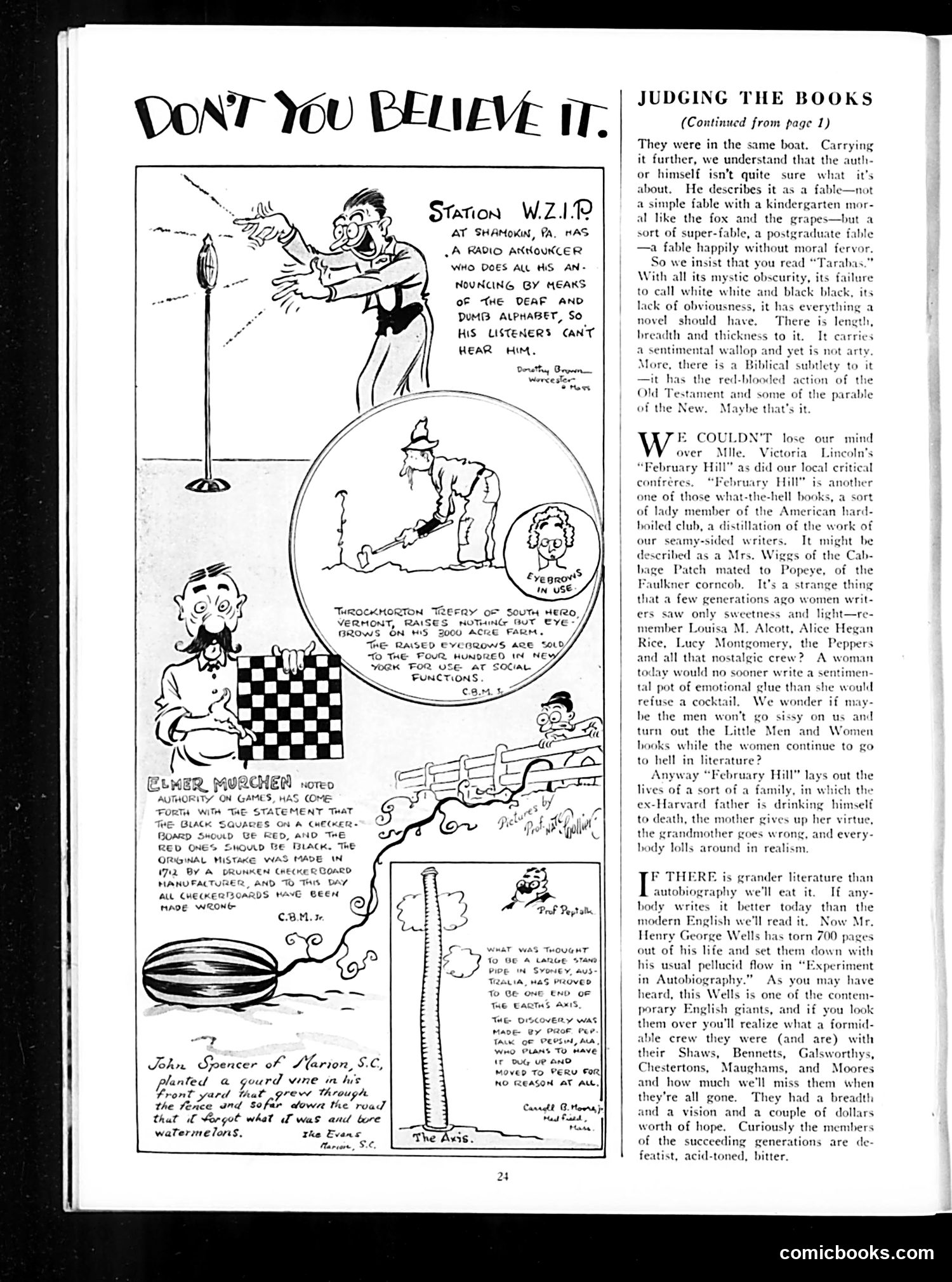
A restored page from Judge, 1935-01. Page through the whole issue in the reader above.
📄 Transcribed text from this page (OCR, searchable)
Machine-transcribed from the original scan — historical spelling and the odd misread are preserved.
LMER, MURCHEN sored AUTHORITY ON GAMES, HAS COME FORTH WITH THE STATEMENT THAT Te GIACK SQUARES ON A CHECKER BOARD SeouD GE RED, AND We RED ONES SHOULD BE BLACK. THE ORGINAL MISTAKE WAS MADE IN KEN CHECKER 7 THis DAY ALL CHECKER OARDS HAVE BEEN MADE WRONE C.B.M. 3, —_y John Spencer of Sfarion, S.C, Planted @ gourd wine in his front yard that grew through the fence and Sofar down the rvad that L forgot what if was and bore watermelons, the Evans Marca, SL, VERMONT, RAISES BROWS ON HS The RAISED EYEBROWS Ace OTHE FOUR HUNDRED IM NE QQ YORK FOR USE ar SOtiAL FUNCTIONS C8.M 5 NT YOU BELIEVE tr: Station W.Z.1 AT SHAMOKIN, PA. NAS wA RADIO AXHOUKCER WHO DOES AU HIS AN- NOUNCING GY MEAKS of THE DEAF AND DUMB ALPHABET, So HIS LISTENERS CANT HEAR HIM, Derthy Brown worcester oH NOTHING GUT CYE- 2000 ACE FARM. wD, Prof Peptalee WHAT WAS THOUGHT To BE A Lance s7aN0 PIPE IN S¥oNeY, auS- Tava, aS PROVED To Ge one THE EACTHS Axis, THe DiscovEeny was Mave @y PROF Por. TAK OF PERS, ALA, WHO PLANS TO HAVE Ir 0UG UP BNO Moved To NO REASON AT ALL, Cancel? B. Hows jr Maal uate, JUDGING THE BOOKS (Continued from page 1) They were in the same boat. Carrying it further, we understand that the auth- or himself isn’t quite sure what it’s about. He describes it as a f a simple fable with a kindergarten mor- al like the fox and the grapes—but a sort of super-fable, a postgraduate fable —a fable happily without moral fervor. So we insist that you read “Tarabas.” With all its mystic obscurity, its failure to call white white and black black, its lack of obviousness, it has everything a novel should have. There is ler breadth and thickness to it. It carr a sentimental wallop and yet is not arty More, there is a Biblical subtlety to it —it has the red-blooded action of the Old Testament and some of the parable of the New. Maybe that’s i W COULDN'T lose our mind over Mile. Victoria Lincoln’. ruary Hill” as did our local eri contréres. yruary Hill” is another one of those what-the-hell books, of lady member of the American hoiled club, a distillation of the work of our seamy-sided writers. It might be described as a Mrs. Wiggs of the Cab- bage Patch mated to Popeye, of the Faulkner corncob, It’s a strange thing that a few generations ago women writ- ers saw only sweetness and light—re- member Louisa M. Alcott, Alice Hegan Rice, Lucy Montgomery, the Peppers and all that nostalgic crew? A woman lay would ne er write a sentimen- tal pot of emotional glue than she would refuse a cocktail. We wonder if m: he the men won't go sissy on us and turn out the Little Men and Women hooks while the women continue to go to hell in literature? Anyway “February Hill” | lives of a sort of a family, in ch the ex-Harvard father is drinking himself to death, the mother gives up her virt ble—not soor ys out the the grandmother goes wrong, and every- body lolls around in realism. FE. is grander literature than raphy we'll eat it. If any- body writes it better today than the modern English we'll read it. Now Mr. Henry George Wells has torn 700 pages out of his life and set them down with his usual pellucid flow in “Experiment in Autobiography.” As you may have heard, this Wells is one of the contem- porary English giants, and if you loo! them over you'll realize what a formid- able crew they were (and are) with their Shaws, Bennetts, Galsworthys, Chestertons, Maughams, and Moores and how much we'll miss them when they’re all gone. They had a breadth and a vision and a couple of dollars worth of hope. Curiously the members of the succeeding generations are de- featist, acid-toned, bitter. comicbooks.com