
Judge, 1933-09 · page 22 of 36
Judge — September 1933 — page 22: what you’re looking at
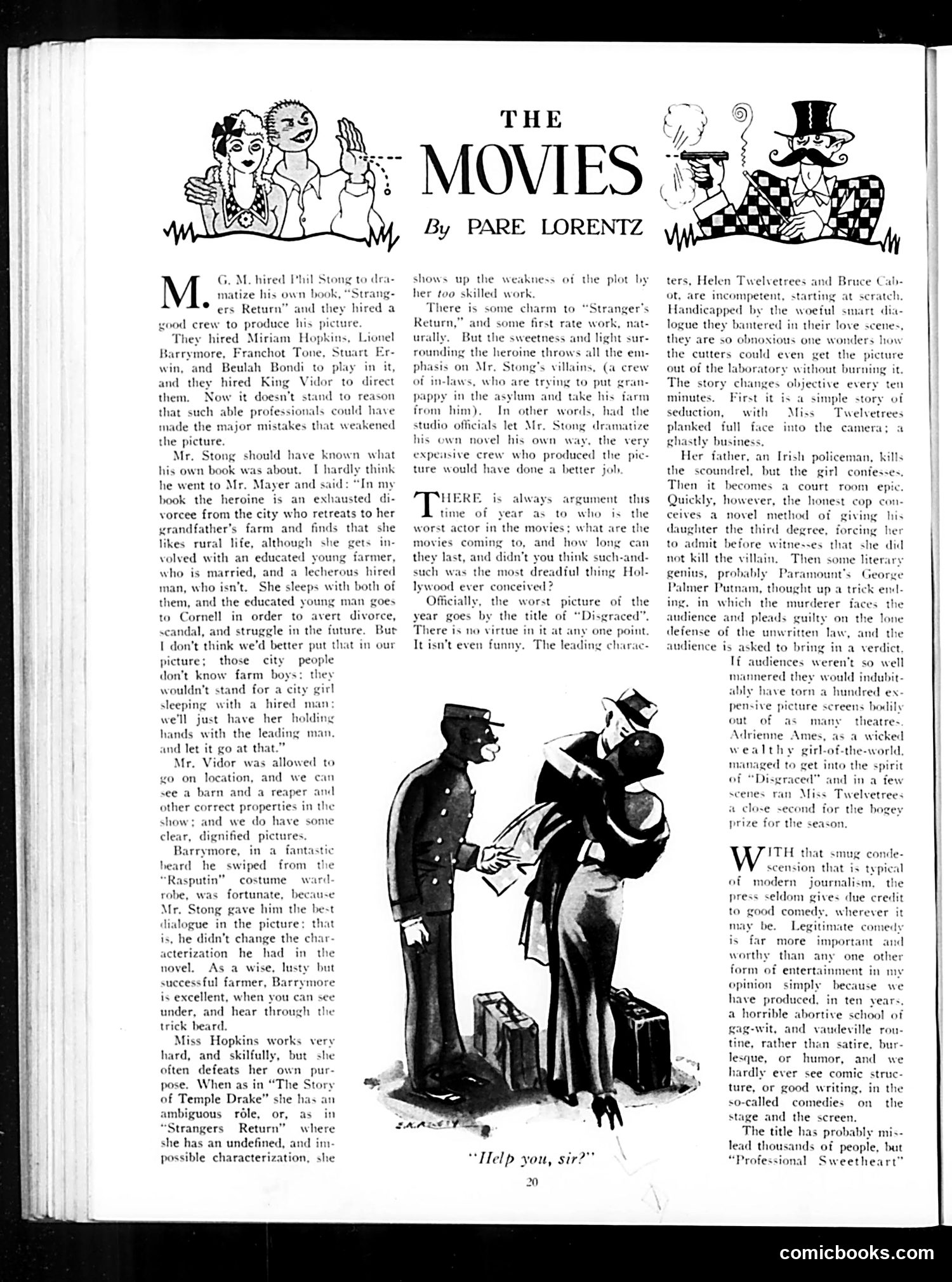
A restored page from Judge, 1933-09. Page through the whole issue in the reader above.
📄 Transcribed text from this page (OCR, searchable)
Machine-transcribed from the original scan — historical spelling and the odd misread are preserved.
G. M. hired 1" matize his own book, “Strang- ers Re od crew to produce hi They hired Miriam Hopkins, Lionel Barrymore, Franchot Tone, Stuart Er- win, and Beulah Bondi to play in it, and they hired King Vidor to direct them. Now it doesn’t stand to reason that such able professionals could have made the major mistakes that weakened the picture. Mr. Stong should have known what his own book was about. [ hardly think he went to Mr. Mayer and said: “In my book the heroine is an exhausted di- vorcee from the city who retreats to her grandfather's farm and finds that she likes rural life, although she gets in- volved with an educated young farmer, who is married, and a lecherous hired man, who isn’t. She sleeps with both of them, and the educated young man goes to Cornell in order to avert divorce, scandal, and struggle in the future. Bur I don’t think we'd better put that in our picture; those city people don’t know farm boys: wouldn’t stand for a city sleeping with a hired man we'll just have her hok hands with the leading man and let it go at that.” Mr. Vidor was allowed to go on location, and we can Stong to dra- arn” and they hired a picture. see a barn and a reaper and other correct properties in the show; and we do ha clear, dignified pictures Barrymore, in a fantast heard he swiped from the “Rasputin” costume robe, was fortunate, because Mr. Stong gave him the best dialogue in the picture: that is, he didn’t change the char- acterization he had in the novel. As a wise, lusty but successful farmer, Barrymore is excellent, when you can see under, and hear through the trick beard. Miss Hopkins works very hard, and skilfully, but she often defeats her own pur- pose. When as in “The Story of Temple Drake” she has an ambiguous role, or, as in trangers Return” where she has an undefined, and im- possible characterization, she e some ward. shows up the weakness of the plot by her too skilled work, There is some charm to “Stranger’s Return,” and some first rate work, nat- urally, But the sweetness and light sur- rounding the heroine throws all the em- phasis on Mr, Stong’s villains, (a crew of in-laws, who are trying to put gran- py in the asylum and take his farm from him). In other words, had the studio officials let Mr. Stong dramatize his own novel his own way, the very expensive crew who produced the pic- ture would have done a better job HERE rgument this time of year as to who the worst actor in the movies; what are the movies coming to, and they last, and didn’t you think such such was the most dreadful thing lywood ever conceived? Officially, the worst picture of the goes by the title of “Dis; Phere is no virtue in it at any ¢ It isn’t even funny is always how long can and- Hol- aced”, ne point year The leading charac- “Help you, sir? 20 ters, Helen Twelvetrees and Bruce Cab- ot, are incompetent, starting at scratch. Handicapped by the woeful smart dia- logue they bantered in their love scene>, they are so obnoxious one wonders how the cutters could even get the picture out of the laboratory without burning it. The story changes objective every ten minutes. First it is a simple story of with = Miss Twelvetrees planked full face into the camera; a ghastly business, Her father, an [rish policeman, kills the scoundrel, but the girl confes Then it court room epic. Quickly, however, the honest cop con- ceives a seduction, becomes novel method of giving his daughter the third degree, forcir to admit before witnesses that not kill the villain. genius, probably Paramount's George Palmer Putnam, thought up a trick end- ing, in which murderer audience and p! s guilty on ¢ defense of the unwritten law, and the wudience is asked to bring in a verdict li audiences weren't so well 2 her she did Then some literary faces the e lone mannered they would indubit- ably have torn a hundred ex- pensive picture screens bodily of as many theatres Adrienne Ames, as a wicked wealthy girl-of-the-world, managed to get into the spirit of “Disgraced” and in a few scenes ran Miss Twelvetrees at close second for the bogey prize for the season. ITH that smug ec scension that is typical of modern journalism, the press seldom gives due credit to good comedy, wherever it may be. Legitimate comedy is far more important and worthy than any one other form of entertainment in my inion simply because we have produced. in ten years, a horrible abortive school of gag-wit, and vaudeville rou- tine, rather than satire, bur- lesque, or humor, and we hardly ever see comic struc- ture, or good writing, in the so-called comedies on the stage and the screen, The title has probably mis- lead thousands of people, but “Professional Sweetheart” comicbooks.com