
Judge, 1932-01-23 · page 18 of 36
Judge — January 23, 1932 — page 18: what you’re looking at
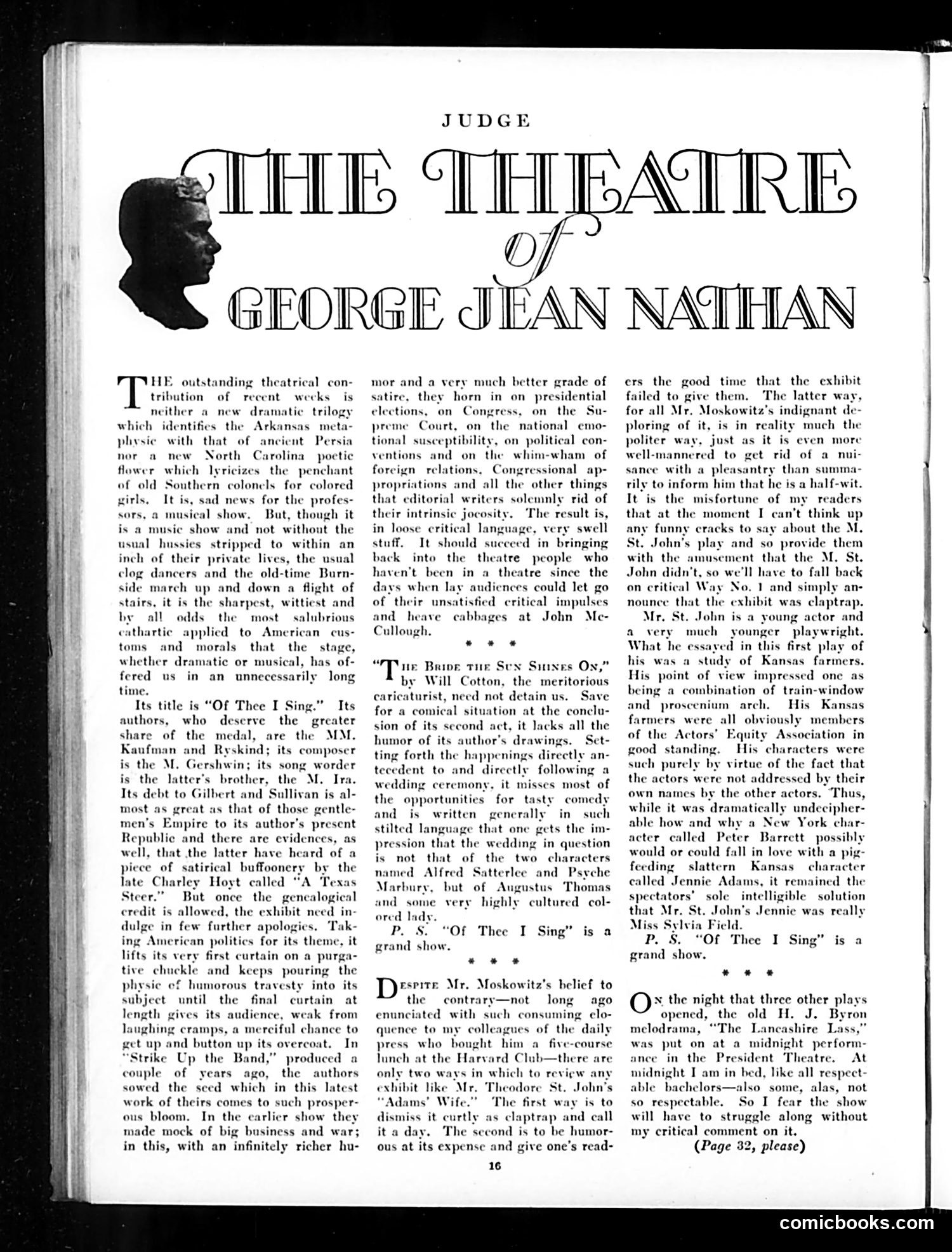
A restored page from Judge, 1932-01-23. Page through the whole issue in the reader above.
📄 Transcribed text from this page (OCR, searchable)
Machine-transcribed from the original scan — historical spelling and the odd misread are preserved.
JUDGE B THEATRE GEORGE JEAN NATHAN HE outstanding theatrics tribution of recent neither a new dramatic trilogy identifies the Arkansas meta- physic with that of ancient Persia nor a new North ‘lina poctic flower which lyricizes the penchant of old Southern colonels for colored girls. It is, sad news for the profes- sors, a musical show. But, though it is a music show and not without the usual hussies stripped to within an inch of their private lives, the usual clog dancers and the old-time Burn- side march up and down a flight of airs, it is the sharpest, wittiest and by all odds the most salubrious cathartic applied to American cus- toms and morals that the stage, whether dramatic or musical, has of- fered us in an unnecessarily long time. Its title is “Of Thee I Sing.” Its authors, who deserve the greater share of the medal, are the MM. afman and Ryskind; its composer the M. Gershwin; its song worde the latter’s brother, the M. Ir: Its debt to Gilbert and Sullivan is al- most as great as that of those gentle- men’s Empire to its author's present Republic and there are evidences, as |, that the latter e heard of a piece of satirical buffoonery by the late Charley Hoyt called Steer.” But once the ge credit is allowed, the exhi dulge in few further apologies. ing American polities for its theme lifts its very first curtain on a purga- tive chuckle and keeps pouring the physic ef humorous travesty into its subject until the final curtain at length gives its audience, weak from laughing cramps, a merciful chance to get up and button up its overcoat. In “Strike Up the Band,” produced a couple of years ago, the authors sowed the seed which in this latest work of theirs comes to such prosper- ous bloom. In the carlier show they made mock of big business and war; in this, with an infinitely richer hu- which mor and a very much better grade of they horn in on presidential on Congress, on the Su- Court, on the national emo- tional susceptibility, on political con- ventions and on the whim-wham of foreign relations. Congressional ap- propriations and all the other things that editorial writers solemnly rid of their intrinsic jocosi The result is, in loose critical language, very swell stuff. It should succeed in bringing back into the theatre people who haven't been in a theatre since the days when lay audiences could let go of their unsatisfied critical impulses and heave cabbages at John Me- Cullough, preme 8 # ur Brive tire Sce~ Sit by Will Cotton, the me: caricaturist, need not detain us. Save for a comical situation at the conclu- sion of its second act, it lacks all the humor of its author's drawings. Set- ting forth the happenings directly an- tecedent to and directly following a wedding ceremony, it misses most of the opportunities for tasty comedy and is written generally in’ suc stilted language that one gets the im- pression that the wedding in question is not that of the two characters named Alfred Satterlee and Psyche Marbury, but of Augustus Thomas and some very highly cultured col- ored lady P. S. “Of Thee I Sing” is a grand show. ** * Espite Mr. Moskowitz’s belief to the contrary—not long ago ated with such consuming elo- to my colleagues of the daily press who bought him a_ five-course lunch at the Harvard Club—there are only two ways in which to review any exhibit like Mr. Theodore St. John’s “Adams’ Wife.” The first way is to dismiss it curtly as claptrap and call The second is to be humor- ous at its expense and give one’s read- 16 ers the good time that the exhibit failed to give them. The latter w for all Mr. Moskowitz’s indignant de- ploring of it, is in reality much the politer way, just as it is even more well-mannered to get rid of a nui- sance with a pleasantry than summa- rily to inform him that he is a half-wit. It is the misfortune of my readers that at the moment I can’t think up any funny cracks to say about the M. St. John’s play and so provide them with the amuse t the M. St. John didn't, fall back on crit 3 nd simply an- nounce that the exhibit was claptrap. Mr. St. John is a young actor and a very much younger playwright. What he es 1 in this first play of his was a study of Kansas farmers. His point of view impressed one as being a combination of train-window nd proscenium arch. His Kansas farmers were all obviously members Actors’ Equity Association in ing. His characters were such purely by virtue of the fact that the actors were not addressed by their own names by the other actors. Thus, while it was dramatically undeciphe able how and why a New York cl acter called Peter Barrett possibly would or could fall in love with a pig- feeding slattern. Kansas character called Jennie Adams, it remained the spectators’ sole intelligible solution that Mr. St. John’s Jennie was really Miss Sylvia Field. P. S. “Of Thee I Sing” is a grand show. * * # O ‘ the night that three other plays opened, the old H. J. Byron melodrama, “The Lancashi “ was put on at a midnight perform- nee in the President Theatre. At midnight I am in bed, like all respect- able bachelors—also some, alas, not so respectable. So I fear the show will have to struggle along without my critical comment on it. (Page 32, please) comicbooks.com