
Judge, 1932-01-23 · page 15 of 36
Judge — January 23, 1932 — page 15: what you’re looking at
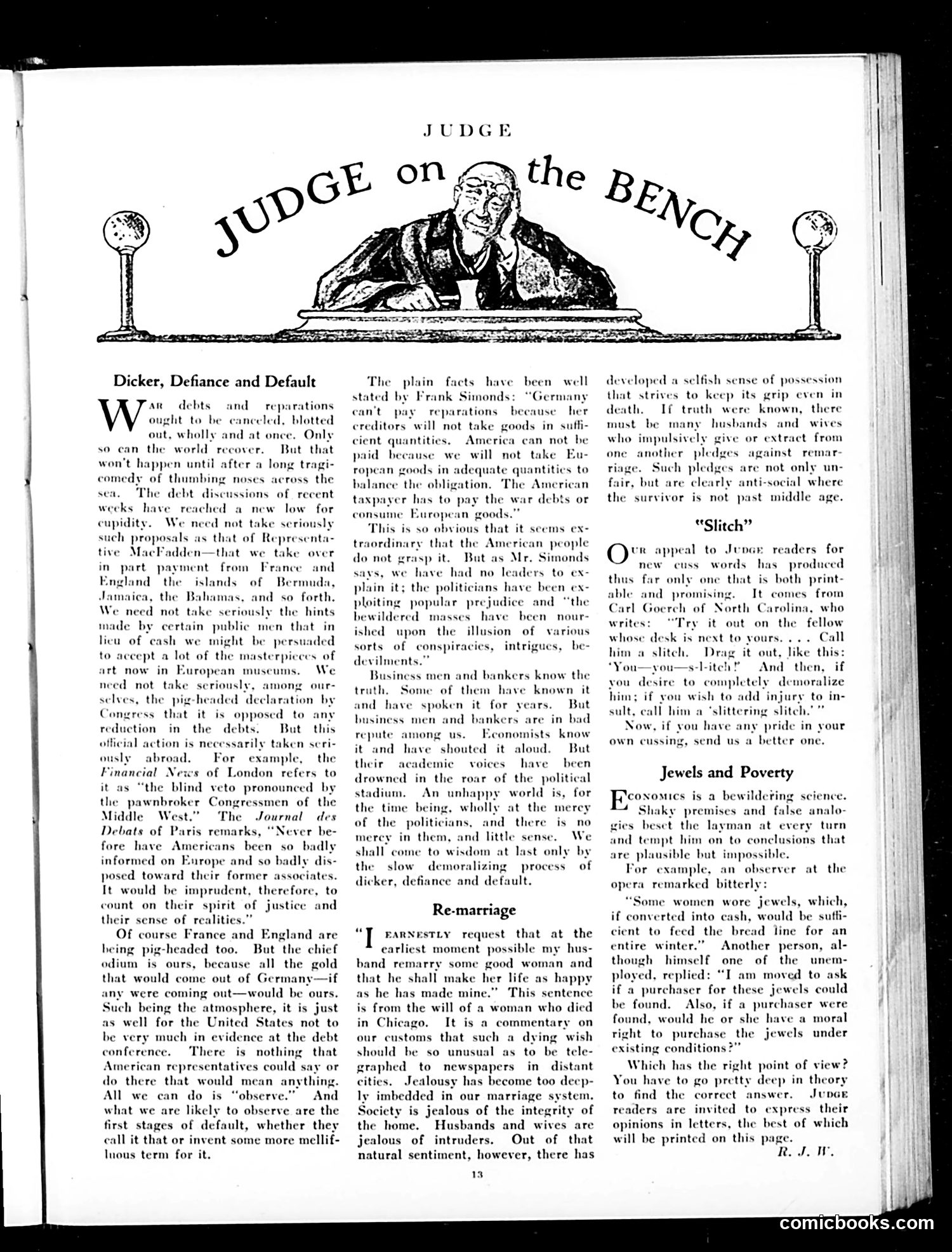
A restored page from Judge, 1932-01-23. Page through the whole issue in the reader above.
📄 Transcribed text from this page (OCR, searchable)
Machine-transcribed from the original scan — historical spelling and the odd misread are preserved.
JUDGE Dicker, Defiance and Default an debts id reparations ought to be canceled, blotted out, wholly and at once. Onl so can the world recover. But t won't happen until after a long tragi- comedy of thumbing noses across the sea. The debt discussions of recent weeks have reached a new low for cupidity. We need not take seriously such proposals as that of Represer tive MacFadden—that we payment from France the islands of Bermud the Bahamas, and so forth. need not take seriously the hints made by certain public men that in lieu of cash we might be persuaded to accept a lot of the masterpicces of irt now in E We not take seriously, among our- selves, the pig-headed declaration by Congress that it is opposed to any reduction in the debts. But — this official action is necessarily taken seri- ously abroad. For example, the Financial News of London refers to it as “the blind veto pronounced by the pawnbroker Congressmen of the Middle West.” The Journal des Debats of Paris remarks, “Never be- fore have Americans been so badly informed on Europe and so badly dis- posed toward their former assoc It would be imprudent, therefore, to count on their spirit of justice and their sense of realities.” Of course France and England are being pig-headed too. But the chief odium is ours, because all the gold that would come out of Germany—if any were coming out—would be ours. Such being the atmosphere, it is just as well for the United States not to be very much in evidence at the debt conference. There is nothing that American representatives could say or do there that would mean anything. All we can do is And what we are likely to observe are the first stages of default, whether they call it that or invent some more mellif- uous term for take over nd iropean museums. “observe. The plain facts have been well stated by Frank Simonds: “Germany can't’ pay reparations because her creditors will not nt quantities. paid be ake goods in sufli- America can not be will not take Eu- ropean goods in adequate quantitics to balance the obligation. The American taxpayer has to pay the war debts or consume European goods.” isc We This is so obvious that it seems ex- traordinary that the American people do not grasp it. But as Mr. Simonds says, we have had no leaders to ex- plain it; the politicians have been ex- ploiting popular prejudice and “the bewildered masses have been ished the illusion of sorts of conspiracies, devilments.” Business men and bankers know the truth, Some of them have known it and have spoken it for years. But nd bankers are in bad repute among us. Economists know it and have shouted it aloud. But their demic voices have been drowned in the roar of the political stadium. An unhappy world is, for the time being, wholly at the merey of the politicians, and there is no nour- upon various intrigues, be- business men mercy in them, and little sense. We shall come to wisdom at last only by the slow demoralizing process of dicker, defiance and default. Re-marriage “7 EARNESTLY request that at the earliest moment possible my hus- band remarry some good woman and that he shall make her life as happy as he has made mine.” This sentence is from the will of a woman who died in Chicago. It is a commentary on our customs that such a dying wish should be so unusual as to be tele- graphed to newspapers in distant cities. Jealousy has become too decp- ly imbedded in our marriage system. Socie jealous of the integrity of the home. Husbands and wives are jealous of intruders, Out of that natural sentiment, however, there has 13 developed a selfish sense of possession that strives to keep its grip even in death, If truth were known, there must be many husbands and wives who impulsively give or extract: from one against remar- riage. are not only un- fair, but are y anti-social where the survivor is not past middle age. “Slitch” Rk appeal to Junge readers for O new words has produced thus far only one that is both print- cuss able and promising. It comes from Carl Goerch of North Carolina, who writes: ry it out on the fellow whose desk is next to yours. Call him a slitch. Drag it out, like this: *You—you—s-liteh! And. then, you desire to completely demoralize him; if you wish to add injury to in- sult, cali him a ‘slittering sliteh.’” ow, if you have } ny pride in your own cussing, send us a better one. Jewels and Poverty conomics is a bewildering science. Shaky premises and false analo- gies beset the layman at every turn and tempt him on to conclusions that are plausible but impossible. For example, an observer at opera remarked bitter! “4 the “Some women wore jewels, which, if converted into cash, would be sutffi- cient to feed the bread line for an entire winter.” Another person, al- though himself one of the unem- ployed, replied: “I am moved to « if a purchaser for these jewels could be found. Also, if a purchaser were found, would he or she have a moral right to purchase the jewels under existing conditions Which has the right point of view? You have to go pretty deep in theory to find the correct answer. June readers are invited to express their opinions in letters, the best of which will be printed on this page. RSW, comicbooks.com