
Judge, 1932-01-09 · page 22 of 36
Judge — January 9, 1932 — page 22: what you’re looking at
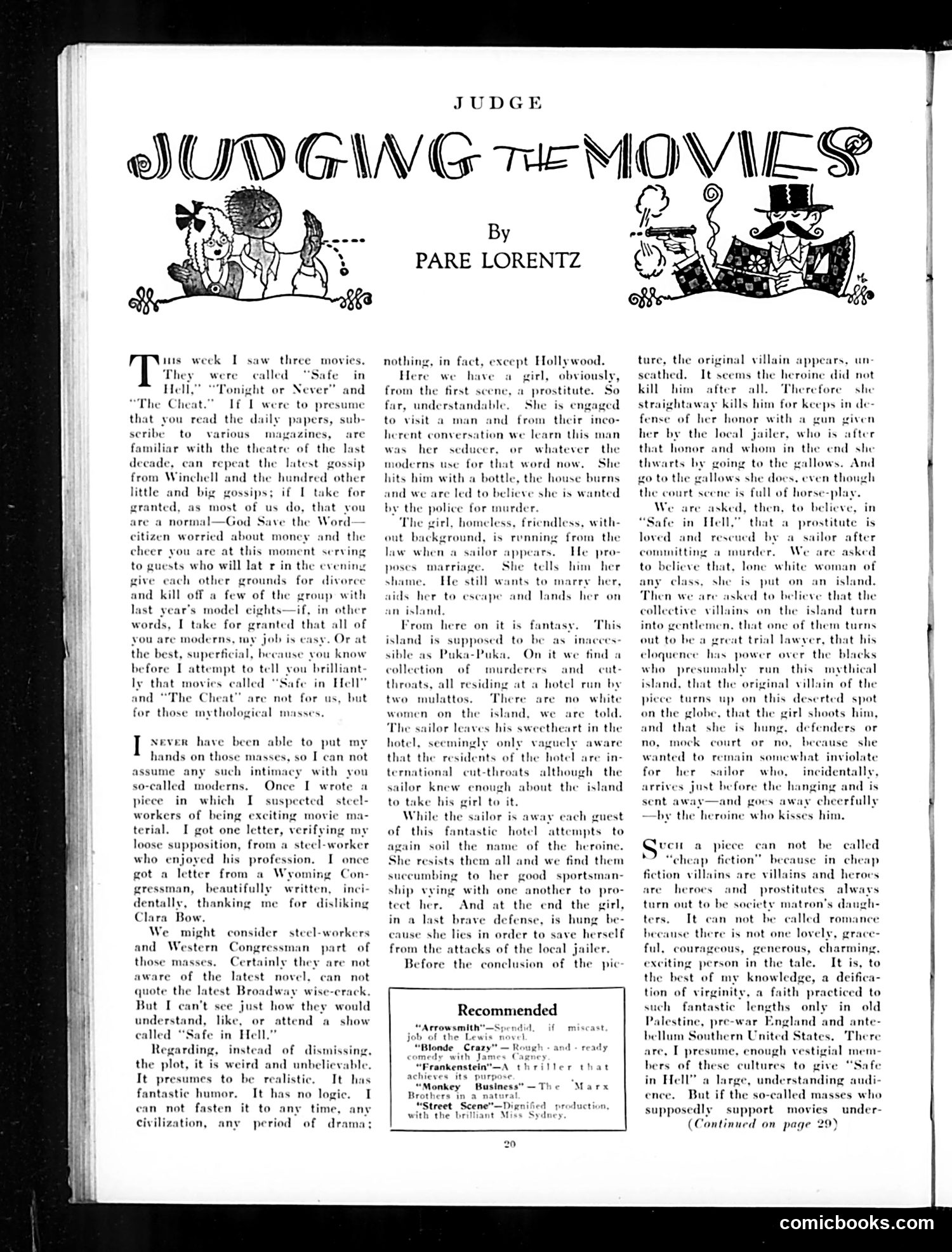
A restored page from Judge, 1932-01-09. Page through the whole issue in the reader above.
📄 Transcribed text from this page (OCR, searchable)
Machine-transcribed from the original scan — historical spelling and the odd misread are preserved.
is week IT saw three movies. | They were called “Safe i Hell,” “Tonight or Never” and “The Cheat.” If LT were to presume that you read the daily papers, sub- seribe to various m, ines, are familiar with the theatre of the last decade, can repeat the latest: gossip from Winchell and the hundred other little and big gossips; if I take for granted, as most of us do, that you are a normal—God Save the Word citizen worried about money and the cheer you are at this moment serving to guests who will lat rin the evening give cach other grounds for dive and kill off a few of the group with last year’s model cights—if. in other words, I take for granted that all of you are moderns, my job is easy. Or at the best, superficial, heeause you know before I attempt to tell vou brilliant ly that movies called “Safe in Hell” and “The Cheat’ are not for us, but for those mythological masses. I Never have been able to put my hands on those masses, so I can not assume any such intims Ned moderns. Once I wrote a in which I suspected stcel- workers of being exciting movie ma- terial. I got one letter, verifying my loose supposition, from a steel-worker who enjoyed his profession. I once got a letter from a Wyoming Con- gressman, beautifully dentally, thanking me Bow. We might and Western those masses, y with you so-c written, inci- for disliking consider stecl-workers Congressman part of Certainly they are not aware of the latest quote the novel, cannot atest Broadway wise-crack. But [ can't see just how they would understand, like, or attend a show called “Safe in Hell.” rding, instead of dismissing. the plot, it is weird and unbelievable. It presumes to be realistic. It has fantastic humor. It has no log I can not fasten it to any time, any civilization, any period of drama; JUDGE G THEM By PARE LORENTZ nothing, in fact, except Hollywood. Here we have a girl, obviously, from the first scene, a prostitute. So far, understandable. She is engaged to visit a man and from their inco- herent conversation we learn this man whatever the moderns use for that word now. She hits him with a bottle, the house burns and we are led to believe she is wanted by the police for murder. The girl, homeless, friendless, with- out background, is renning from the was her seducer, or law when a sailor appears. He pro- poses marriage. She tells him her shame. He still wants to marry her, aids her to eseape and lands her on in island. This island is supposed to be as’ inacces sible as Puka-Puka, On it we find a collection of murderers and cut- throats, all residing at a hotel run by There are no white island, we are told. he sailor leaves his sweetheart in the hotel, seemingly only vaguely aware that the residents of the hotel are in- ternational cut-throats although the sailor knew enough about the island to take his girl to it. While the sailor is away each guest of this fantastic hotel attempts to again soil the name of the heroine. She resists them all and we find them succumbing to her good sportsman- ship vying with one another to pro- tect her. And at the end the girl, in a last brave defense, is hung be- From here on it is fantasy. two mulattos. women on the cause she lies in order to save herself from the attacks of the local jailer. Before the conclusion of the pic Recommended “ Arrowsmith’ nid. f miscast. b of the Lewi Blonde Craz: comedy with James ( “Frankenstein"—A thriller that achieves its purpose “Monkey Business” — Th « Brothers in a natura “Street Scene”—Digniied with the brilliant Miss “Marx production, Sydney ov [Se ture, the original villain appears, un seathed, It seems the heroine did not kill him after all. Therefore she chtaway kills him for keeps in de- of her honor with a gun given her by the local jailer, who is after that honor and whom in the end she thwarts oing to the gallows. ¢ go to the gallows she does, even tl the court scene is full of horse-play. We are asked, then, to believe, in ‘Safe in Hell,” that a prostitute is loved and rescued by a. sailor after committing a murder. We are asked to believe that, lone white woman of any class, she is put on an island. Then we are asked to believe that the collective villains on the island turn into gentlemen, that one of them turns out to be a great trial lawyer, that his eloquence has power over the blacks who presumably run this mythical island, that the original villain of the piece turns up on this deserted spot on the globe, that the girl shoots him, and that she is hung, defenders or no, mock court or no, b “ause she wanted to remain somewhat inviolate for her sailor incidentally, arrives just before the hanging and is sent aw who, nd goes away cheerfully by the heroine who kisses him. uch a “cheap. fiction” fiction villains are villains and here are heroes and called because in cl piece can not be ‘ prostitutes always turn out to be society matron’s daugh- ters. It can not be called romance because there is not one lovely, grace- ful, cours ‘ous, generous, charming. exciting person in the tale. It is, to the best ec, a deifica- tion of v such fa Palestine, pre-w bellum Southern United $ There -, I presume, enough vestigial mem- rs of these cultures to give “Safe in Hell” a large, understanding audi- ence. But if the so-called masses who supposedly support movies under- (Continued on page 29) iced to in old nd ante- only comicbooks.com