
Judge, 1932-01-02 · page 26 of 36
Judge — January 2, 1932 — page 26: what you’re looking at
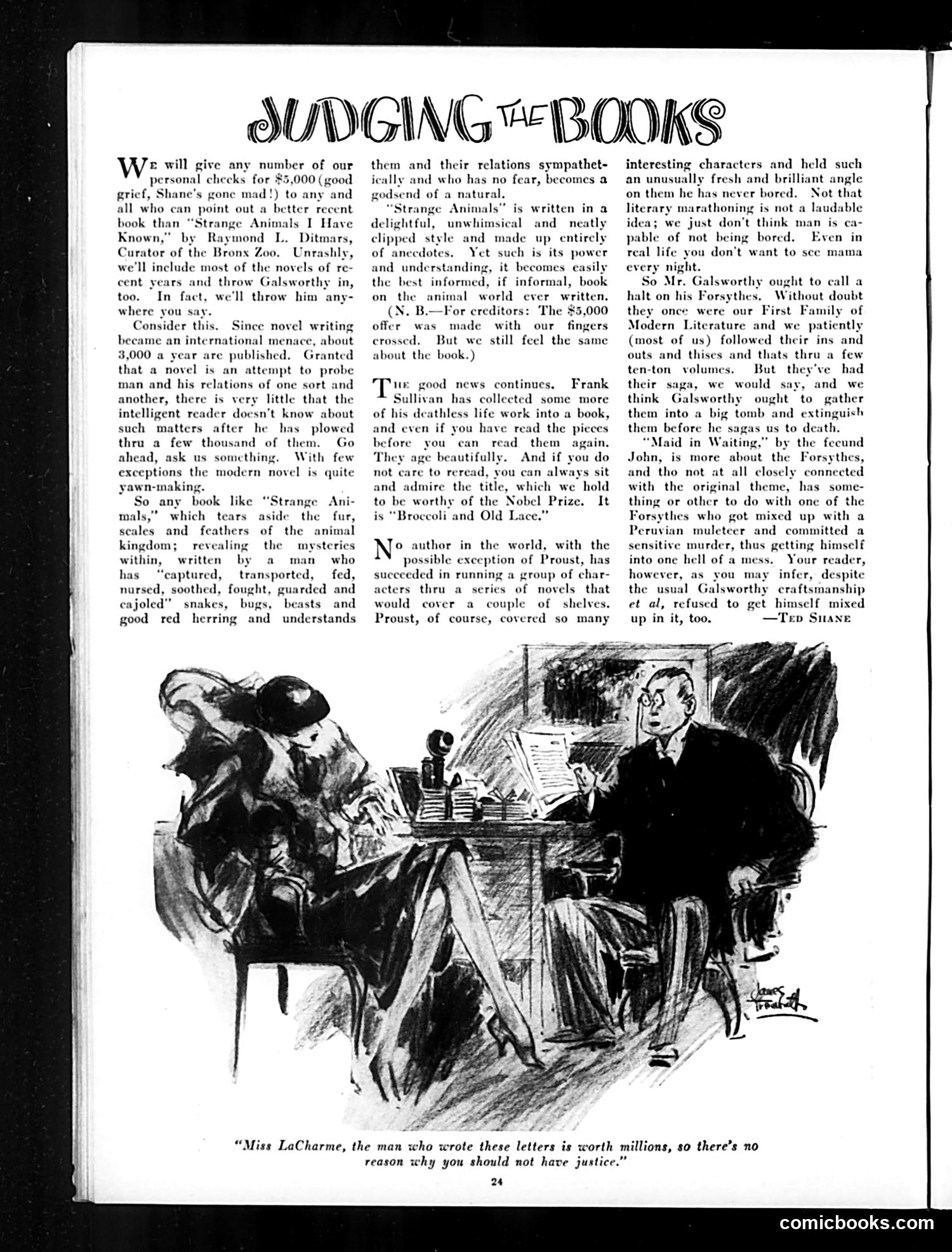
A restored page from Judge, 1932-01-02. Page through the whole issue in the reader above.
📄 Transcribed text from this page (OCR, searchable)
Machine-transcribed from the original scan — historical spelling and the odd misread are preserved.
AUDGING™ BOOK We: will give any number of our personal checks for grief, Shane’s gone mad!) to any 4 all who can point out a better recent book than “Strange Animals I Have Known,” by Raymond L. Ditmars, Curator of the Bronx Zoo. Unrashly, we'll include most of the novels of re- cent years and throw Galsworthy in, too. In fact, we'll throw him any- where you say. Consider this. Since novel writing became an international me: about 3,000 a year are published. Granted that a novel is an attempt to probe man and his relations of one sort and another, there is very little that the intelligent reader doesn't know about such matters after he has plowed thru a few thousand of them. Go ahead, ask us something. With few exceptions the modern novel is quite ing. any book which like “Strange Ani- tears aside the fur, cales and feathers of the animal ngdom; revealing the mysteries within, written by au who has rd, transported, fed, nurse , fought, guarded and cajoled” snakes, bugs, beasts and good red herring and understands them and their relations sympathet- ically and who has no fear, becomes a godsend of a natural, Strange Animals” is written in a delightful, unwhimsical and neatly clipped style and made up. entirely of anecdotes. Yet such is its power and understanding, it becomes easily the best informed, if informal, book on the animal world ever written. (N. B.—For creditors: Th offer made with our fingers crossed. But we still feel the same about the book.) was Tue good news continues, Frank Sullivan has collected some more of his deathless life work into a book, and even if you have read the pieces before you can read them again. y age beautifully. And if you do not care to reread, you can always sit and admire the title, which we hold to be worthy of the Nobel Prize. It is “Broccoli and Old Lace.” Ne author in the world, with the possible exception of Proust, has succeeded in running a group of char- acters thru a series of novels that would cover a couple of shelves. Proust, of course, covered so m: interesting characters and held such an unusually fresh and brilliant angle on them he has never bored. Not that literary marathoning is not a laudable i we just don’t think man is ca- ble of not being bored. Even in Isworthy ought to call a halt on his Forsythes. Without doubt they once were our First Family of Modern Literature and we patiently (most of us) followed their ins and outs and thises and thats thru a few ten-ton volume But they've had we would and we think Galsworthy ought to gather them into a big tomb and extinguish them before he sagas us to death. “Maid in Waiting,” by the fecund John, is more about the Forsythes, and tho not at all closely connected with the original theme, has some- thing or other to do with one of the Forsythes who got mixed up with a Peruvian muleteer and committed a sensitive murder, thus getting himself into one hell of a mess. Your reader, however, as you may infer, despite the usual Galsworthy craftsmanship et al, refused to get himself mixed up in it, too. —Tep Suane say, “Miss LaCharme, the man who wrote these letters is worth millions, so there’s no reason why you should not have justice.” 24 comicbooks.com