
Judge, 1931-12-26 · page 26 of 37
Judge — December 26, 1931 — page 26: what you’re looking at
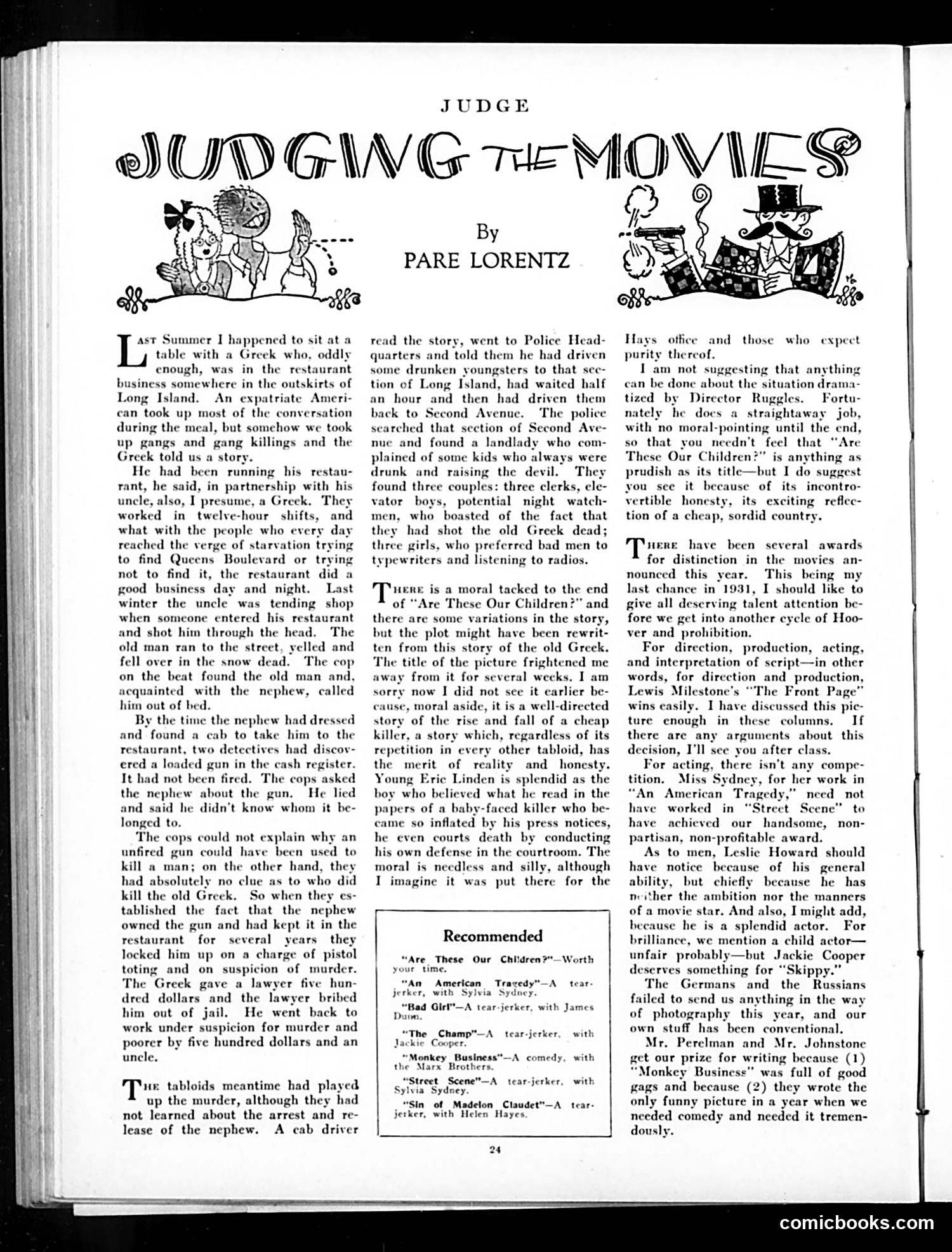
A restored page from Judge, 1931-12-26. Page through the whole issue in the reader above.
📄 Transcribed text from this page (OCR, searchable)
Machine-transcribed from the original scan — historical spelling and the odd misread are preserved.
JUVGWG THe MOV’ ast Summer I happened to sit at a able with a Greek who, oddly enough, the restaurant business somewhere in the outskirts of Long Island. An expatriate Ame can took up most of the conversation during the meal, but somehow we took up gangs and gang killings and the Greek told us a rates: He had been running his rests rant, he said, in partnership with his uncle, also, I presume, a Greek. They worked in twelve-hour shifts, and what with the people who every day reached the verge of starvation trying to find Queens Boulevard or trying not to find it, the restaurant did a good business day and night. Last winter the uncle was tending shop when someone entered his restaurant and shot him through the head. The old man ran to the street, yelled and fell over in the snow dead. The cop on the beat found the old man and, acquainted with the nephew, called him out of bed. By the time the nephew had dressed and found a cab to take him to the restaurant, two detectives had discov- ered a loaded gun in the cash register. It had not been fired. The cops asked the nephew about the gun. He lied and said he didn’t know whom it be- longed to. The cops could not explain wh unfired gun could have been used to kill a man; on the other hand, they ad absolutely no clue as to who did the old Greek. So when they es- tablished the fact that the nephew owned the gun and had kept it in the restaurant for several they locked him up on a cl toting and on suspicion of murder. The Greek gave a lawyer five hun- dred dollars and the lawyer bribed him out of jail. He went back to work under suspicion for murder and poorer by five hundred dollars and an uncle. T" tabloids meantime had played up the murder, although they had not learned about the arrest and re- lease of the nephew. A cab driver JUDGE By PARE LORENTZ read the story, went to Police Head- quarters and told them he had dri some drunken youngsters to that sec- tion of Long Island, had waited half an hour and then had driven them back to Second Avenue. The police searched that section of Second Ave- and found a landl who com- jained of some kids who always were drunk and raising the devil. They found three couples: three clerks, ele- vator boys, potential night watch- men, who boasted of the fact that they had shot the old Greek dead; three girls, who preferred bad men to typewriters and listening to radios. Te is a moral tacked to the end of “Are These Our Children?” and there are some variations in the story, but the plot might have been rewrit- ten from this story of the old Greek. The title of the picture frightened me away from it for several weeks. I am sorry now I did not sce it earlier be- cause, moral aside, it is a well-directed story of the rise and fall of a cheap killer, a story which, regardless of its repetition in every other tabloid, has the merit of and honesty. Young Eric Linden is splendid as the boy who believed what he read in the papers of a baby-faced killer who be- ame so inflated by his press notices, he even courts death by conducting his own defense in the courtroom. The moral is needless and silly, although I imagine it was put there for the Recommended “Are These Our Children?"—Worth “An American Travedy"—A_ tear- jerker, with Sylvia Sydney. 4 Gitt"—A tear-jerker, with James “The Champ"—A ckie Cooper. “Monkey Business"—A comedy, with the Marx Brothers. “Street Scene"—A tear-jerker, with Sylvia Sydney. “Sin of Madelon Claudet”—A tear- jerker, with Helen Hayes. tear-jerker, with Hays office and purity thereof. I am not suggesting that anything can be done about the situation drama- tized by Director Ruggles. Fortu- nately he does a straightaway job, with no moral-pointing until the end, so that you needn't feel that “Are These Our Children?” is anything as prudish as its tit but I do suggest you sce it because of its incontro- vertible honesty, its exciting reflee- tion of a cheap, sordid country. Tee. have been several awards for distinction in the movies an- nounced this year. This being my last chance in 1931, I should like to give all deserving talent attention be- fore we get into another cycle of Hoo- ver and prohibition. For direction, production, acting, and interpretation of script—in other words, for direction and production, Lewis Milestone’s “The Front Page” wins easily, I have discussed this pic- ture enough in these columns. If there are any arguments about this you after class. ¢ isn't any compe- : for her work in American ly,” need not orked in “Street Scene” to ieved our handsome, non- partisan, non-profitable award. As to men, Leslie Howard should have notice because of his general ability, but chiefly because he has neither the ambition nor the manners of a movie star. And also, I might add, because he is a splendid actor. For brilliance, we mention a child actor— unfair probably—but Jackie Cooper deserves something for “Skippy.” The Germans and the Russians failed to send us anything in the way of photography this year, and our own stuff has been conventional. Mr. Perelman and Mr. Johnstone get our prize for writing because (1) “Monkey Business” was full of good gags and because (2) they wrote the only funny picture in a year when we needed comedy and needed it tremen- dously. those who expect comicbooks.com