
Judge, 1931-12-12 · page 11 of 36
Judge — December 12, 1931 — page 11: what you’re looking at
What you’re looking at
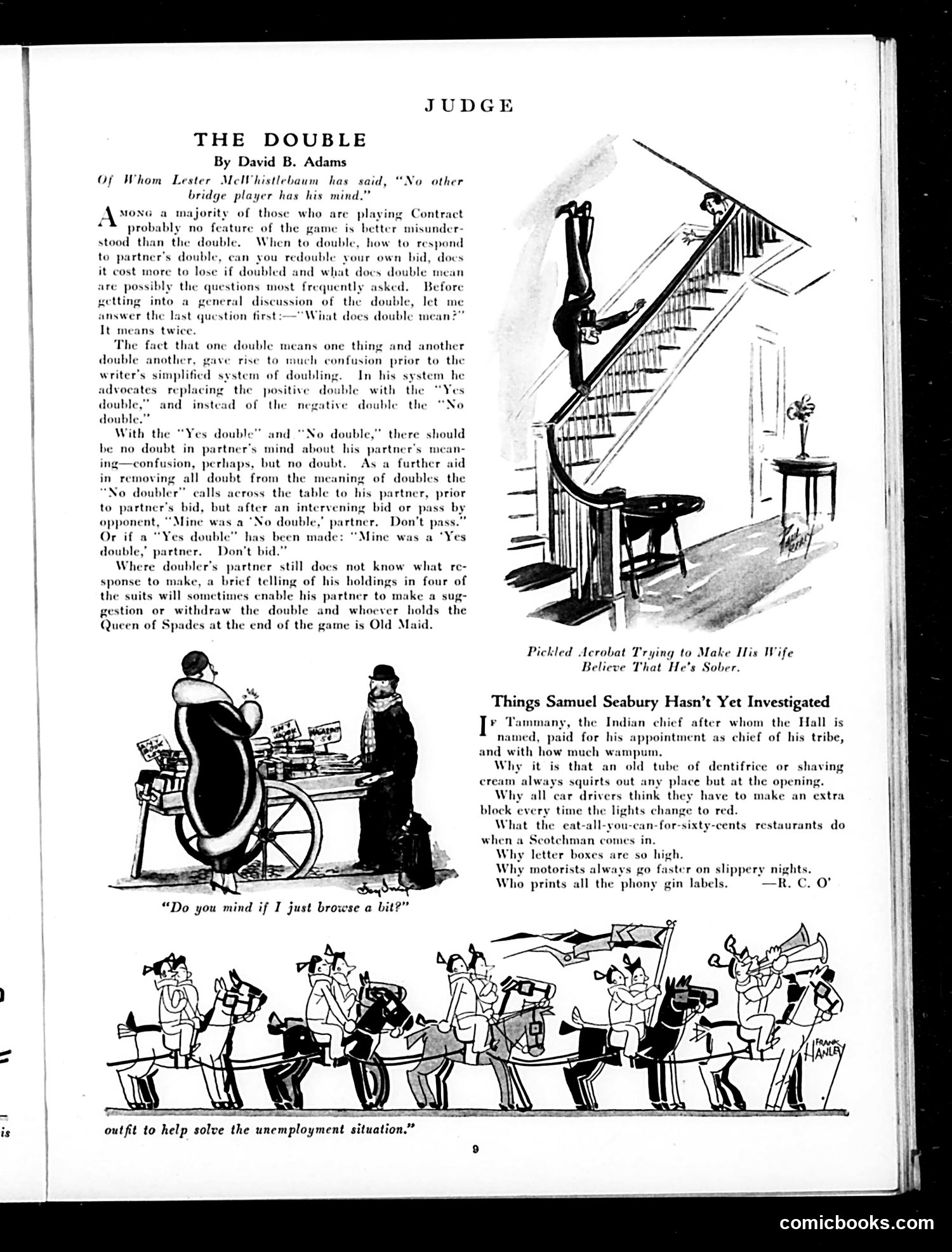
# Analysis This Judge magazine page contains two distinct elements: **"The Double" (main article):** A humorous instructional piece by David B. Adams about Contract Bridge strategy, specifically how to interpret and communicate "doubles" (competitive bids). The satire lies in the deliberately absurd "simplified system"—replacing confusing bridge terminology with blunt declarations like "Mine was a 'No double,' partner. Don't pass," culminating in the joke that whoever holds the Queen of Spades at game's end plays "Old Maid" (a children's card game), mocking the complexity bridge players encounter. **"Things Samuel Seabury Hasn't Yet Investigated":** A satirical list referencing Samuel Seabury, likely the 1930s New York judge who investigated municipal corruption (Tammany Hall). The piece humorously suggests trivial, unsolvable mysteries he should investigate instead—like why toothpaste tubes malfunction or why Scotsmen avoid restaurant deals. This mocks Seabury's high-profile investigations as potentially endless, suggesting there are always more absurd "crimes" to examine. Both items use absurdist humor typical of Judge's sophisticated readership.
📄 Transcribed text from this page (OCR, searchable)
Machine-transcribed from the original scan — historical spelling and the odd misread are preserved.
NA | JUDGE THE DOUBLE By David B. Adams Of Whom Lester McWhistlebaum has said, “No other bridge player has his mind.” MONG a majority of those who are playing Contract probably no feature of the game is better misunder- stood than the double. When to double, how to respond to partner's double, can you redouble your own bid, docs it cost more to lose if doubled and what docs double mean are possibly the questions most frequently asked. Before getting into a general discussion of the double, let- me answer the last question first:—"Wiat does double me: " It means twice. The fact that one double means one thing and another double another, gave rise to much confusion prior to the writer's simplified system of doublin advocates replacing the positive dou doul double.” With the “Yes double’ and “No doubl there should be no doubt in partner's mind about his partner's: mean- ing—confusion, perhaps, but no doubt. As a further aid in removing all doubt from the meaning of doubles the “No doubler” calls across the table to his partner, prior to partner's bid, but after an intervening bid or pass by opponent, “Mine was a ‘No double,’ partner. Don’t pass.” Or if a “Yes double” has been made: “Mine was a ‘Yes double,’ partner, Don't bid.” In his system he > with the and instead of the negative double the No Where doubler’s partner still does not know what re- sponse to make, a brief telling of his holdings in four of the suits will sometimes enable his partner to make a sug- gestion or withdraw the double and whoever holds the Queen of Spades at the end of the game is Old Maid. Pickled Acrobat Trying to Make His Wife Believe That He’s Sober. Things Samuel Seabury Hasn’t Yet Investigated ry Tammany, the Indian chief after whom the Hall is named, paid for his appointment as chief of his tribe, and with how much wampum. W it is that an old tube of dentifrice or shaving always squirts out any place but at the opening. Il car drivers think they have to make an extra block every time the lights change What the ll-you-can-for-sixty-cents restaurants do when a Scotchman comes in. Why letter boxes are so high. Why motorists always go faster on slippery nights. Who prints all the phony gin labels. “—R. C. O° comicbooks.com