
Judge, 1931-10-31 · page 22 of 36
Judge — October 31, 1931 — page 22: what you’re looking at
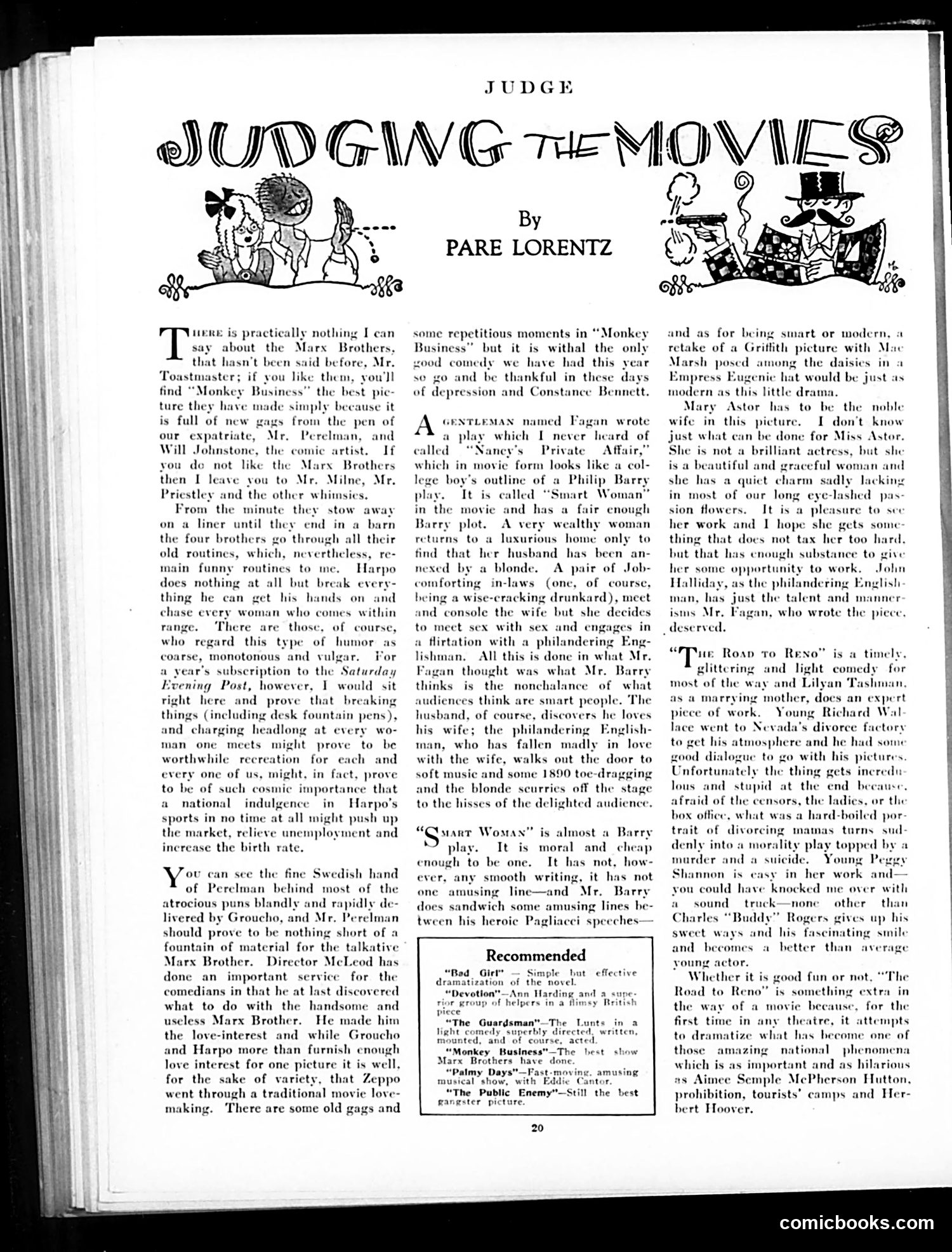
A restored page from Judge, 1931-10-31. Page through the whole issue in the reader above.
📄 Transcribed text from this page (OCR, searchable)
Machine-transcribed from the original scan — historical spelling and the odd misread are preserved.
eee a JJUWVGI tere is practically nothing I can I say about the Marx Brothers, that hasn't been said before, Mr. Toastmaster; if you like them, you'll find “Monkey Business” the best pic- ture they have made simply because it is full of new gays from the pen of our expatriate, Mr. Perelman, Will Johnstone, the comic artist. you do not like the Marx Brothers then I leave you to Mr. Milne, Mr. Priestley and the other whimsies. From the minute they stow away ona liner until they end in a barn the four brothers go through all their old routines, which, nevertheless, re- main funny routines to me. does nothin; thing he Harpo tall but break every- this hands on and chase every woman who comes within range. who There are those, of course, this type of humor as coarse, monotonous and vulgar, For a year’s subscription to the Saturday Evening Post, however, 1 would sit right here and prove that aking things (including desk fountain pens), and charging headlong at every wo- man one meets might prove to be worthwhile recreation for each and every one of us, might, in fact, prove to be of such cosmic importance that a national indulgence in Harpo's sports in no time at all might push up the market, relieve unemployment and increase the birth rate. Yr can see the fine Swedish hand of Perelman behind most of the atrocious puns blandly and rapidly de- livered by Groucho, and Mr, 1 should prove to be nothing short of a fountain of material for the talkative Marx Brother. Director McLeod has done an important service for the comedians in that he at last discovered what to do with the handsome and useless Marx Brother. He made him the love-interest and while Groucho and Harpo more than furnish enough love interest for one picture it is well, for the sake of variety, that Zeppo went through a traditional movie love- making. There are some old gags and rrelman JUDGE G THe MOV (mS Go By PARE LORENTZ some repetitious moments in “Monkey Business” but it is withal the only xood comedy we have had this year so go and be thankful in these days of depression and Constance Bennett. : named Fagan wrote +h [never heard of called Private Affair,” which in movie form looks like a col- lege boy's outline of a Philip Barry play. It is called “Smart Woma in the movie and has a fair cnough Barry plot. A very wealthy woman returns to a luxurious home only to tind that her husband has been an- nexed by a blonde. A pair of Job- comforti ws (one, of course, being a wise-cracking drunkard), meet and console the wife but she to mect sex with sex and en, a flirtation with a philandering Eng- lishman, All this is done in what Mr. agan thought was what Mr. Barry thinks is the nonchalance of what audiences think are smart people. The husband, of course, discovers he loves his wife; the philandering English- ™: who has fallen madly in love with the wife, walks out the door to soft music and some 1890 toe-dragging and the blonde scurries off the stage to the hisses of the delighted audience, “Gant Woman” is almost a Barry play. It is moral and cheap enough to be one. It has not, how- ever, any smooth writing, it has not one amusing line—and Mr. Barry does sandwich some amusing lines be- tween his heroic Pag! speeches Recommended “Bad Girt? — Simple but effective dramatization of the novel. “Devotion"—Ann Harding and a supe- he Guardsman"—The Lunts in a t comedy superbly d written, nted, and of acted Monkey Business"—The best show Marx Brother “Palmy Days” musical show, “The Public Enemy”. gangster picture amusing tor. the best BPR and as for being smart or modern, a retake of a Griflith picture with Mac Marsh posed Empress Eu mong the daisies in a wenic would be just as modern as this little drama. Mary Astor has to be the noble wife in this picture. I don't know just what can be done for Miss Astor. She is not a brilliant actress, but she beautiful and ¢ he has a quict charm sa in most of our long ¢ sion flowers. anand y lackin pas- It is a pleasure to see her work and I hope she gets some thing that does not tax her too hard, but that has cnough substance to give her some opportunity to work, John Halliday, « i man, has just the talent isms Mr. n, who wrote the piece. “Mie Roan to Reno” is a timely. glittering and light comedy for most of the way and Lilyan Tashman, as a marrying mother, does an expert piece of work. Young Richard Wal lace went to Nevada's divorce factory to get his atmosphere and he h good dialogue to go with his pictures. Unfortunately the thing gets ineredu lous and stupid at the end b afraid of the censors, the ladies box office, what was a ha trait of divorcing m: ad some use, the rd-boiled por nas turns sud denly into a morality play topped by a murder and a suicide. Young Pe Shannon is easy in her work and you could have knocked me over with a sound truck—none other than Charles “Buddy” Rogers gives up his sweet ways and his fascinating smile and a better than average young actor. Whether it is good fun or not, “The Road to Reno” is something extra in the way of a movie because, for the first time in any theatre, it attempts tod what has beeome one of those ng national phenomena which it mportant and as hilarious as Aimee Semple McPherson Hutton, prohibition, tourists’ camps and Her- bert Hoover. comicbooks.com