
Judge, 1931-10-31 · page 15 of 36
Judge — October 31, 1931 — page 15: what you’re looking at
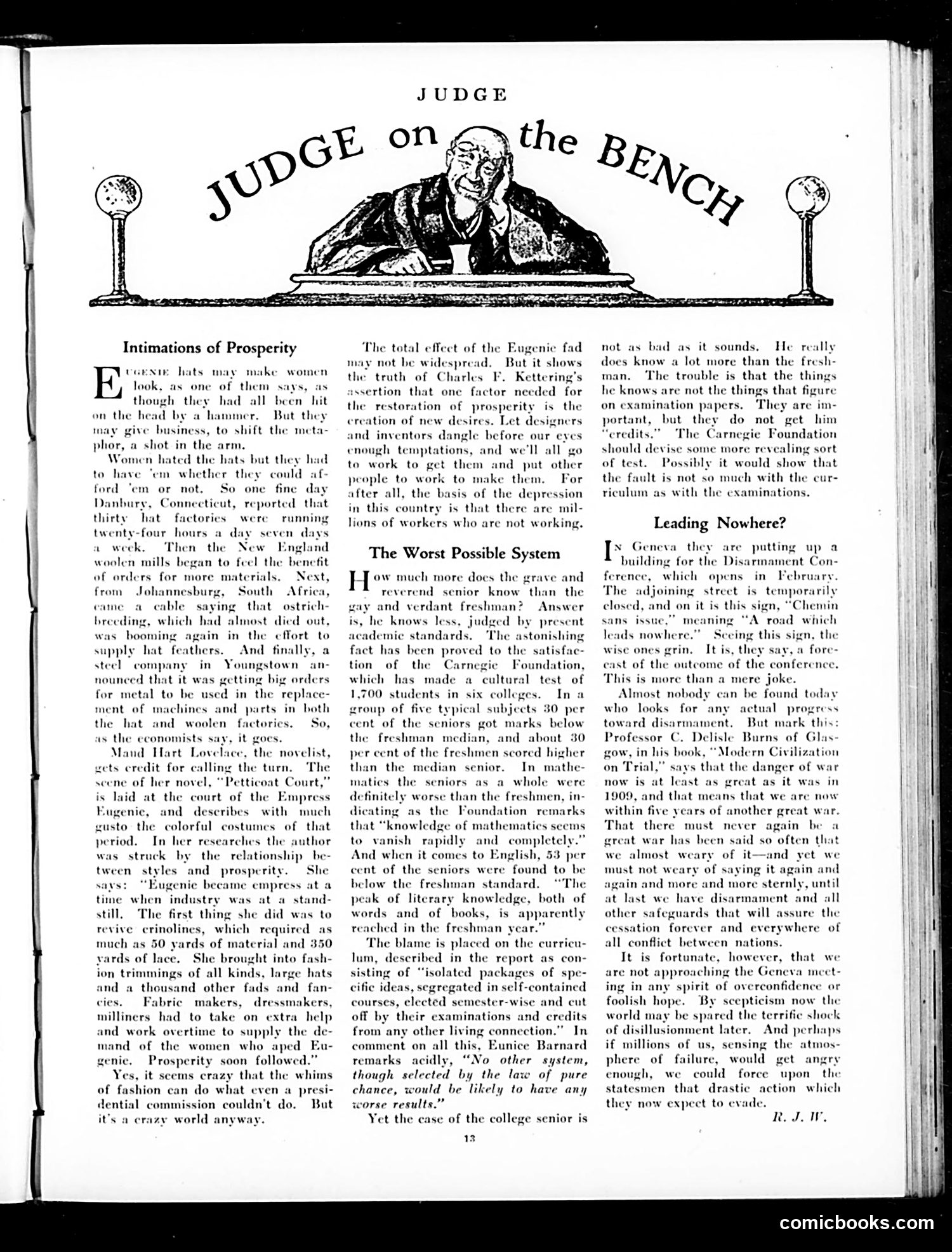
A restored page from Judge, 1931-10-31. Page through the whole issue in the reader above.
📄 Transcribed text from this page (OCR, searchable)
Machine-transcribed from the original scan — historical spelling and the odd misread are preserved.
Intimations of Prosperity vorni® hats may make look, ne of them though they had all on the head may give women says, ts been hit ahammer, But they g s, to shift the meta- phor, a shot in the arm. Women hated the hats but they had to have ‘em whether they could af ford ‘em or not. So one fine day Danbury, Connecticut, reported that thirty hat were running twenty-four hours a day seven days 1 week, Then the New England woolen mills began to feel the benefit of orders for more materials. Next, outh Africa, that ostrich- 1d almost died out, again in the effort to supply hat feathers. And finally, steel company in’ Youngstown an- nounced that it was getting big orders for metal to be used in the repl ment of machines and parts in the hat and ts the economists say, it goes. Mand Hart Lovelace, the novelist, xets credit for calling the turn. The scene of her novel, “Petticoat Court,” is laid at the court of the Empress Kugenie, and describes with much gusto the colorful of that riod. In her researches the author was struck by the relationship be- tween styles and prosperity. She says: nie became empress at a time when industry was at a stand- still. The first thing she did was to revive crinolines, which required as much as 50 yards of material and 350 ards of lace. She brought into fash- on trimmings of all kinds, large hats nd a thousand other fads Fabric makers, dressmakers, milliners had to take on extra help and work overtime to supply the de- mand of the women who aped Eu- genie. Prosperity soon followed.” Yes, it seems crazy that the whims Jo what even a presi- 1 commission couldn't do. But crazy world anyway factories from Johannesburg, breeding, which was boomi woolen factories. costumes. The total ef of the Eugenie fad may not be widespread. But it shows the truth of Charles PF. Kettering’s sssertion that one factor needed for the restoration of prosperity is the creation of new desires. Let designers and inventors dangle before our eyes cnough temptations, and we'll all’ go to work to get them and put other people to work to make them. For ifter all, the basis of the depression in this country is that there are mil- lions of workers who are not working. The Worst Possible System H™ much more does the grave and reverend senior know than the and verdant freshman? is, he knows less, judged by present demic standards. The astonishi ‘act has been proved to the satis tion of the Carnegic Foundation, which has made a cultural test of 700 students in six colleges. In a group of five typical subjects 30 per cent of the seniors got marks below the freshman median, and about 30 per cent of the freshmen scored higher than the median senior. In mathe- maties the seniors as a whole were definitely worse than the freshmen, in- dicating as the Foundation remarks that “knowle to vanish rapidly And when it comes to English, 53 per cent of the seniors were found to be below the freshman standard. The peak of literary knowledge, both of words and of books, is apparently reached in the freshman year.” The blame is placed on the curricu- lum, described in the report as con- 1 packages of spe- ed in self-contained courses, elected semester-wise ¢ off by their from any other living conn comment on all this, Eunice Barnard remarks acidly, “No other system, though selected by the law of pure chance, would be likely to have any worse results.” Yet the case of the college senior is Answer 13 not as bad ay it sounds. He really does know a lot more than the fresh- man. The trouble is that the things he knows are not the things that figure on examination papers. ‘They are im- portant, but they do not get him “credits.” The Carnegie should devise some more rev of test. Possibly it would show that the fault is not so much with the eur- riculum as with the examinations. Leading Nowhere? I Geneva they are putti up a building for the Disarmament Con- ference, which opens in’ February. The adjoining strect is temporarily closed, and on it is this sign, “Chemin issue.” meaning “A road which leads nowhere.” Seeing this sign, the It is, they say, a fore- cast of the outcome of the conference. This is more than a mere joke. Almost nobody can be found today who looks for any actual pro toward disarmament, But mark this: Professor C. Delisle Burn his book, “Modern Ci ” says that the now is at least as great as it was in 1909, and that means that we arc within five years of another great war. That there must never again be a great war has been said so often that we almost weary of it—and yet must not weary of say in and more and more sternly wise ones grin. now hand until other safeguards that will assure the cessation forever and everywhere of all conflict between nations. It i: ate, however, that we eneva meet- ing in y spirit of overconfidence or foolish hope. By scepticism now the world may be spared the terrific shock of disillusionment later. And perhaps if millions of us, sensi the atmos- phere of failure, would get angry enough, we could force upon the that drasti n which they now expect to evade. statesmen RJILW, comicbooks.com