
Judge, 1931-10-24 · page 15 of 36
Judge — October 24, 1931 — page 15: what you’re looking at
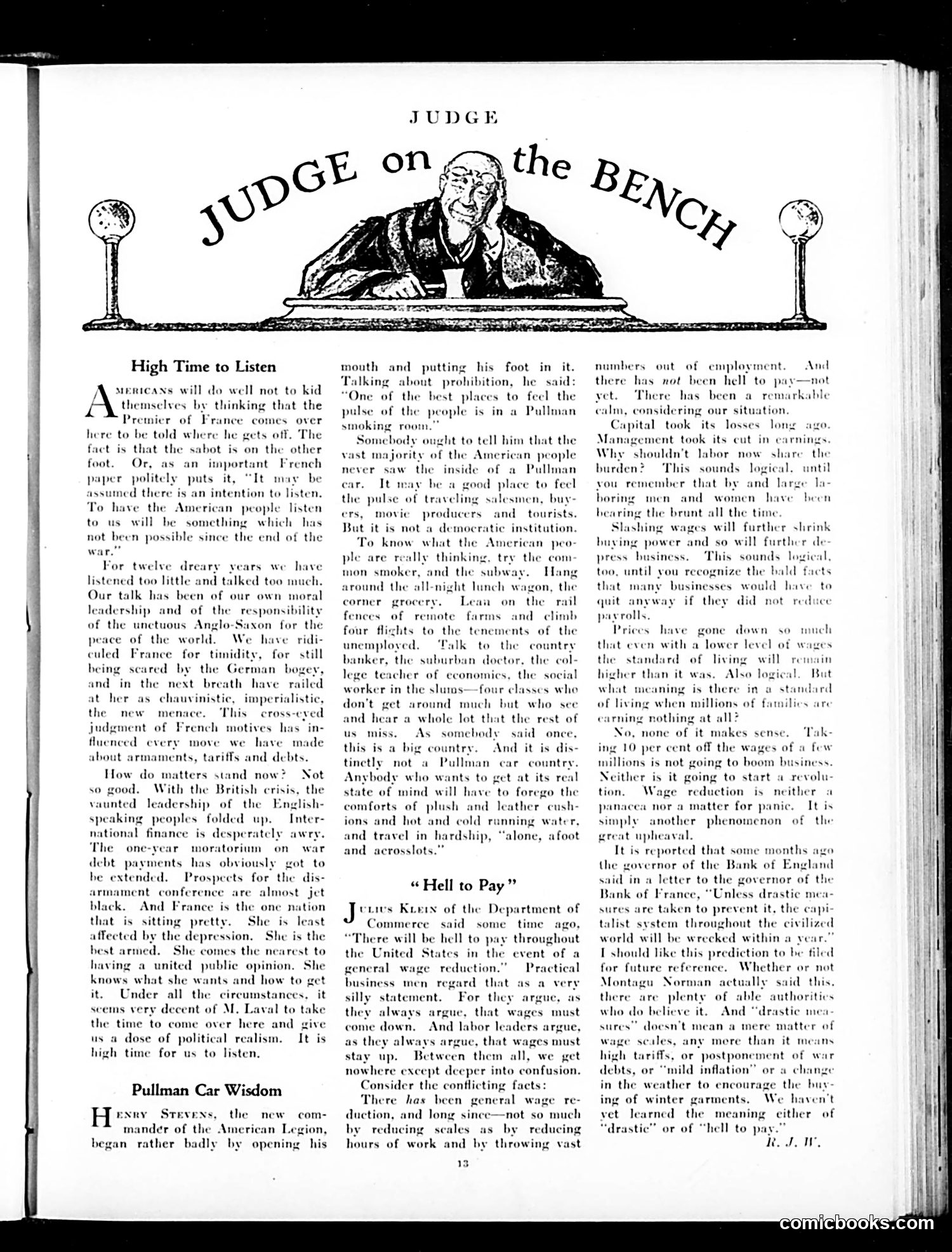
A restored page from Judge, 1931-10-24. Page through the whole issue in the reader above.
📄 Transcribed text from this page (OCR, searchable)
Machine-transcribed from the original scan — historical spelling and the odd misread are preserved.
High Time to Listen AL senicays will do well not to kid L themselves by thinking that the Premier of France comes over here to be told where he fact is that the ot is on the other foot. Or, as an important French paper politely puts it, “It may be assumed there is an intention to listen. To have the American people listen to us will be something which has not been possible since the end of the war. For twelve dreary ars we have listened too little and talked too much. Our talk has been of our own mo) leadership and of the responsibility of the unctuous Anglo-Saxon for the peace of the world. We have ridi- culed France for timidity, for. still being sed ed by the German and in the next breath have r at her as chauvinistic, imperialistic, the new menace. This cross-e3 judgment of French motives has’ in- fluenced every move we have made about armaments, tariffs and debts. How do matters stand now? Not so good. With the British crisis, the vaunted leadership of the English- speaking peoples folded up. Inter- national fing The one-ye debt payments has obviously got to be extended. Prospects for the dis- nent conference are almost jet And France is the one nation is sitting pretty. She is least affected by the depression. She is the best armed. She comes the nearest to having a united public opinion. She knows what she wants and how to g it. Under all the circumstances, it seems very decent of M. Laval to take the time to come over here and give us a dose of political realism. It is high time for us to listen. nce is desperately awry. r moratorium on war Pullman Car Wisdom eNny Stevens, the new com- mander of the American Legion, n rather badly by opening his JUDGE mouth nd putting his foot in it. alking about prohibition, he said: ‘One of the best places to feel the pulse of the people is in a Pullman smoking room.” Somebody ought to tell him that the vast majority of the American people never saw the inside of a Pullman ar. It may be a good place to feel the pulse o traveling salesmen, buy- ers, movie producers and tourists. But it is not a democratic institution. To know what the American peo- ple are really thinking, try the com and the subway. Hang round the all-night lunch we the corner grocery. Lean on the rail fences of remote farms and climb four flights to the tenements of the unemployed. ‘Talk to. the country banker, the suburban doctor, the col- lege teacher of economics, the social mon sm worker in the sluras—four classes who don’t get around much but who see and hear a whole lot that the rest of us miss. As somebody said once, this isa big country. And it is dis- tinctly not a Pullman car country. Anybody who wants to get at its real state of mind will have to forego th comforts of plush and leather cush- ions and hot and cold running water, and travel in hardship, “alone, afoot and acrosslots.”” “ Hell to Pay” J’ tivs Kiet of the Department of Commerce said some time ago, “There will be hell to pay throughout the ited States in the event of a gene reduction.” P business men regard that as silly statement. For they « they alway gue, that wa come down, And labor leaders argue, as they always argue, that wages must stay up. Between them all, we get nowhere except deeper into confusion. Consider the conflicting facts There has been gener: duction, and long sinc gue, as ges must re not so much by reducing scales as by reducing hours of work and by throwing vast 13 numbers out of employment. And there has not been hell to pay—not yet. There has been a remarkable calm, considering our situation. Capital took its losses long nagement took its cut in earning Why shouldn't labor now share the burden? This sounds logical. until you remember that by and large la- h hearing the brunt all the time Slashing wages will further shrink buying power and so will further de press business. This sounds los M ring men and women have been too, until you recognize the b that many businesses would quit anyway if they did not reduce payrolls, Prices have gone down so much that even with a lower level of wages the standard of living will remain higher than it was. Also logical. But what meaning is there in a standard of living when millions of families arc earning nothing at No, none of it makes sense. t off the w: millions is not going to boom business. Neither is it going to start a revolu tion. Wage reduction is neither a panacea nor a matter for panic. It is simply another phenomenon of the great uph 1. It is reported that some months ago the governor of the Bank of England said in a letter to the governor of the Bank of France, “Unless drastic me sures are taken to prevent it, the capi talist system throughout the civilized world will be wrecked within a year.” I should like this prediction to be filed for future reference. Whether or not Montagu Norman actually said this. of able authorities who do believe it. And “drastic mea 10 per ce sof a few there are plen sures” doesn’t mean a mere matter of wage scales, any mere than it means high tariffs, or postponement of war debts, or “mild inflation” or a change in the weather to encourage the buy- ing of winter garments. We haven't vet learncd the meaning cither of “drastic” or of “hell to pay.” ROW,