
Judge, 1931-10-10 · page 25 of 36
Judge — October 10, 1931 — page 25: what you’re looking at
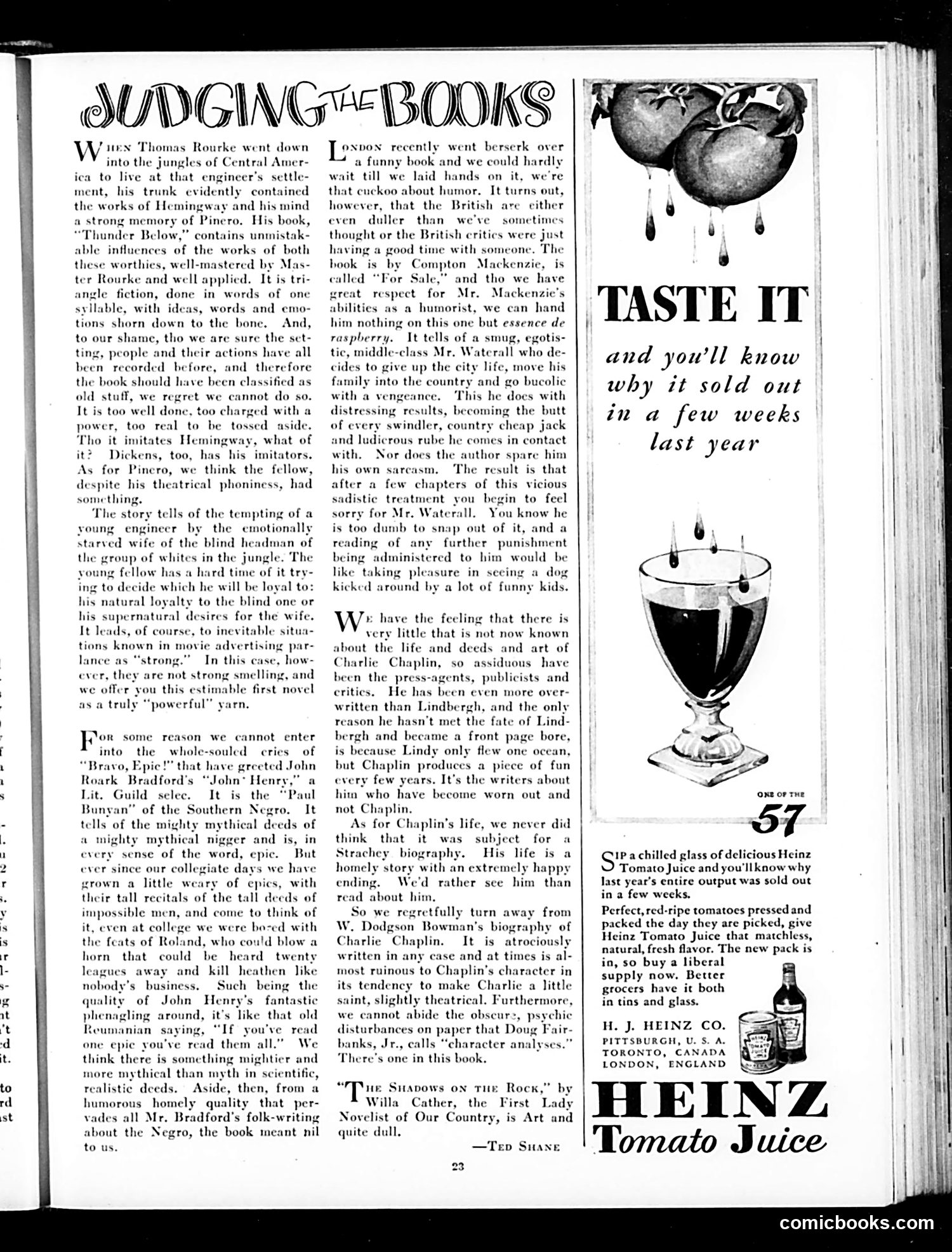
A restored page from Judge, 1931-10-10. Page through the whole issue in the reader above.
📄 Transcribed text from this page (OCR, searchable)
Machine-transcribed from the original scan — historical spelling and the odd misread are preserved.
st W wen Thomas Rourke went down into the jungles of Central Amer- ica to live at that engincer’s settle- ment, his trunk evidently contained the works of Hemingway and his mind a strong memory of Pinero. His book, “Thunder Below,” contains unmistak- able influences of the works of both these worthies, well-mastered by Mas- ter Rourke and well applied. It is tri- angle fiction, done in words of one syllable, with ideas, words and emo- tions shorn down to the bone, And, to our shame, tho we are sure the set- ting, people and their actions have all been recorded before, and therefore the book should have been classified as old stuff, we regret we ci It is too well done, too cha nnot do so. ed with a power, too real to be tossed aside. Tho it imitates Hemingway, what of it? Dickens, too, has his imitators. As for Pinero, we think the fellow, despite his theatrical phoniness, had something. The story tells of the tempting of a young engineer by the emotionally starved wife of the blind headman of the group of whites in the jungle. The young fellow hard time of it try- ing to decide which he will be loyal to: his natural loyalty to the blind one or his supernatural desires for the wife. It leads, of course, to inevitab! situa- tions known in movie advertising par- lance as “stron; In this case, how- ever, they are not strong smelling, and we offer you this estimable first novel asa truly “powerful” yarn. ke some reason we cannot enter into the whole-souled cries of “Bravo, Epic!" that have greeted John Roark Bradford's “John* Henry,” a Lit. Guild selec. It is the “Paul Bunyan” of the Southern Negro. It tells of the mighty mythical deeds of a mighty mythical nigger and is, in every sense of the word, epic. But ever since our collegiate days we have grown a little weary of epics, with their tall recitals of the tall deeds of impossible men, and come to think of it, even at colle we were bored with the feats of Roland, who could blow a horn that could be heard twenty leagues aw: nd kill heathen like nobody's business. Such being the quality of John Henry's fantastic phenagling around, it’s like that old Roumanian saying, “If you've read one epic you've read them all.” V think ther htier and more mythical than myth in scientific, realistic deeds. Aside, then, from a humorous homely quality t per- vades all Mr. Bradford's folk-writing about the Negro, the book meant nil to us. s something mi L bon recently went berserk over a funny book and we could hardly wait till we laid hands on it, we're that cuckoo about humor. It turns out, however, that the British are either even duller than) we've sometimes thought or the British critics were just having a good time with someone. The hook is | p, fi called * S great respect for Mr. abilities him nothi Mackenzie's a humorist, we can hand on this one but essence de raspberry. It tells of a smug, egotis- tic, middle-class Mr. Waterall who de- cides to give up the city life, move his family into the country and go bucolic with a vengeance. This he docs with distressing results, becoming the butt of every swindler, country cheap jack and ludicrous rube he comes in contact with. Nor does the author spare him his own sarcasm. The result is that after a few chapters of this vicious sadistic treatment you begin to feel sorry for Mr. Waterall. You know he is too dumb to snap out of it, and a reading of any further punishment being administered to him would be like taking pleasure in seeing a dog kicked around by a lot of funny kids. W' have the feeling that there is very little that is not now known about the life and deeds and art of Charlie Chaplin, so assiduous have been the press-agents, publicists and crities. He has been even more over- written than Lindbergh, and the only reason he hasn't met the fate of Lind- bergh and became a front page bore, is because Lindy only flew one ocean, but Chaplin produces a picce of fun every few years. It's the writers about him who have become worn out and not Chaplin, As for Chaplin's life, we never did think that it was subject for a Strachey biography. His life is a homely story with an extremely happy ending. We'd rather see him than read about him, So we regretfully turn away from W. Dodgson Bowman's biography of Charlie Chaplin. It is atrociously written in any case and at times is a most ruinous to Chaplin's character in its tendency to make Charlie a little saint, slightly theatrical. Furthermore, we cannot abide the obscure, psychic aper that Doug F “character analyse There’s one in this book. ir- “Tue Sutavows on tue Rock,” by Willa Cather, the First) Lady Novelist of Our Country, is Art and quite dull, —Tep Suane 23 TASTE IT and you'll know why it sold out in a few weeks last year Sf achilled glass of delicious Heinz Tomato Juice and you'll know why last year’s entire output was sold out in a few weeks, Perfect, red-ripe tomatoes pressed and packed the day they are picked, give Heinz Tomato Juice that matchless, natural, fresh flavor. The new pack is in, so buy a liberal supply now. Better grocers have it both in tins and glass. H. J. HEINZ CO. PITTSBURGH, U. S. A. TORONTO, CANADA LONDON, ENGLAND comicbooks.com