
Judge, 1931-10-10 · page 18 of 36
Judge — October 10, 1931 — page 18: what you’re looking at
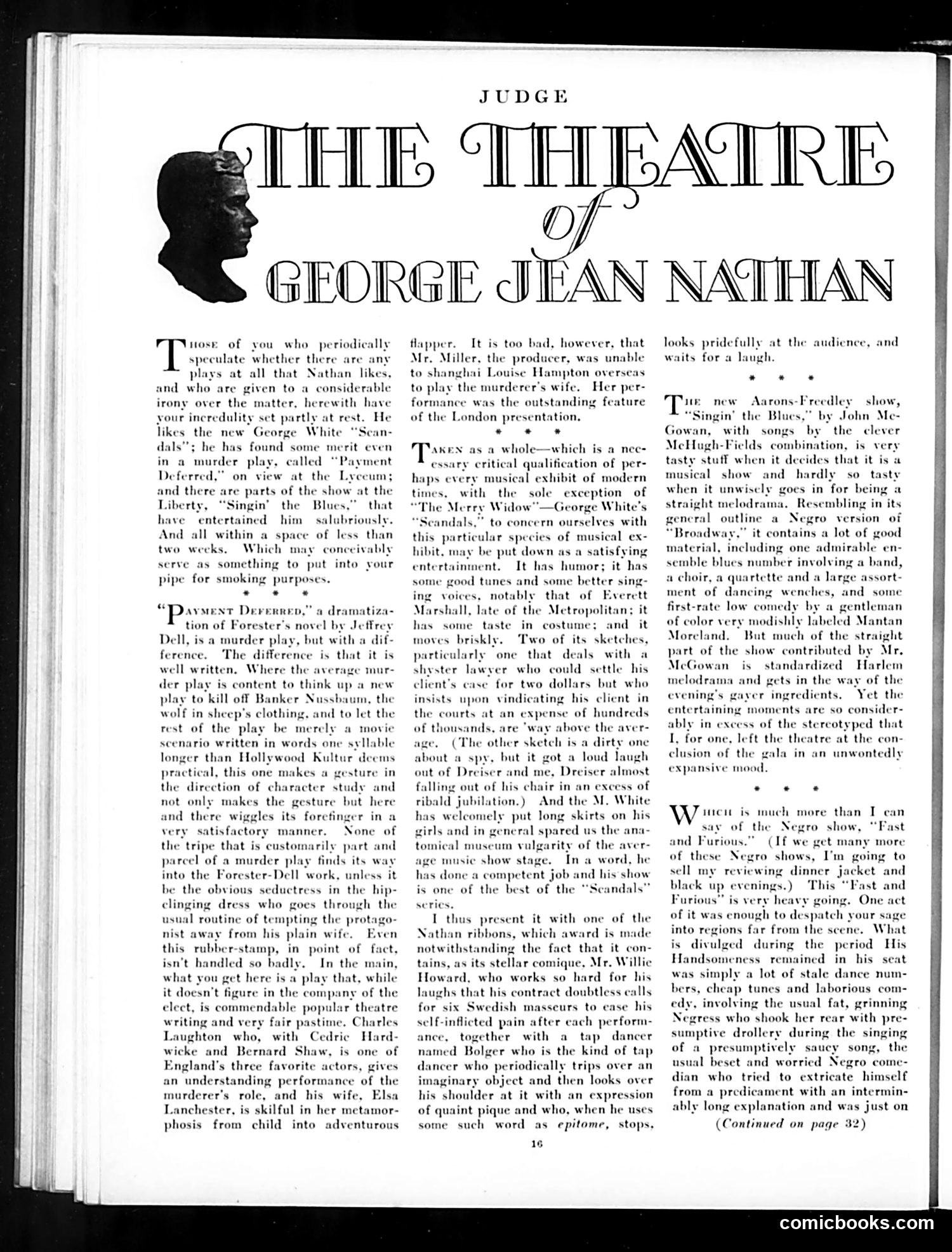
A restored page from Judge, 1931-10-10. Page through the whole issue in the reader above.
📄 Transcribed text from this page (OCR, searchable)
Machine-transcribed from the original scan — historical spelling and the odd misread are preserved.
JUDGE THEATRE GEORGE JE nose. of you who periodically speculate whether there plays at all that Nath and who are given to a considerable irony over the matter, herewith have your incredulity set partly at rest. He likes the White f dals"; he has found some merit even in a murder play, called “Payment Deferred,” on view at the Lyceum; and there are parts of the show at the Liberty, ngin’ the Blues,” that have ‘entertained him salubriously. And all within a space of less than two weeks. Which may conceivably » as something to put into your pipe for smoking purposes. . 8 « new George yaMeNT Dererren,” a dramat tion of Forester’s novel by Jeffr Dell, is a murder play, but with a dif- ference. The difference well written. Where the « der play is content to think up a new play to kill off Banker Nussbaum, the wolf in sheep's clothing, and to let the rest of the play be merely a movie scenario written in words one syllable longer than Hollywood Kultur deems practical, this one makes a gesture in the direction of character study and not only m but here and there wiggles its forefinger in a very satisfactory manner. None of the tripe that is customarily part and parcel of a murder play finds its way into the Forester-Dell work, unless it the obvious seductress in the hip- ing dress who goes through the usual routine of tempting the protago- nist away from his plain wife. Even this rubber-stamp, in point of fact, isn’t handled so bs In the main, what you get he play that, while it doesn’t figure in the company of the elect, is commendable popular theatre writing and very fair pastime. Charles Laughton who, with Cedric Hard- wicke and Bernard Shaw, is one of England's three favorite actors, gives an understanding performance of the murderer's role, and his wife, Elsa Lanchester, is skilful in her metamor- phosis from child into adventurous “P es the gesture flapper. It is too bad, however, that Mr. Miller, the producer, was unable to shanghai Louise Hampton overseas to play the murderer's wife. Her per- formance was the outstanding feature of the London presentation, “ * * AKEN as a whole—which is a nec- essary critical qualitication of per- haps every musical exhibit of modern times, with the sole exception of “The Merry Widow"—George White's “Scandals,” to concern ourselves with this particular species of musical ex- hibit, may be put down as a satisfying entertainment. It some humor; it has rod tunes and some better sing- ing voices, notably that of Everett Marshall, late of the Metropolitan; it has some taste in costume; and it moves briskly. Two of its sketches, particularly that deals with a shyster lawyer who could settle his client's case for two dollars but who insists upon vindicating his client in the courts at an expense of hundreds of thousands, are ‘way above the aver- (The other sketch is a dirty one about a spy, but it got a loud In out of Dreiser and me, Dreiser alm falling out of his ch ribald jubilation.) And the M. White has weleomely put long skirts on his girls and in general spared us the ana- tomical museum vulgarity of the aver- age music show stage. In a word, he has done a competent job and his show is one of the best of the “Scandals” one series. I thus present it with one of the Nathan ribbons, which award is made notwithstanding the fact that it con- as its stellar comique, Mr. Willie ‘d, who works so hard for his 1s that his contract doubtless calls for six Swedish masseurs to ease his self-inflicted pain after each perform- ance, together with a tap dancer named Bolger who is the kind of tap dancer who periodically trips over an imaginary object and then looks over his shoulder at it with an expression of quaint pique and who, when he uses some such word as epitome, stops, 16 NATHAN looks pridefully at the audience waits for a laugh. * *# « ue new Aarons-Freedley show, “Singin’ the Blues,” by John Me- owan, with songs by the clever McHugh-Fields combir : tasty stuff when it decide musical show and hardly so. tasty when it unwisely goes in for being straight melodrama. Resembling in its neral outline a Negro version of “Broadway,” it contains a lot of good material, including one admirable e semble blues number involving a band, a choir, a quartette and a large assort- ment of dancing wenches, first-rate low comedy 1 of color very modishly labeled Mantan Moreland. But much of the straight part of the show contributed by Mr. McGowan is s' ardized Harlem melodrama and gets in the way of the i ver ingredients, Yet the entertaining moments are so consider- ably in excess of the stereotyped that I, for one, left the theatre at the con- clusion of the gala in an unwontedly expansive mood. is ve nd some entleman * * « W wien is much more than say of the and Furious.” Negro show, (If we get many more of these Negro shows, I'm going to sell my reviewing dinner jacket and black up evenings.) This “Fast and Furious” is very heavy going. One « of it was enough to despatch your sage into regions far from the scene. What is divulged during the period His Handsomeness remained in his seat was simply a lot of stale dance num- bers, cheap tunes and laborious com- involving the usual fat, grinning Negress who shook her rear with pre- sumptive drollery during the singing presumptively saucy song, the nd worried Negro come- dto extricate himself ament with an intermin- xplanation and was just on who tr from a predi ably long (Continued on page 32) comicbooks.com