
Judge, 1931-06-13 · page 24 of 36
Judge — June 13, 1931 — page 24: what you’re looking at
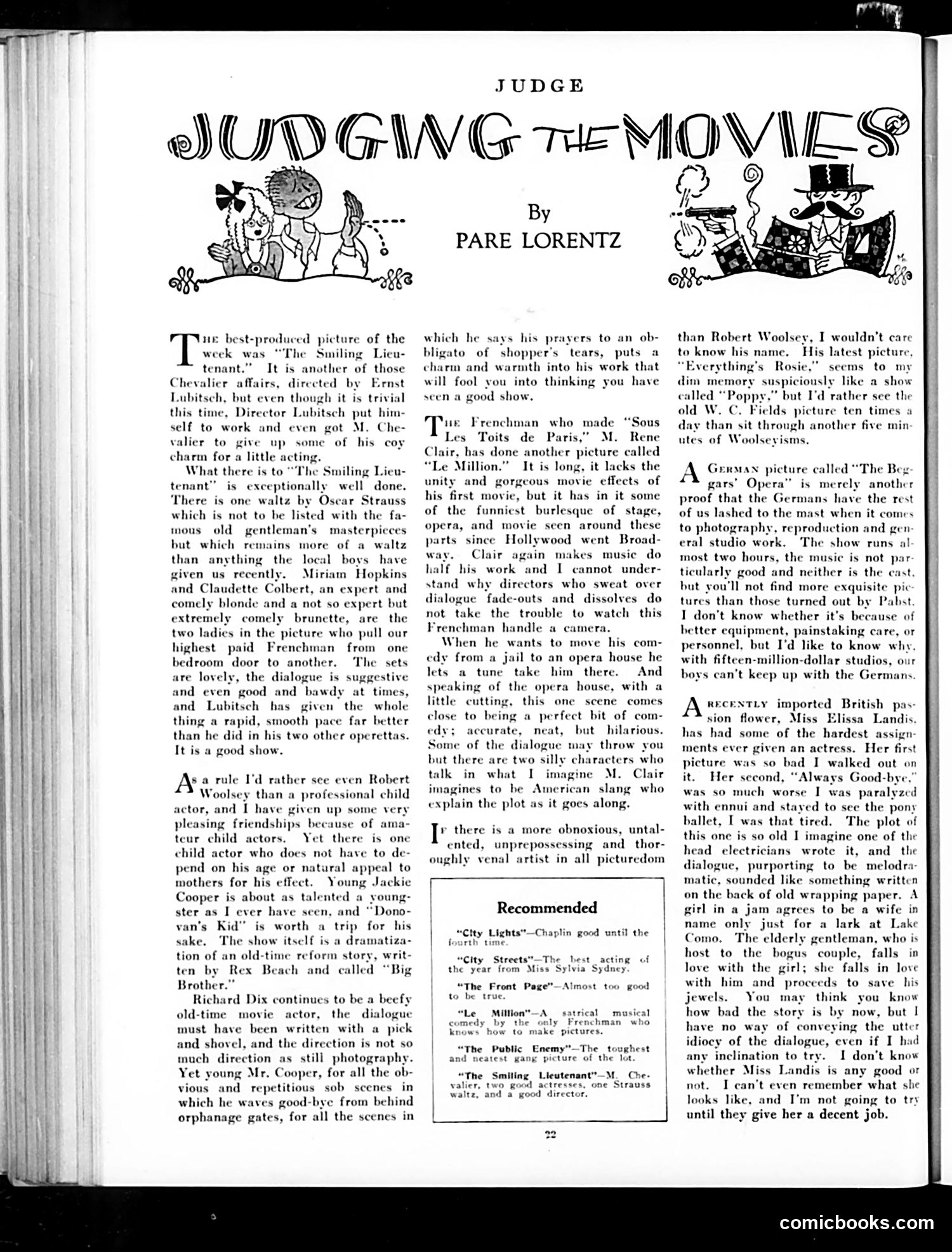
A restored page from Judge, 1931-06-13. Page through the whole issue in the reader above.
📄 Transcribed text from this page (OCR, searchable)
Machine-transcribed from the original scan — historical spelling and the odd misread are preserved.
ue best-p: ed picture of the fl Dagact> f he Smiling Lieu- tenant.” ther of those Chevalier affairs, directed by Ernst Lubitseh, but even though it is trivial this time, Director Lubitsch put hi self to work and even got M. Che- valier to give up some of his coy charm for a little acting. What there is to “The Smiling Lieu- ant” is exceptionally well done. here is one waltz by Oscar Strauss which is not to be listed with the fa- mous old gentleman's masterpieces but which remains more of a waltz than anything the local boys have given us recently. Miriam Hopkins nd Claudette Colbert, an expert and ymely blonde and a not so expert but extremely comely brunctte, are the two ladies in the picture who pull our highest paid Frenchman from one bedroom door to another. The sets are lovely, the dialogue is suggestive and even good and bawdy times, and Lubitsch has given the whole thing a rapid, smooth pace far better than he did in his two other operettas. It is a good show. & a rule I'd rather see even Robert Woolsey than a professional child actor, and I ha iven up some very pleasing friendships because of ama teur child actors. Yet there is one child actor who does not h pend on his age or natural app mothers for his effect. Young Jackie Cooper is about as talented a young- ster as I ever have seen, and “Dono- van's Kid” is worth a trip for his sake. The show itself is a dramati tion of an old-time reform story ten by Rex Beach and called Brother. Richard Dix continues to be old-time movie actor, the dis must have been written with a pick and shovel, and the direction is not so much direction as still photography. Yet young Mr. Cooper, for all the ob- vious and repetitious sob scenes in which he waves good-bye from behind orphanage gates, for all the scenes in JUDGE JUDGWG THM =) By PARE LORENTZ which he says his prayers to an ob- bligato of Shopper's tears, puts a charm and warmth into his work that will fool you into thinking you have seen a good show, T te Frenchman who made “Sous Les Toits de Paris,” M. Rene Clair, bas done another picture called ‘Le Million.” It is long, it lacks the and gorgeous movie effects of his first movie, but it has in it some of the funniest burlesque of stag opera, and movie seen around these parts since Hollywood went Broad- we Clair n makes music do alf his work and I cannot under- stand why directors who sweat over dialogue fade-outs and dissolves do not take the trouble to watch this Frenchman handle a camer. When he wants to move his com- edy from a jail to an opera house he lets a tune take him there. And speaking of the opera house, with a little cutting, this one scene comes close to being a perfect bit of com- edy; accurate, neat, but hilarious. Some of the dialogue may throw you but there are two silly characters who talk in what I imagine M. Clair imagines to be American slang who explain the plot as it goes along. I there is a more obnoxious, untal- ented, unpreposscasing and. thor- oughly venal artist in all picturedom Recommended | |, ,2City Lights”—Chaplin good until the fourth time “City Streets"—The best acting of the year from Miss Sylvia Sydney | “The Front Pag: | to be true Almost too good Le Million"—A_— satrical musical ly by the only Frenchman who w to make pictures. “The Public Enemy"—The tou: and neatest gang picture of the st “The Smiling Lieutenant”—M. Che- valier, two good actresses, one Strauss waltz, and a good director. | OVIEYS f) Mi U than Robert Woolsey to know his name. Hi “Everything’s Ro: dim memory suspi called “Poppy,” but I'd rather see the old W. C. Fields picture ten times day than sit through another five min utes of Woolseyisms. I wouldn't care latest picture, seems to my jously like a show German picture called “The Beg gars’ Opera” is merely another proof that the ns have the rest of us lashed to the mast when it comes to photography, reproduction and gen eral studio work. The show runs al most two hours, the mus ticularly good and 1 but you'll not find more exquisite pic tures than those turned out by Pabst I don't know whether it’s because of better equipment, painstaking care, or personnel, but I'd like to know why. with fifteen-million-dollar stu boys rm an’t keep up with the Germans RECENTLY imported British pas- ion flower, Miss Elissa Landis. has had some of the hardest assig ments ever given an actress. Her first picture was so bad I walked out on it. Her second, “Alw Good was so much worse I was paralyzed with ennui and stayed to see the pony ballet, [ was that tired. The plot of this one is so old I imagine one of the head electricians wrote it, and_ the dialogue, purporting to be melodra matic, sounded like something written on the back of old wrapping paper. A girl in a jam agrees to be a wife in name only just for a lark at Lake Como. The elderly gentleman, who is host to the bogus couple, falls in Jove with the girl; she falls in love with him and proceeds to save his jewels. You may think you know how bad the story is by now, but | have no way of conveying the utter idiocy of the dialogue, even if I had any inclination to try. I don’t know whether Miss Landis is any good or not. rant even remember what she and I'm not going to try give her a decent job. comicbooks.com