
Judge, 1931-06-06 · page 24 of 36
Judge — June 6, 1931 — page 24: what you’re looking at
A restored page from Judge, 1931-06-06. Page through the whole issue in the reader above.
📄 Transcribed text from this page (OCR, searchable)
Machine-transcribed from the original scan — historical spelling and the odd misread are preserved.
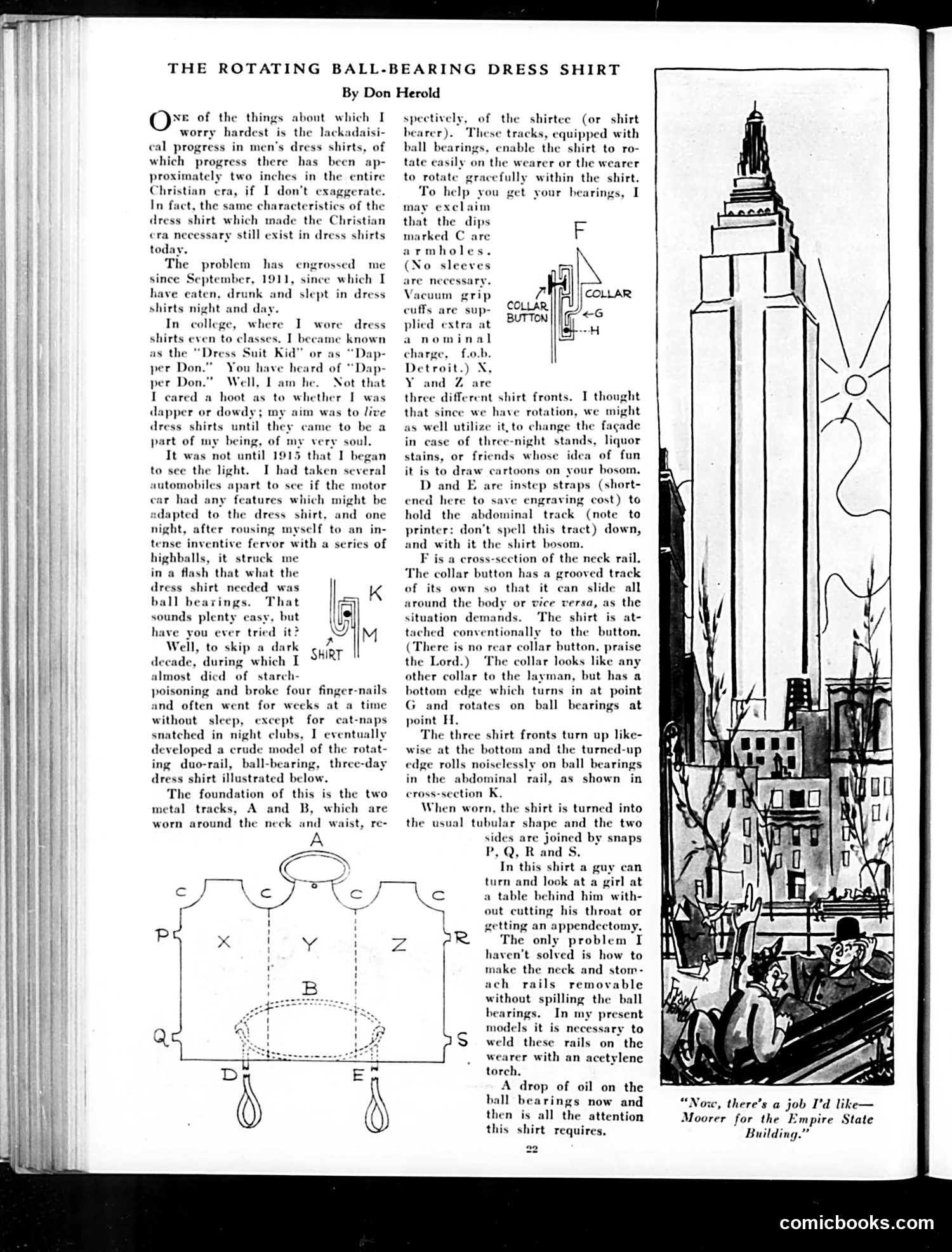
THE ROTATING BALL-BEARING DRESS SHIRT By Don Herold Ne of the things about which I worry hardest is the lackadaisi- cal progress in men’s dress shirts, of which progress there has been ap- proximately two inches in the entire ‘hristian cra, if I don’t exaggerate. rt, the same characteristics of the dress shirt which made the Christian cra necessary still exist in dress shirts today. The problem has engrossed me since September, 1911, since which I have eaten, drunk and slept in dress zht and day. Hege, whe I wore dress shirts even to classes, I became known as the “Dress Suit Kid” or as “Dap- per Don.” You have heard of “Dap- per Don.” Well, I am he. Not that I cared a hoot as to whether I was dapper or dowdy; my aim was to live dress shirts until they came to be a part of my being, of my very soul. It was not until 1915 that I began to see the light. I had taken several sutomobiles apart to see if the motor car had any features which might be adapted to the dress shirt, and one night, after rousing myself to a nventive fervor with a Is, it struck me in a flash that what the dress shirt needed was ball bearings. sounds plenty easy, but have you ever tried it? Y Well, to skip a dark «7 M decade, during which I almost dicd of starch- poisoning and broke four finger-nails and often went for wecks at a time without sleep, except for cat-naps snatched in night clubs, I eventually developed a crude model of the rotat- ing duo- three-day dress shirt illustrated below. The foundation of this is the two metal tracks, A and B, which are worn around the neck and waist, re- spectively bearer). of the shirtee (or shirt These tracks, equipped with ball bearings, enable the shirt to ro- tate easily on the wearer or the wearer to re acefully within the shirt. To help you your hearings, I ma exclaim that the dips F marked C are armholes. (No sleeves are necessary. 4 Vacuum grip © 7 Jeotear cuffs are sup- oy G<s -H plied extra at a nominal charge, f. Detroit.) X, Y and Z are three different shirt fronts. I thought that since we have rotation, we might as well utilize it,to change the facade in case of three-night stands, liquor stains, or friends whose idea of fun it is to draw cartoons on your bosom, D and E are instep straps (short- ened here to save engraving cost) to hold the abdominal track (note to printer: don’t spell this tract) down, and with it the shirt bosom. F is a cross-section of the neck rail. The collar button has a grooved track of its own so that it can slide all around the body or vice versa, as the situation demands. The shirt is at- tached conventionally to the button, (There is no rear collar button, praise the Lord.) The collar looks like any other collar to the layman, but has a bottom edge which turns in at point G and rotates on ball bearings at point H. The three shirt fronts turn up like- t the bottom and the turned-up e rolls noiselessly on ball bearings in the abdominal rail, as shown in cross-section K, When worn, the shirt is turned into the usual tubular shape and the two sides are joined by snaps P,Q, Rand S, In this shirt a guy can turn and look at a girl at a table behind him with- out cutting his throat or getting an appendectomy. R ~The only problem I 7 4 i haven't solved is how to make the neck and stom- ach rails removable without spilling the ball bearings. In my present models it is necessary to S weld these rails on’ the wearer with an acetylene torch. A drop of oil on the ball bearings now and then is all the attention this shirt requires. “Now, there’s a job I'd like— Moorer for the Empire State Building.” comicbooks.com