
Judge, 1931-05-23 · page 24 of 36
Judge — May 23, 1931 — page 24: what you’re looking at
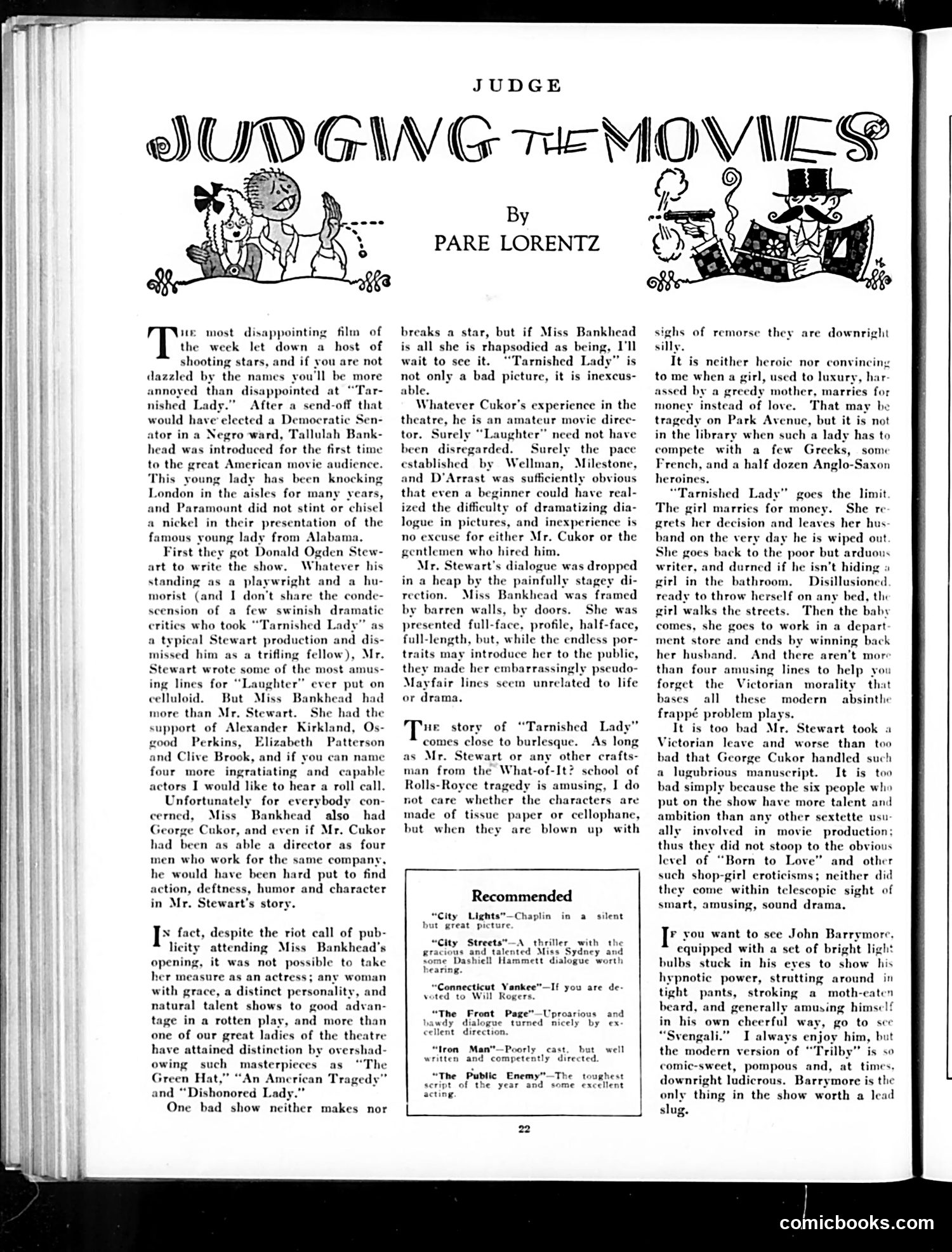
A restored page from Judge, 1931-05-23. Page through the whole issue in the reader above.
📄 Transcribed text from this page (OCR, searchable)
Machine-transcribed from the original scan — historical spelling and the odd misread are preserved.
JUDGE JUVGWG THE MIO’ LS ME the week let de host of shooting stars, and if you are not dazzled by the names you'll be more annoyed than disappointed at nished Lady.” After a send-off that would have elected a Democratic ator in a Negro ward, Tallulah Bank- head was introduced for the first time to the great Americ: This young lady has been knoe! king London in the aisles for many years, and Paramount did not stint or chisel a nickel in their presentation of the famous young lady from Alabama. st they got Donald Ogden Stew- art to write the show. Whatever his standing as a playwright and a hu- morist (and I don't share the nde- scension of a few swinish dramatic critics who took “Tarnished Lady” as a typical Stewart production and dis- missed him as a trifling fellow), Mr. Stewart wrote some of the most amus- ing lines for “Laughter” ever put on celluloid. But Miss Bankhead had more than Mr, Stewart. She had the support of Alexander Kirkland, Os- good Perkins, Elizabeth Patterson and Clive Brook, and if you can name four more ingratiating and capable tors I would like to hear a roll call. Unfortunately for everybody con- cerned, Miss Bankhead also had George Cukor, and even if Mr. Cukor had been as able a director as four men who work for the same company, he would have been hard put to find ion, deftness, humor and character Mr. Stewart's story Is fact, despite the riot call of pub- licity attending Miss Bankhead’s opening, it was not possible to take her measure as an actress; any woman with grace, a distinct personality, and natural talent shows to good advan- ge in a rotten play, and more than one of our great ladies of the theatre have attained distinction by overshad- owing such masterpie as “The Green Hat,” “An American Tragedy” and “Dishonored Lady.” One bad show neither makes nor By PARE LORENTZ breaks a star, but if Miss Bankhead is all she is rhapsodied as being, I'll wait to sce it. “Tarnished Lady” is not only a bad picture, it is inexcus- able. Whatever Cukor’s experience in the theatre, he is an amateur movie diree- tor. Surely ughter” need not have been disregarded. Surely the pace established by Wellman, Milestone, and D'Arrast was sufficiently obvious that even a beginner could have real- ized the difficulty of dramatizing dia- logue in pictures, and inexperience is no excuse for either Mr. Cukor or the gentlemen who hired him. Mr. Stewart's dialogue was dropped in a heap by the rection. Miss Bankhead was f by barren walls, by doors. She presented full-face, profile, half-fa full-length, but, le the endless por- s may introduce her to the public, made her embarrassingly pseudo- air lines seem unrelated to life or drama. ne story of “Tarnished Lady” ‘omes close to burlesque. As long as Mr. Stewart or any other crafts- man from the What-of-I ? school of Rolls-Royce tra musing, I do not care whether the characters are made of tissue paper or cellophane, but when they are blown up. with Recommended “City Lights” but great picture. Chaplin in a silent “City Streets*—A thriller, with the gracious and talented Miss Sydney and me Dashiell Hammett dialogue worth hearing. “Connecticut Yankee"—If you are de- voted to Will Rogers. “The Front Page” nawdy dialogue cellent direction, Uproarious and turned nicely by ex Poorly cast. but well competently directed. “Iron Mai written an “The Public Enemy”—The te script of the year and some ex: acting sighs of remorse they are downr silly. It is neither heroic nor con to me when a girl, used to luxu assed by a greedy mother, marries for money instead of love. That may be tragedy on Park Avenue, but it is not in the library when such a lady has to compete with a few Greeks, some French, and a half dozen Anglo-Saxon heroines. Tarnished Lady” goes the limit The girl marries for money. She re grets her decision and leaves her hus band on the very day he is wiped out ie goes back to the poor but arduous writer, and durned if he isn’t hiding » girl in the bathroom. Disillusioned dy to throw herself on bed, the ks the streets. Then the babs comes, she goes to work in a depart ment store and ends by winning back her husband. And there aren't mor: than four amusing lines to help you forget the Victorian morality that bases all these modern absinthe frappé problem plays. It is too bad Mr. Stewart took a Victorian leave and worse than too bad that George Cukor handled such a lugubrious manuscript. It is too bad simply because the six people who put on the show have more talent and ambition than any other sextette usu- ally involved in movie produc thus they did not stoop to the obvious level of “Born to Love” and other such shop-girl croti her did they come hin telescopic sight of smart, amusing, sound drama. F you want to see John Barrymore, equipped with a set of bright li bulbs stuck in his eyes to show his hypnotic power, strutting around in tight pants, stroking a moth-eaten beard, and generally amusing himse in his own cheerful way, go to sce “Svengali.” I always enjoy him, but the modern version of “Trilby” is so comic-sweet, pompous and, at times, downright ludicrous. Barrymore is the only thing in the show worth a lead slug. | comicbooks.com