
Judge, 1931-05-09 · page 20 of 36
Judge — May 9, 1931 — page 20: what you’re looking at
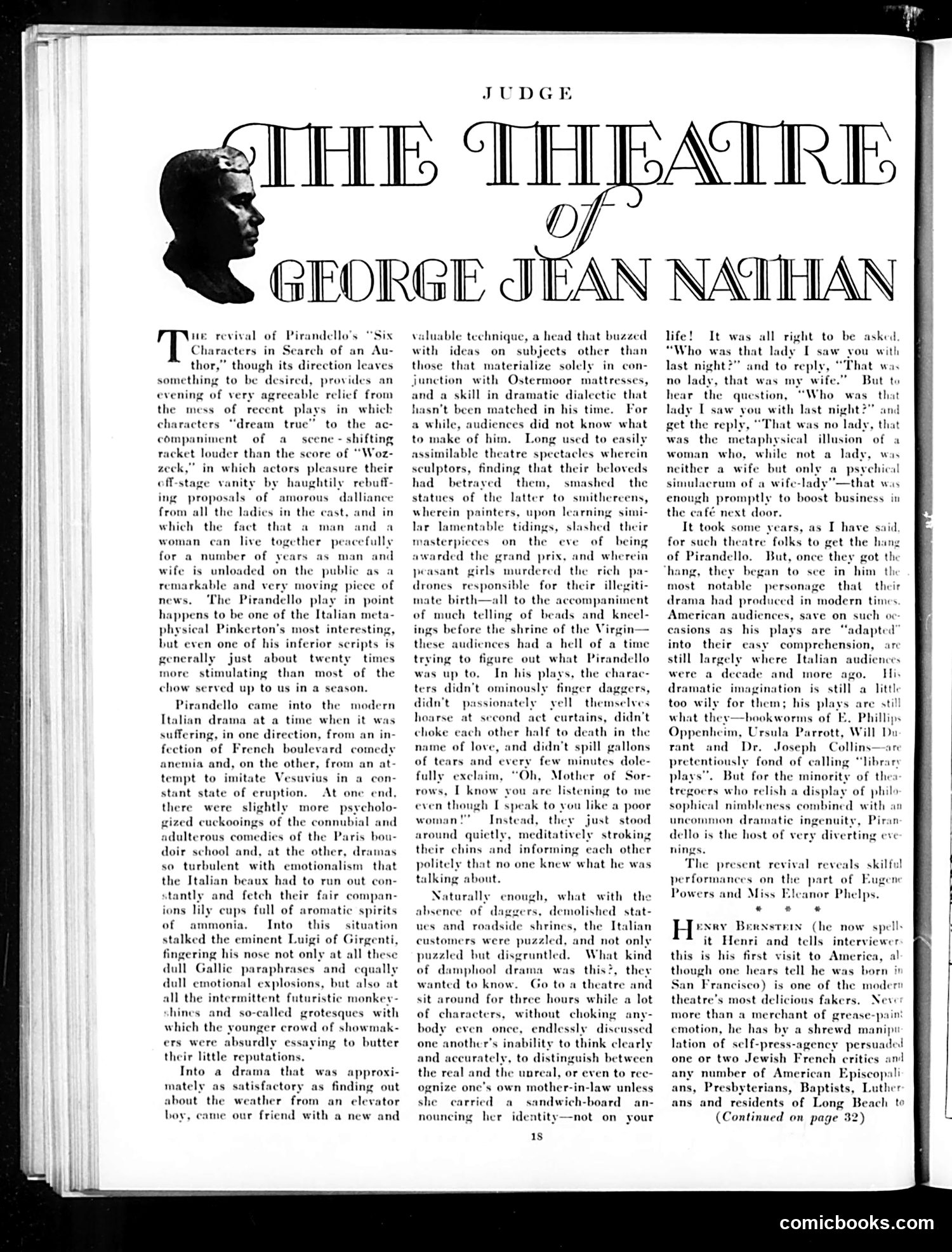
A restored page from Judge, 1931-05-09. Page through the whole issue in the reader above.
📄 Transcribed text from this page (OCR, searchable)
Machine-transcribed from the original scan — historical spelling and the odd misread are preserved.
JUDGE OD GEORGE J Pirandello’s “Six Characters in Search of an Au- thor,” though its direction leaves something to be desired, provides an evening of very agreeable relief from the mess of recent plays in which « eters “dream true” to the ac- companiment of a scene - shifting racket louder than the score of “Woz- zeck,” in which actors pleasure their off-stage vanity by haughtily rebuff- ing proposals of amorous dalliance from all the ladies in the cast, and in which the fact that a man and a woman can live together peacefully for a number of years as man and wife is unloaded on the public as a remarkable and very moving piece of The Pirandello play in point s to be one of the Italian meta- Pinkerton’s most interesting, but even one of his inferior scripts is generally just about twenty times more stimulating than most of the chow served up to us in a season. Pirandello came into the modern Italian drama at a time when it was suffering, in one direction, from an in- fection of French boulevard comedy anemia and, on the other, from an at- tempt to imitate Vesuvius in a con- stant state of eruption. At one end, there were slightly more psycholo- gized cuckooings of the connubial and adulterous comedies of the Paris bou- doir school and, at the other, dramas so turbulent with i ism that the Ital beaux ha out con- stantly r compan- ions lily cups full of aromatic spirits of —ammor Into this situation stalked the eminent Luigi of Girgenti, fil ing his nose not only at all these dull Gallic paraphrases and equally dull emotional explosions, but also at all the intermittent futuristic monk shines and so-called grotesques with which the younger crowd of showmak- ers w absurdly essaying to butter their little reputations, Into a drama that was approxi- mately as satisfactory as finding out about the weather from an boy, came our friend with an ie revival ¢ valuable technique, a head that buzzed with ideas on subjects other than those that materialize solely in con- junction with Ostermoor mattresses, and a skill in dramatic dialectic that hasn't been matched in his time. For a while, audiences did not know what to make of him. Long used to easily assimilable theatre spe sculptors, finding t th had betrayed smashed — the tues of the latter to smithereens, wherein painters, upon learning simi- lar lamentable tidings, slashed their masterpieces on the eve of warded the grand prix, and wherein peasant girls murdered the rich pa drones responsible for their ile mate birth—all to the accompa of much telling of beads and kn ings before the shrine of the Virgin these audiences had a hell of a time trying to figure out what Pirandello was up to, In his plays, the ch ters didn’t ominously finger dagg didn't passionately | yell themselves hoarse at second act curtains, didn’t choke cach other half to death in the name of love, and didn’t spill gallons of tears and every few minutes dole- fully exclaim, “Oh, Mother of Sor- rows, [ know you are listening to me even though I Speak to you like a poor woman! Instead, they just) stood around quietly, meditatively stroking their chins and informing each other politely that no one knew what he was talking about. Naturally absence cles where! beloveds them, being enough, what with the of daggers, demolished stat- ues and roadside shrines, the Italian customers were puzzled, and not only puzzled but disgruntled. What kind of damphool drama was this?, they wanted to know. Go to a theatre and sit around for three hours while a lot of characters, without choking any- body even once, endlessly discussed one another's inability to think clearly and accurately, to distinguish between the real and the unreal, or even to re ognize one’s own mother-in-law unless she carried a sandwich-board an- nouncing her identity—not on your 18 AIRE: NATHAN life! It was all right to be asked “Who was that lady [ saw you with last night?” and to reply, “ no lady, that was my wilt hear the question, “Who wa lady [ saw with last nigh get the reply, “That was no lady, that was the metaphysical illusion of a woman who, while not a lady, was neither a wife but only a_ psychical simulacrum of a wife-lady"—that was enough promptly to boost business in the café next door, It took some years, as I have said for such theatre folks to get the hang of Pirandello. But, once they got the hang, they began to see in him most notable pers: that their drama had produced in modern times American audiences, save on such oe casions as his plays are “adapted into their easy comprehension, arc still largely where Italian audiences were de nd more ». His dramatic imagination is still a_ little too wily for them; his plays are still what they—bookworms of E. Phillips Oppenheim, Ursula Parrott, Will Du rant and Dr. Joseph pretentiously fond of “Library plays’. But for the minority of thea tregocrs who relish a display of philo sophie A bined with an uncommon dramati nuity, Piran dello is the host of very diverting eve ning The present revival reveals skilful performances on the part of Eugen Powers and Miss Eleanor Phelps. * * © H™="* Bernstein (he now spell it Henri and tells interviewer this is his first visit to America, al though one hears tell he was born it San Francisco) is one of the 1 theatre's most delicious fake more than a nt of gre emotion, he has by a shrewd manip lation of self-press-agenc i one or two Jewish Frenc! any number of American Episcopsli ans, Presbyterians, Baptists, Luther ans and residents of Long Beach to (Continued on page 32) Collins —are comicbooks.com