
Judge, 1931-04-11 · page 21 of 36
Judge — April 11, 1931 — page 21: what you’re looking at
A restored page from Judge, 1931-04-11. Page through the whole issue in the reader above.
📄 Transcribed text from this page (OCR, searchable)
Machine-transcribed from the original scan — historical spelling and the odd misread are preserved.
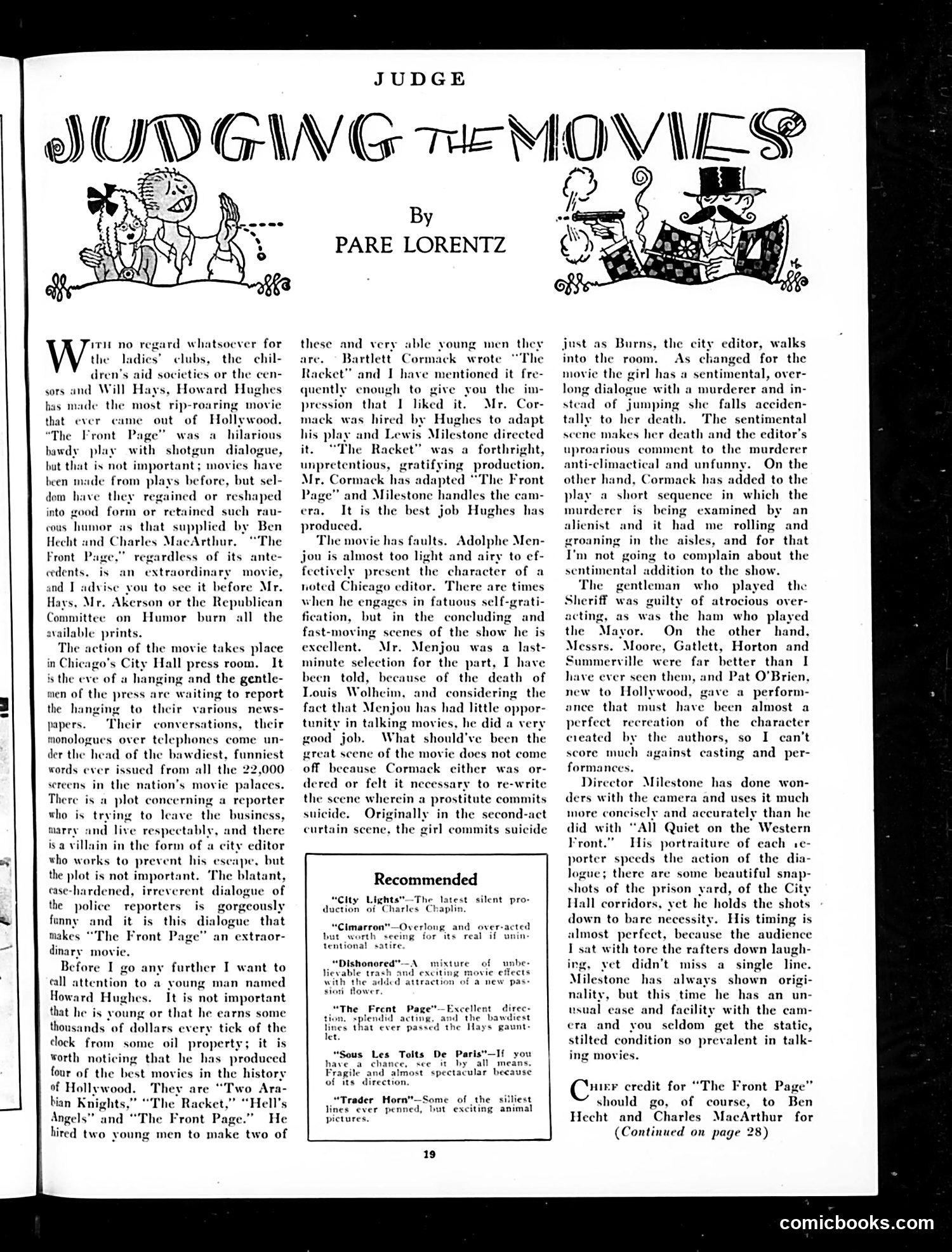
ivi no regard whatsoever for Wii ladies’ clubs, the chil- dren's aid societies or the cen- sors and Will Hays, Howard Hughes has made the most rip-roaring movie that ever came out of Hollywood, “The Front) Page’ was a_ hilarious hawdy play with shotgun dialogue, but that is not important; movies have been made from plays before, but sel- dom have they regained or reshaped into good form or retained such rd cous humor as that supplied by Ben Hecht and Charles MacArthur, “The Front P. " regardless of its ante- cedents. is an extraordinary movie, and | advise you to see it before Mr. Hays, Mr. Akerson or the Republican Committee on Humor burn all the available prints. The action of the movie takes place i ity Hall press room, It is the eve of and the gentle- men of the press aiting to report the hanging to their various news- papers. ‘Their conversations, their monologues over telephones come un- der the head of the bawdiest, funniest words ever issued from all the sereens in the nation’s movie pal There is a plot concerning a reporter who is trying to leave the business, marry and live respectably, and there isa villain in the form of a city editor tho works to prevent his eseape, but the plot is not important. The blatant case-hardened, irreverent dialogue of the police reporters is gorgeously funny and it is this dialogue that makes “The Front Page” an extraor- dinary movie. Before I go any further I want to call attention to a young man named Howard Hughes. It is not important that he is young or that he earns some thousands of dollars every tick of the clock from some oil property; it is Worth noticing that he has produced four of the best movies in the history of Hollywood are “Two Ara- tian Knights,’ acket,” “Hell's Angels” and “The Front Page.” He hired two young men to make two of JUDGE UDGING meMOVIES? By PARE LORENTZ these and very able young men they are. Bartlett. Cormack wrote “The Racket” and I have mentioned it fre- ntly enough to you the im- sion that I liked it. Mr. Cor- was hired by Hughes to adapt and Lewis Milestone directed he Racket” was a forthright, unpretentious, gratify production. Mr. Cormack has adapted ‘The Front Page” and Milestone handles the cam- era, It is the best job Hughes has produced. The movie has faults. Adolphe Men- jou is almost too light and to ef- fectively present the character of a noted Chicago editor. There are times when he engages in fatuous self-grati- fication, but in the concluding and fast-moving scenes of the show he is excellent. Mr. Menjou was a last- minute selection for the part, I have been told, because of the death of Louis Wolhcim, and considering the fact that Menjou has had little oppor- tunity in talking movies, he did a very good job, What should've been the great scene of the movie does not come off because Cormack either was or- dered or felt it necessary to re-write the scene wherein a prostitute commits: suicide, Originally in the second-act curtain scene, the girl commi' s suicide Recommended “Clty Lights"—The latest silent pro- duction of Charles Chaplin. “Cimarron”—Overlong and over-acted Lut worth seeing for its real if unin tentional satire. “Dishonored”. lievable tras with the flower. mixture of unbe+ nd exciting movie effects led attraction of a new pas- e"—Excellent direc i. and the bawdiest ed the Hays gaunt- “Sous Les Tolts De Paris*—Ii you ave a chance, sce it by all means. Fragit almost spectacular because of its direction, “Trader Horn"—Some lines ever penned, pictures. of the silliest but exciting animal i\ & 2) just as Burns, the city editor, walks into the room. As cha d for the movie the girl has a sentimental, over- long dialogue with a murderer and in- stead of jumping she falls acciden- tally to her death. The sentimental scene makes her death and the editor's uproarious comment to the murderer anti-climactical and unfun On the other hand, Cormack has added to the play a short sequence which the murderer is being examined by an alienist and it had me rolling and groaning in the aisles, and for that I'm not going to complain about the sentimental addition to the show. The gentleman who played the Sheriff was guilty of atrocious over- acting, as was the ham who played the Mayor. On the other hand, Messrs. Moore, Gatlett, Horton and Summerville were far better than I have ever seen them, and Pat O'Brien, new to Hollywood, a_perform- ance that must have been almost a perfect recreation of the character created by the authors, so I can’t score much against casting and per- formances. Dircetor Milestone has done won- ders with the camera and uses it much more concisely and accurately than he did with “All Quiet on the Western Front.” His portraiture of each .¢- porter speeds the action of the dia- logue; there are some beautiful s shots of the prison yard, of the City Hall corridors, yet he holds the shots down to bare necessity. His timing is almost perfect, because the audience I sat with tore the rafters down laugh- ing, yet didn’t miss a single line. Milestone has always shown origi- nality, but this time he has an un- usual ease and facility with the cam- er. d you seldom get the static, stilted condition so prevalent in talk- ing movies. C :F credit for “The Front Page” should go, of course, to Ben Hecht and Charles MacArthur for (Continued on page 28) comicbooks.com