
Judge, 1931-04-11 · page 18 of 36
Judge — April 11, 1931 — page 18: what you’re looking at
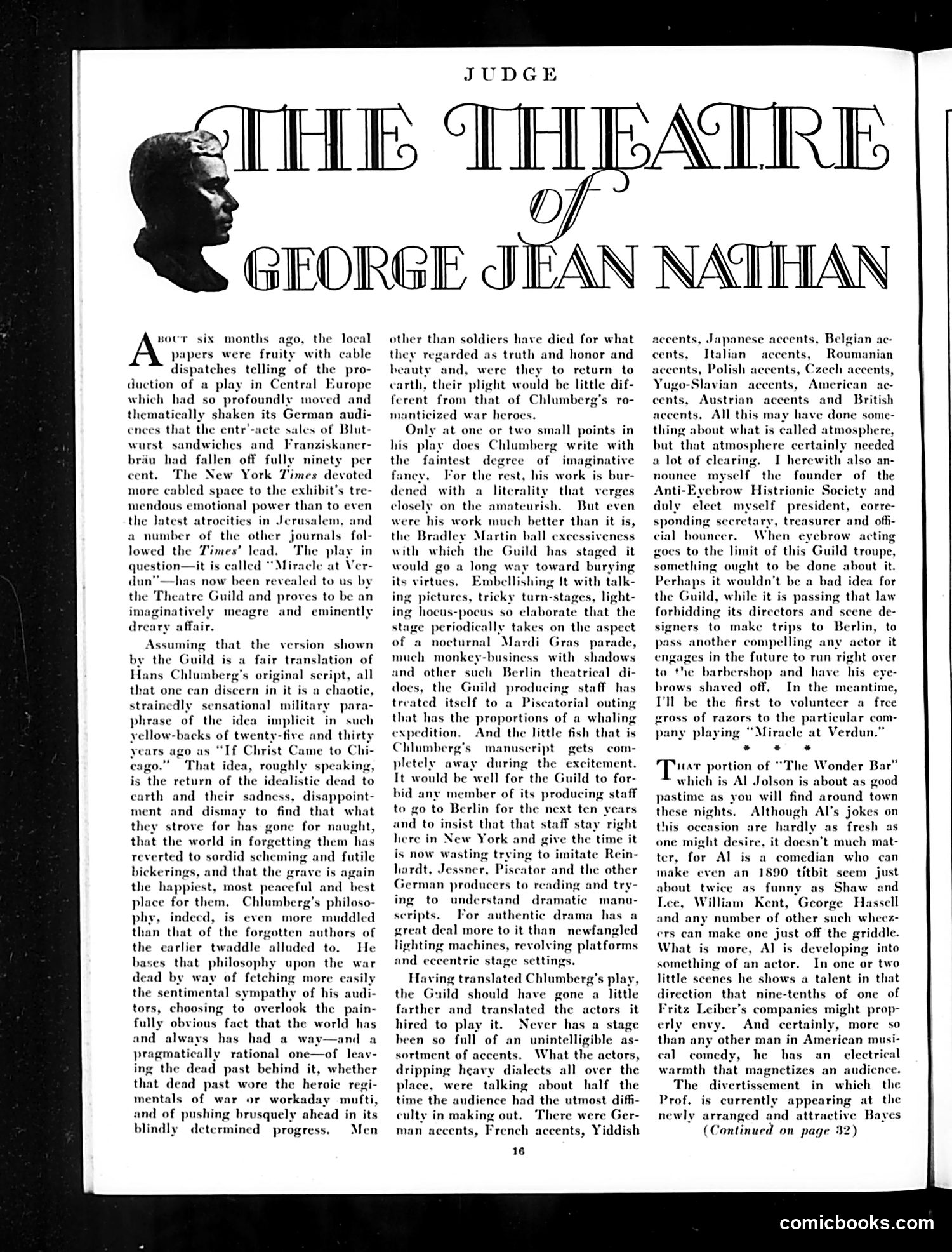
A restored page from Judge, 1931-04-11. Page through the whole issue in the reader above.
📄 Transcribed text from this page (OCR, searchable)
Machine-transcribed from the original scan — historical spelling and the odd misread are preserved.
JUDGE © GEORGE J months ago, the local papers were fruity with cable dispatches telling of the pro- duction of a play in Central Europe which had so profoundly moved and thematically shaken its German audi- ences that the entr’-acte sales of Blut- wurst sandwiches and Franziskaner- briiu had fallen off fully ninety per cent. The New York Times devoted more cabled space to the exhibit’s tre- mendous emotional power than to even the latest atrocities in Jerusalem, and a number of the other journals fol- lowed the Times’ le: question—it is called dun" —has now been revealed to us by the Theatre Guild and proves to be an imaginatively meagre and eminently dreary affair. Assuming that the version shown by the Guild is a fair translation of Hans Chlumberg’s original script, all that one can discern in it is a chaotic, strainedly sensational military pa phrase of the idea implicit in suc yellow-backs of twenty-five and thirty years ago as “If Christ Came to Chi- cago.” idea, roughly speaking, is the return of the idealistic dead to earth and their sadness, disappoint- ment and dismay to find that what they strove for has gone for that the world in forgetting them hs reverted to sordid schem nd futile bickerings, and that the i i the happiest, most peaceful and best place for them, Chlumberg’s philoso- phy, indecd, is even more muddled n that of the forgotten authors of arlicr twaddle alluded to. He war ; sily sentimental sympathy of his audi- tors, choosing to overlook the pain- fully obvious fact that the world has and always has had a way—and a pragmatically rational one—of le: ing the dead past behind it, whether that dead past wore the heroic regi- mentals of war or workaday mufti, and of pushing brusquely ahead in its blindly determined progress. Men other than soldiers have died for what they regarded as truth and honor and beauty and, were they to return to earth, their plight would be little dif- ferent from that of Chlumberg’s ro- manticized war heroes. Only at one or two small points in his play does Chlumberg write with the faintest degree of imaginative fancy. For the rest, his work is bur- dened with a literality that verges closely on the amateurish. But even were his work much better than it is, the Bradley Martin ball excessiveness with which the Guild has staged it would go a long way toward burying its virtues. Embellishing It with talk- ing pictures, tricky turn-stages, light- ing hocus-pocus so claborate that the ¢ periodically takes on the aspect of a nocturnal Mardi Gras parade, much monkey-business with shadows and other such Berlin theatrical di- does, the Guild producing staff has treated itself to a Piscatorial outing that has the proportions of a whaling expedition, And the little fish that is Chlumberg’s manuscript. gets com- pletely away during the excitement. It would be well for the Guild to for- bid any member of its producing staff to go to Berlin for the next ten years and to insist that that staff stay right here in New York and give the time is now wasting trying to imitate Rein- lardt, Jessner, Piscator and the other German producers to reading and try- ing to understand dramatic manu- scripts. For authentic drama has a great deal more to it than newfangled lighting machines, revolving platforms and eccentric stage settings. Having translated Chlumberg’s play, the Guild should have gone a little farther and translated the actors it hired to play it. Never has a stage heen so full of an unintelligible as- sortment of accents. What the actors, dripping heavy dialects all over the place, were talking about half th time the audience had the utmost diffi- culty in making out. There were Ger- man accents, French accents, Yiddish 16 ARE NAGIHIAN accents, Japanese accents, Belgian ac- cents, Italian accents, Roumanian accents, Polish accents, Czech accents, Yugo-Slavian accents, American ac- cents, Austrian rents and British accents. All this may have done some- thing about what is called atmosphere, but that atmosphere certainly needed a lot of clearing. I herewith also an- nounce myself the founder of the Anti-Eyebrow Histrionic Society and duly elect myself president, corre- sponding secretary, treasurer and offi- ial bouncer. When eycbrow actin; goes to the limit of this Guild troupe, something ought to be done about it. Perhaps it wouldn't be a bad idea for the Guild, while it is passing that law forbidding its directors and scene de- signers to make trips to Berlin, to pass another compellir ctor it engages in the future to run right over to the barbershop and have his eye- ved off. In the meantime, I'll be the first to volunteer a free gross of razors to the particular com- pany playing “Miracle at Verdun.” * * «# Tet portion of “The Wonder Bar” which is Al Jolson is about as good pastime as you will find around town these nights. Although Al's jokes on nsion are hardly as fresh one might desire, it doesn’t much mat- ter, for Al is a comedian who can make even an 1890 titbit seem just about twice as funny as Shaw Lee, William Kent, George Hassell nd any number of other such whee: ers can make one just off the griddle. What is more, Al is developing something of an actor. In one or two little scenes he shows a talent in that direction that nine-tenths of one Fritz Leiber’s companies might prop- erly envy. And certainly, more so than any other man in American musi- al comedy, he has an_ electrical warmth that magnetizes an audience. The divertissement in which the Prof. is currently appearing at the newly arranged and attractive Bayes (Continued on page 32) brows. sh comicbooks.com