
Judge, 1931-03-14 · page 15 of 36
Judge — March 14, 1931 — page 15: what you’re looking at
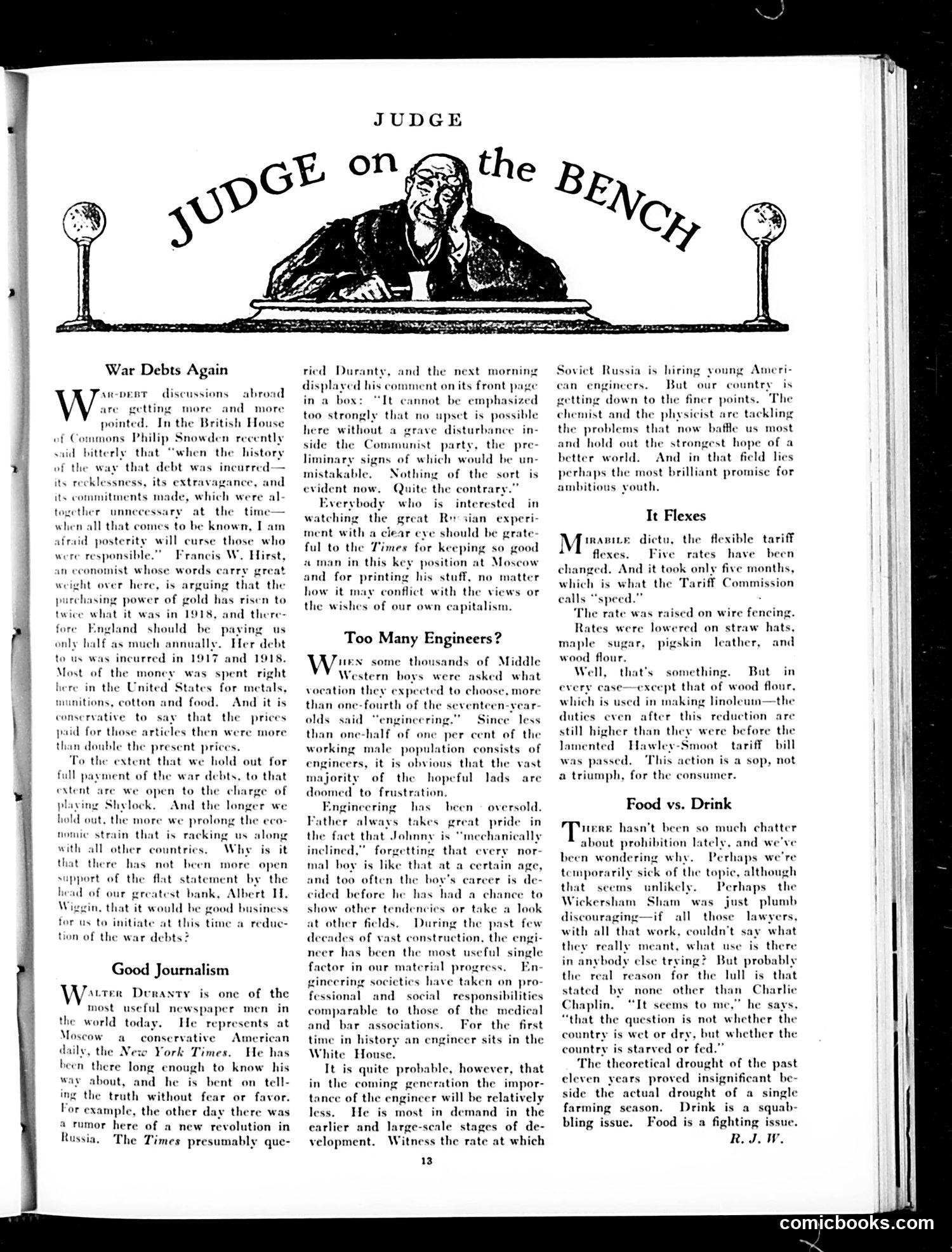
A restored page from Judge, 1931-03-14. Page through the whole issue in the reader above.
📄 Transcribed text from this page (OCR, searchable)
Machine-transcribed from the original scan — historical spelling and the odd misread are preserved.
War Debts Again ar-peBT discussions are tting and pointed. In the British House of Commons Philip Snowden recently said bitterly that “when the history that debt was incurred — its recklessness, its extravagance, and its commitments made, which were al together at the time— when all that comes to be known, Iam ufraid posterity were responsibl abroad more more of the way unnecessary ill curse those who Francis W. Hirst, in economist whose words ¢: + is arguing purchasing power of gold twice wl ry grea that the weight over here, as risen to t it was in 1918, and there- fore England should be paying us only half as much annually. Her debt to us was incurred in 1917 and 1918, Most of the money was spent. right here in the United States for metals, initions, cotton and foc And it is conservative to that the prices paid for those articles then were more than double the present prices. » the extent that we hold out for full payment of the war debts, to that extent are we open to the charge of playing Shylock, And the longer we hold out, the more we prolon fl strain that is racking us along with all other countries. Why is it that there not no more open support of the flat statement by the head of our greatest bank, Albert H. Wiggin, that it would t for us to initiate at this time a reduc- tion of the war debts? say he eco- ‘ood business Good Journalism V Tauren Deranty is one of the most useful newspaper men in the world tod He represents at Moscow a conservative American the New York Times. He has heen there long enough to know his rout, and he is bent on. tell- truth without fear or favor. For example, the other day there was 4 rumor here of a new revolution in Russia, The Times presumably que- ricd Duranty, and the next morning displayed his comment on its front p in a box: “It cannot be emphasized too strongly that no upset is possible here without a grave disturbance side the Communist party, the pre- liminary signs of which would be un- mistakable. Nothing of the sort is evident now. Quite the contrary.” Everybody who is interested in watching the great Re sian experi- ment with a clear eye should be grate ful to the Times for keeping so good aman in this key position at Moscow and for printing his stuff, no matter how it may conflict with the views or the wishes of our own capitalism. in- Too Many Engineers? V HEN some thousands of Middle Western boys were asked what vocation they expected to choos: than one-fourth of the seventeen- olds said “engineering.” Sin than one-half of one per cent of the working male population consists of engincers, it is obvious that the vast majority of the hopeful lads doomed to frustratio Engincering n- oversold, Father always takes great pride in the fact that Johnny is “mechanically inclined,” forgetting that every nor- mal boy is like that at a certain age, and too often the boy's carcer is de- cided before he has had a c¢ show other tendencies or t: at other fields. if decades of vast construction, the engi- neer has been the most useful single fa En neering societies have taken on pro- fessional and social responsibilities comparable to those of the medical and bar associations. For the first time in history an engincer sits in the White House, It is quite probable, however, that in the coming generation the impor- tance of the engincer will be relatively les: He is most in demand in the earlier and large-scale stages of de- velopment. Witness the rate 13 .more are During the ‘tor in our material progress. Soviet Russia is hiring young Ameri- But stting down to the finer points. The chemist and the physicist are tackling the problems that now baffle us most and hold out the strongest hope of a better world. And in that field lies perhaps the most brilliant promise for ambitious youth, can engineers. our country is It Flexes iranite dictu, the flexible tariff M flexes. Five rates have been changed. And it took only five months, which is what the Tariff Commission calls “speed.” The rate was raised on wire fencing. Rates were lowered on straw hats, maple su pigskin leather, and wood flour, Well, that's something. But in every case—except that of wood flour, which is used in making linoleum—the duties even after this reduction are still higher than they were before the lamented) Hawley-Smoot tariff bill was passed. This action is a sop, not a triumph, for the consumer. Food vs. Drink T ere hasn't been so much chatter bout prohibition lately, and we've been wondering why. Perhaps we're temporarily sick of the topic, although that seems unlikely. Perhaps the Wickersham Sham was just) plumb discouraging—if all those lawyers, with all that work, couldn't what they really meant, what use is there in anybody else trying? But probably the real reason for the lull is that stated by none other than Charlie Chaplin. It seems to me,” he says, “that the question is not whether the country is wet or dry, but whether the country is starved or fed.” The theoretical drought of the past eleven years proved insignificant be- side the actual drought of a single farming season. Drink is a squab- bling issue. Food is a fighting issue. R.JLW. comicbooks.com ~