
Judge, 1931-02-28 · page 15 of 36
Judge — February 28, 1931 — page 15: what you’re looking at
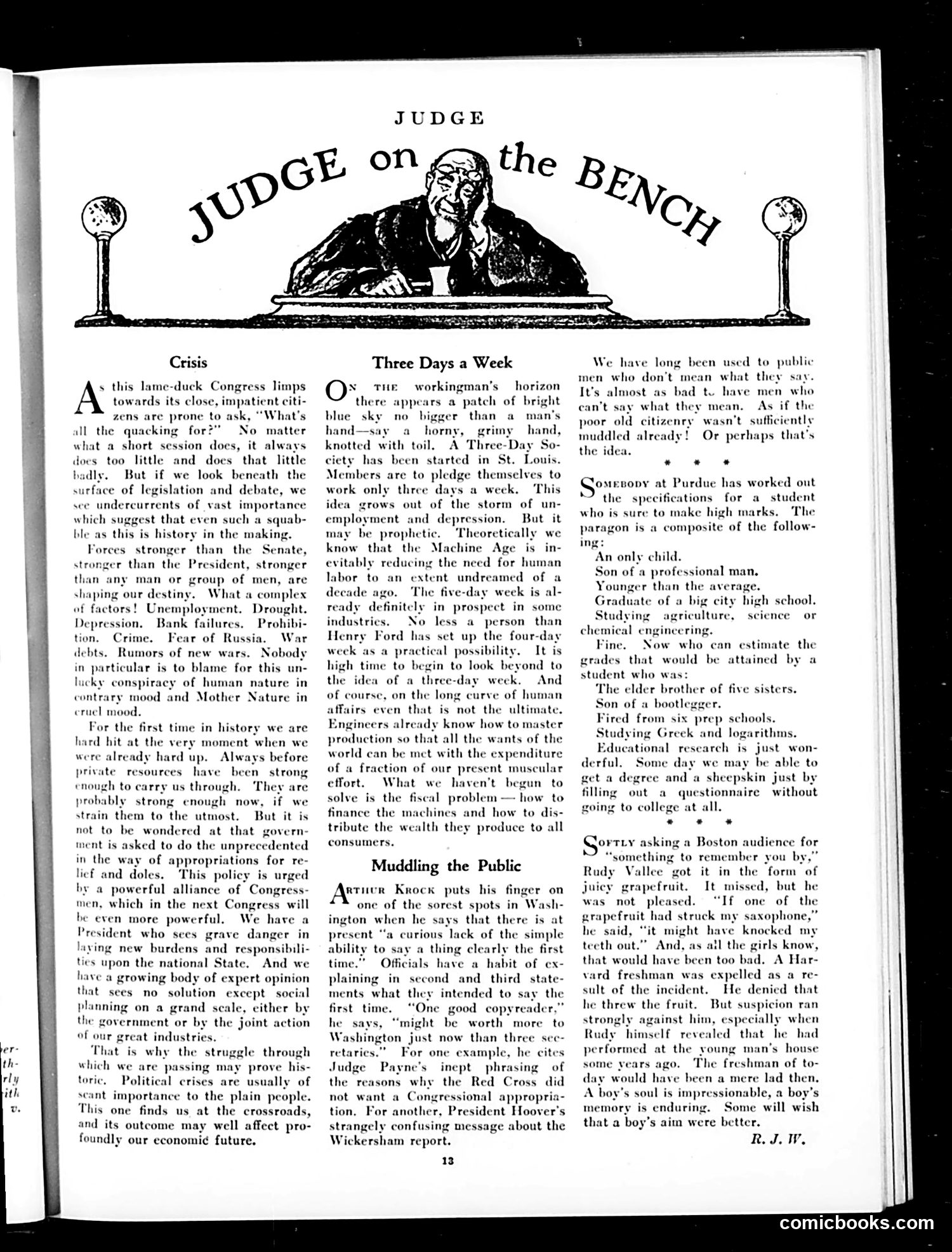
A restored page from Judge, 1931-02-28. Page through the whole issue in the reader above.
📄 Transcribed text from this page (OCR, searchable)
Machine-transcribed from the original scan — historical spelling and the odd misread are preserved.
s this lame-duck Congress limps A towards its close, impatient cit zens are prone to ask, “What's ill the quacking for?" No matter what a short session does, it « little and does that little But if we look beneath the of legislation and debate, we sce undercurrents of vast importance which suggest that even such ble as this is history in the r Forces stronger than the stronger than the President, stronger than any man or group of men, are shaping our destiny. What a complex of factors! Unemployment. Drought. Depression. Bank failures. Prohibi- tion, Crime. Fear of Russia. War debts. Rumors of new wars. Nobody in particular is to blame for this un- lucky conspiracy of human nature in contrary mood and Mother Nature in cruel mood. does too badly. surface For the first time in history we are hard hit at the very moment when we were already hard up. Alwa private have been y us through. ‘Th strong enough now, if we strain them to the utmost. But it is not to be wondered at that govern- ment is asked to do the unprecedented in the way of appropriations for re- lief and doles. This policy is urged by a powerful alliance of Congress- men, which in the next Congress will be even more powerful. We have a President who sees grave danger in laying new burdens and responsibili- ties upon the national State, And we have a growing body of expert opinion that sees no solution except social planning on a grand scale, either by the government or by the joint action of our great industries. That is why the which we are | toric, Polit scant import This one s before resources stror enough to carry probably struggle passing 1 through prove his- crises are usually of ¢ to the plain people. finds us at the crossroads, and its outcome may well affect pro- foundly our economi¢ future. JUDGE Three Days a Week tue workingman’s — horizon there appears a patch of bright blue sky no bigger than a hand—say horny, grimy knotted with toil, A Three-I started in St. Louis. Members are to pledge themselves to work only three days a week, This idea grows out of the storm of un- employment and depression, But it may be prophetic. Theoretically we know that the Machine Age is in- evitably reducing the need for human labor to an undreamed of a man’s ciety has been decade ago. ready definitely in prospect in some industries. No less a person than Henry Ford has set up the four-d week as a practical possibility. It h time to begin to look beyond to the idea of a three-day week, And of course, on the long curve of human affairs even that is not the ultir Engineers already know how to master production so that all the wants of the world can be met with the expenditure of a fraction of our present muscular effort. What we haven't begun to solve is the fiscal problem — how to finance the machines and how to dis- tribute the wealth they produce to all consumers. Muddling the Public rtitr Krock puts his finger on one of the sorest spots in Wash- ington when he says that th is at present “a curious lack of the simple ability to thing clearly the first time Officials have a habit of ex- plaining in second and third state- ments what they intended to say the first tim Ine good copyreader,” he says, “might be worth more to Washington just now than three see- retaries.”” For one example, he Judge Payne’s inept phrasing of the reasons why the Red Cross did not want a Congressional appropria- tion. For another, President Hoover's strangely confusing message about the Wickersham report. 13 cites We have long been used to public men who don't mean what they say. It's almost as bad te have men who can’t say what they mean. As if the poor old citizenry muddled already! the idea. asn’t sufliciently Or perhaps that’s * * Qomesopy at Purdue has worked out the specifications for a student who is sure to make high marks. The paragon is a composite of the follow- ing: An only child. Son of a professional man, Graduate of a big city “hi sh school. Studying agriculture, chemical engineering. Fine. Now who can estimate the grades that would be attained by a student who was: The elder brother of five sisters. Son of a booth r Fired from six prep schools. Studying Greek and logarithms. Educational research is just won- derful, Some day we may be able to get a degree and « kin just by filling out without going to college at all. * 8 * science or ortry asking a Boston audience for “something to remember you by Rudy Vallee got it in the form of juicy grapefruit. It missed, but he was not pleased. “If one of the grapefruit had struck my saxophone,” he said, “it might h: knocked my teeth out.” And, as all the girls know, that would have been too bad. A Har- vard freshman was expelled as a re- sult of the incident. He denied that he threw the fruit. But suspicion ran gainst him, especially when himself revealed that he had performed at the young man’s house some years ago. The freshman of to- day would have been a mere lad then A boy's soul is impressionable, a boy’s memory is enduring. Some will wish that a boy’s aim were better. RJILW, comicbooks.com