
Judge, 1931-02-07 · page 24 of 36
Judge — February 7, 1931 — page 24: what you’re looking at
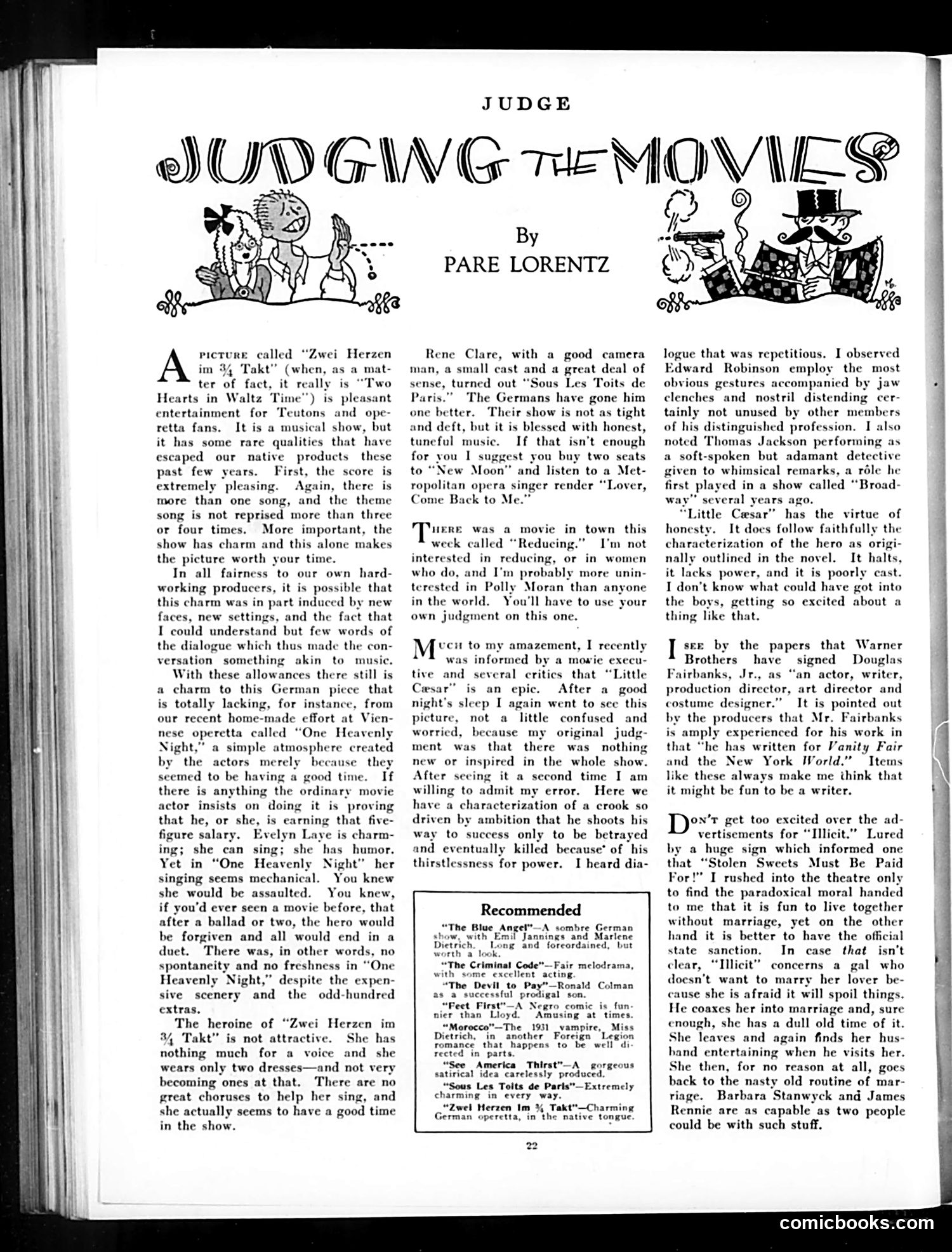
A restored page from Judge, 1931-02-07. Page through the whole issue in the reader above.
📄 Transcribed text from this page (OCR, searchable)
Machine-transcribed from the original scan — historical spelling and the odd misread are preserved.
= ' preture called “Zwei Herzen im 34 Takt” (when, as a mat- ter of fact, it really is “Two Hearts in Waltz Time’’) is pleasant entertainment for Teutons and ope- retta fans. It is a musical show, but it has some rare qualities that have escaped our native products these past few years. First, the score is extremely pleasing. Again, there is more than one song, and the theme song is not reprised more than three or four times. More important, the show has charm and this alone makes the picture worth your time. In all fairness to our own hard- working producers, it is possible that this charm was in part induced by new faces, new settings, and the fact that I could understand but few words of the dialogue which thus made the con- versation something akin to music. With these allowances there still is a charm to this German piece that is totally lacking, for instance, from our recent home-made effort at Vien- nese operetta called “One Heavenly Night,” a simple atmosphere created by the actors merely because they seemed to be having a good time. If there is anything the ordinary movie actor insists on doing it is proving that he, or she, is earning that five- figure salary. Evelyn Laye is charm- ing; she can sing; she has humor. Yet in “One Heavenly Night” her singing seems mechanical. You knew she would be assaulted. You knew, if you'd ever seen a movie before, that after a ballad or two, the hero would be forgiven and all would end in a duet. There was, in other words, no spontaneity and no freshness in “One Heavenly Night,” despite the expen- sive scenery and the odd-hundred extras. The heroine of “Zwei Herzen im 34 Takt” is not attractive. She has nothing much for a voice and she wears only two dresses—and not very becoming ones at that. There are no great choruses to help her sing, and she actually seems to have a good time in the show. JUDGE By PARE LORENTZ Rene Clare, with a good camera man, a small cast and a great deal of sense, turned out “Sous Les Toits de Paris.” The Germans have gone him one better. Their show is not as tight and deft, but it is blessed with honest, tuneful music. If that isn’t enough for vou I suggest you buy two seats to “New Moon” and listen to a Met- ropolitan opera singer render “Lover, Come Back to Me.” Ture was a movie in town this weck called “Reducing.” I'm not interested in reducing, or in women who do, and I'm probably more unin- terested in Polly Moran than anyone in the world. You'll have to use your own judgment on this one. vucu to my amazement, I recently informed by a mowie execu- tive and seve critics that “Little Cesar” is an epi After a good night's sleep I again went to see this picture, not a little confused and worried, because my original judg- ment was that there was nothing new or inspired in the whole show. After seeing it a second time I am willing to admit my error. Here we have a characterization of a crook so driven by ambition that he shoots his way to success only to be betrayed and eventually killed because’ of his thirstlessness for power. I heard dia- Recommended “The Blue Anget*—A sombre German show, with Emil Jannings and Marlene Dietrich. Long and foreordained, but worth a’ look “The Criminal Code”— with some excellent acting. “The Devil to Pay"—Ronald Colman as a successful prodigal son. “Feet Flest"—A Negro comic is fun nier than Lloyd. “Amusing at times. “Morocco”—The 1931_vampire, Miss Dietrich, in another Foreign Legion romance that happens to be well di rected in parts. “See America Thirst"—A gorgeous satirical idea carelessly produced. “Sous Les Toits de Parts"—Extremely charming in every way. “Zwel Herzen Im % Takt"—Charming German operetta, in the native tongue, melodrama, UDGWG TMOVIES | Nas. SESE Vi, logue that was repetitious. I observed Edward Robinson employ the most obvious gestures accompanied by jaw clenches and nostril distending cer- tainly not unused by other members of his distinguished profession. I also noted Thomas Jackson performing as a soft-spoken but adamant detective given to whimsical remarks, a réle he first played in a show called “Broad- way” several years ago. “Little Cesar” has the virtue of honesty. It does follow faithfully the characterization of the hero as origi- nally outlined in the novel. It halts, it lacks power, and it is poorly cast. I don’t know what could have got into the boys, getting so excited about a thing like that. I see by the papers that Warner Brothers have signed Douglas Fairbanks, Jr., as ‘an actor, writer, production director, art director and costume designer.” It is pointed out hy the producers that Mr. Fairbanks is amply experienced for his work in that “he has written for Vanity Fair and the N York World. Items like these always make me think that it might be fun to be a writer. on’r get too excited over the ad- vertisements for “Illicit.” Lured by a huge sign which informed one that “Stolen Sweets Must Be Paid For!” I rushed into the theatre only to find the paradoxical moral handed to me that it is fun to live together without marriage, yet on the other hand it is better to have the offici state sanction. In case that isn't clear, “Illicit” concerns a gal who doesn’t want to marry her lover be- cause she is afraid it will spoil things. He coaxes her into marriage and, sure enough, she has a dull old time of it. She leaves and again finds her hus- hand entertaining when he visits her. She then, for no reason at all, goes back to the nasty old routine of mar- riage. Barbara Stanwyck and James Rennie are as capable as two people could be with such stuff. comicbooks.com