
Judge, 1931-01-31 · page 26 of 36
Judge — January 31, 1931 — page 26: what you’re looking at
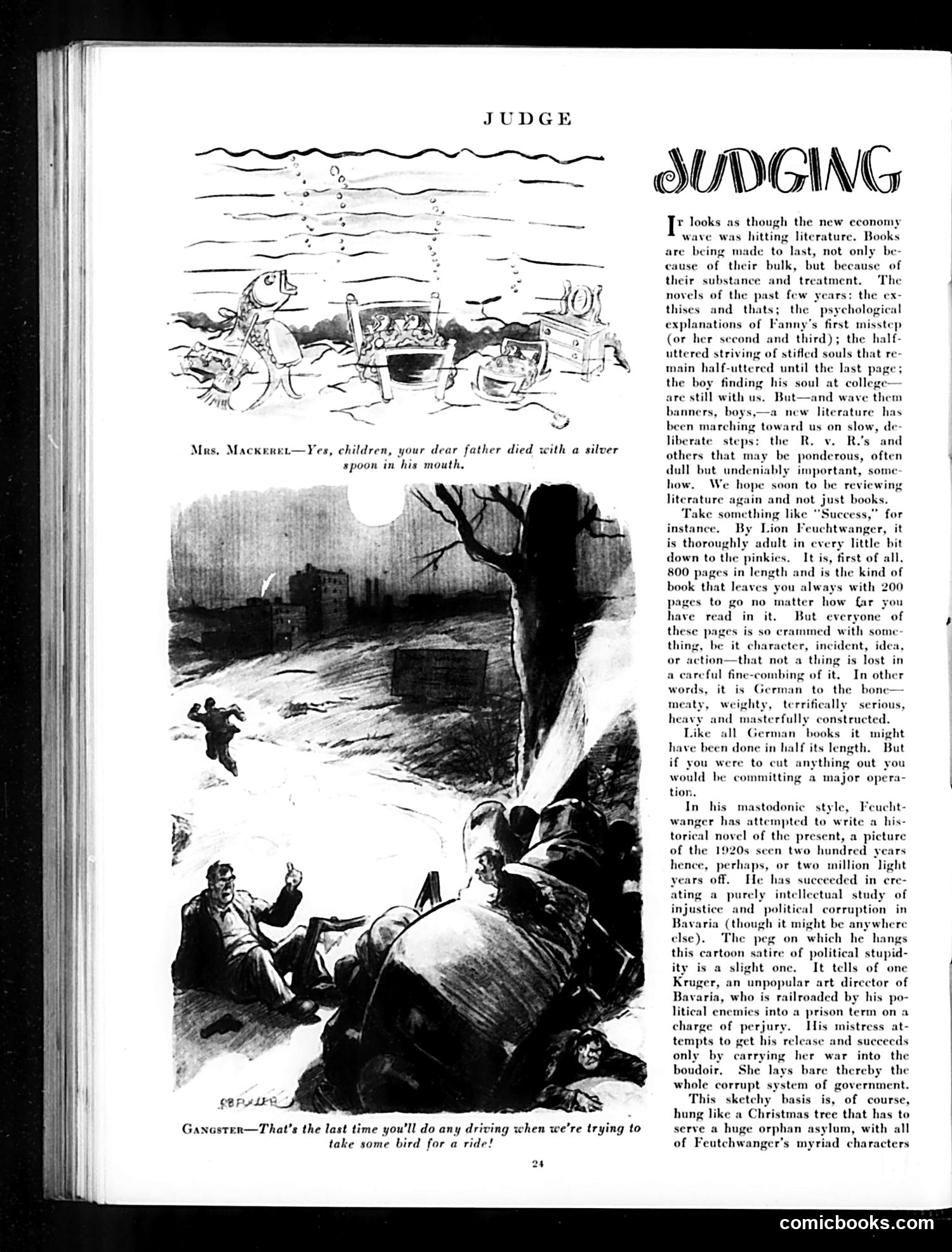
A restored page from Judge, 1931-01-31. Page through the whole issue in the reader above.
📄 Transcribed text from this page (OCR, searchable)
Machine-transcribed from the original scan — historical spelling and the odd misread are preserved.
JUDGE AUDGING r looks as though the new economy wave was hitting literature. Books are being made to last, not only be- cause of their bulk, but because of their substance and treatment. The novels of the past few years: the thises and thats; the | psycholog explanations of Fanny’s first misstep (or her second and third); the half- uttered striving of stifled souls that re main half-uttered until the last p: the boy finding his soul at colle are still with us, But—and wave them banners, boys,—a new literature has been marching toward us on slow, de- liberate steps: the R. v. R.’s) and others that y be ponderous, often dull but undeniably important, some how, We hope soon to be reviewing literature again and not just books. Take something like “Success,” for instance. By Lion Feuchtwanger, it is thoroughly adult in every little bit down to the pinkies. It is, first of all. 800 pages i 1 is the kind of book that leaves you always with 200 pages to go no matter how far you have read in it. But everyone’ of these pages is so crammed with some thing, be it character, incident, idea, or action—that not a thing is lost in ful fine-combing of it. In other words, it is German to the bone— meaty, weighty Mrs. Mackeret—Yes, children, your dear father died with a silver spoon in his mouth, , terrifically serious, heavy and masterfully constructed. Like all German books it might have been done in half its length. But if you were to cut anything out you would be committing 4 major opera- tion. In his mastodonic style, Feucht- has attempted to write a his- torical novel of the present, a picture of the s seen two hundred years , perhaps, or two million light rs off. He has succeeded in cre- ating a purely intellectual study of injustice and political corruption in Bavaria (though it might be anywhere else). The peg on which he hangs this cartoon satire of political stupid- ity is a slight one, It tells of one er, an unpopular art director of who is railroaded by his po- mies into a prison term on a of perjury. His mistress at- tempts to get his release and succeeds only by carrying her war into the boudoir. She lays bare thereby the whole corrupt system of government. CB PLLER ACS This sketchy basis is, of course, ; ~ hung like a Christmas tree that has to Ganosten—That’s the last time you'll do any driving when we're trying to serve a huge orph: take some bird for a ride! of Feutchwanger’s myriad characters 24 comicbooks.com