
Judge, 1931-01-17 · page 10 of 48
Judge — January 17, 1931 — page 10: what you’re looking at
What you’re looking at
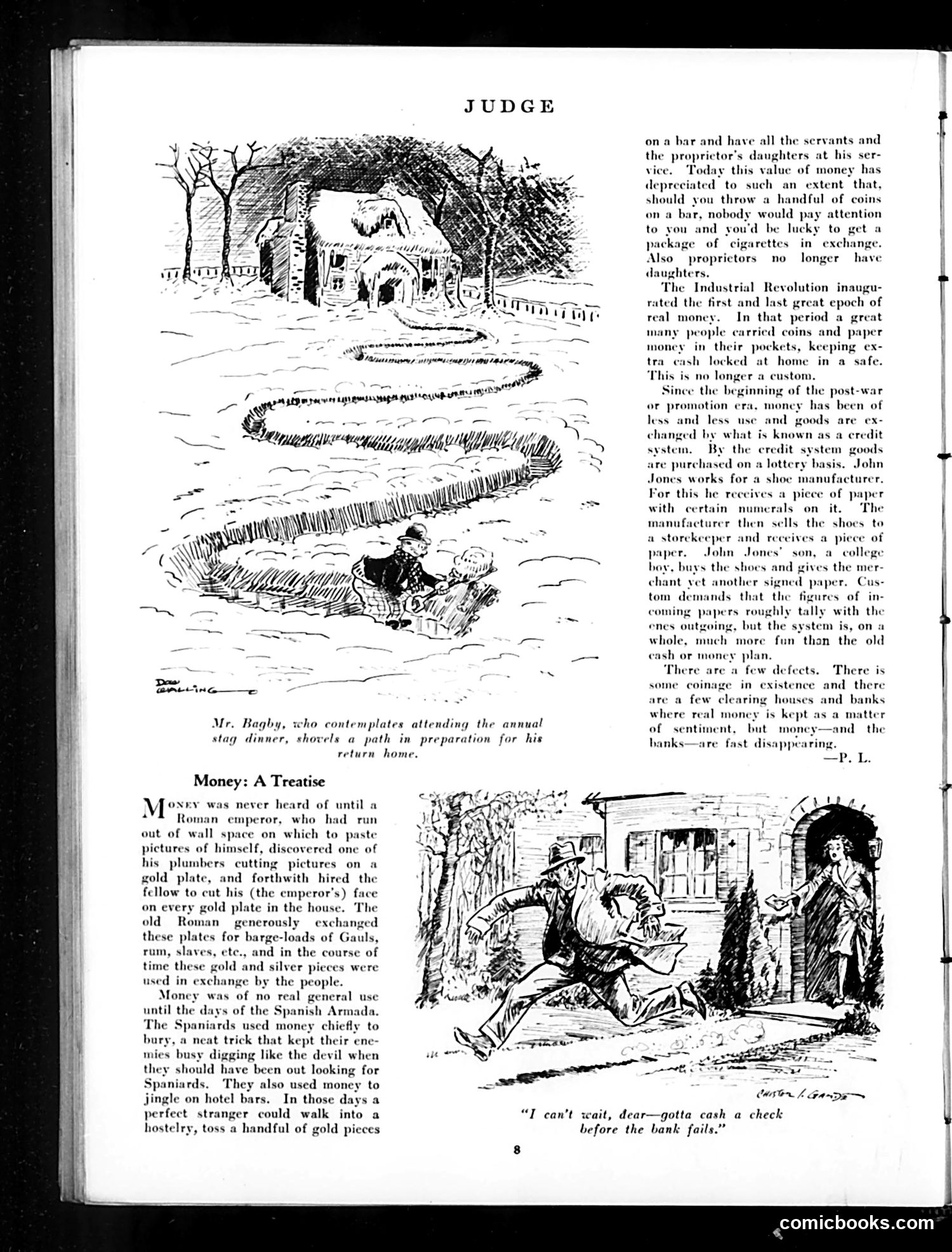
# Analysis of Judge Magazine Page This page contains two satirical pieces on money and finance, likely from the 1920s post-WWI era. **Top section ("Judge"):** A cartoon shows a man shoveling snow, illustrating how money's value has collapsed—he must physically labor rather than rely on cash. The accompanying text laments that real money has nearly disappeared, replaced by a credit system based on exchanging signed papers. The example of "John Jones" demonstrates the absurdity: a manufacturer receives paper for shoes, a storekeeper receives different paper, Jones's son receives yet another signed paper—an unstable chain dependent on numbers "roughly" matching. **"Money: A Treatise":** A humorous pseudo-historical essay traces money from Roman emperors to the Spanish Armada, ending with a cartoon showing a couple urgently discussing cashing a check "before the bank fails." This captures post-war economic anxiety—the satire suggests banking collapse is imminent and inevitable. **The satire's point:** Both pieces mock the fragility of credit-based economics and the public's loss of faith in financial institutions during this economically turbulent period.
📄 Transcribed text from this page (OCR, searchable)
Machine-transcribed from the original scan — historical spelling and the odd misread are preserved.
all the servants and ughters at his ser- ue of money has n extent t _ ae should you throw a handful of on a bar, nobody would and you'd be lucky to get age of rettes in ex Also. proprictors no longer have attenti daughters. The Industrial Revolution inaugu- Tt rated the first and last great epoch of real money. In that period a great people carried coins and p: . =. i me in their pockets, | ee ae . t sh locked at home in a safe. ] C Sinmaeoo Since the beginning of the post-war i case pee os = or promotion era, money has been of — = - = less and less use and goods are ex- ~ ly ie Wy Wa - do by what is known as a credit sZt “emcee ate Me My > iby the evedit system goods = —— 7 4 2 on a lottery basis. John ; NX : ks for a shoe manufacturer. = AN See For this he receives a piece of paper ; * with certain numerals on it. The = es a _ manufacturer then sells the shoes to “<i pes . naper.. dob boy, buys the shoes and gives the mer- | Saagees ve chant yet another signed paper. Cus- | tom demands that the figures of in- a coming papers roughly tally with the _ _ enes outgoing, but the system is, on a a aid whole, much more fun than the old = cash or money plan, > eee . cts. There is a = some. ce nee and there urea few clearing houses and banks | Mr. Baghy, who contemplates attending the annual xhere real money, dees some er j stag dinner, shovels a path in preparation for his banks—are fast disapps return home. Money: A Treatise Mex’ was never heard of until a Roman emperor, who had run out of wall space on which to paste pictures of himself, discovered one of his plumbers cutting pictures on a gold plate, and forthwith hired the fellow to cut his (the emperor's) face on every gold plate in the house. The generously exchanged ‘ge-loads of Gauls, nd in the course of were time these gold used in exch Money was of no real ge use until the days of the Spanish Armada. The Spaniards used money chiefly to trick that kept their ene- aging like the devil when should have been out looking for also used money to jingle on hotel bars. In those days a (asen h Gana perfect stranger could walk into a “I can't wait, dear—gotta cash a check hostelry, toss a handful of gold pieces before the bank fails.” 8 .comicbooks.com