
Judge, 1930-11-29 · page 21 of 36
Judge — November 29, 1930 — page 21: what you’re looking at
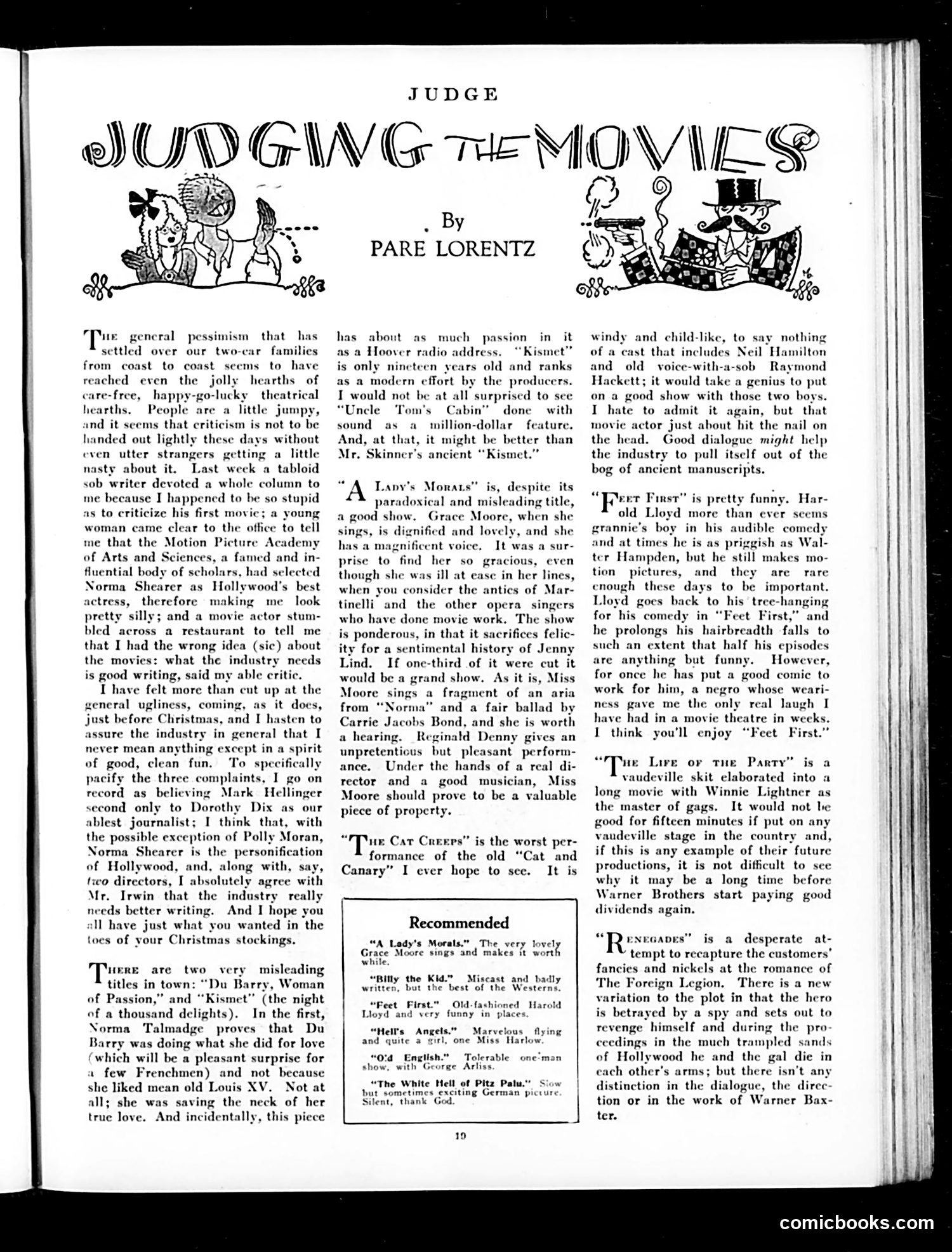
A restored page from Judge, 1930-11-29. Page through the whole issue in the reader above.
📄 Transcribed text from this page (OCR, searchable)
Machine-transcribed from the original scan — historical spelling and the odd misread are preserved.
T" general pessimism that has settled over our two-car families from coast to coast seems to ched even the jolly hearths of ire-free, happy-go-lucky theatrical rths. People are a little jumpy, it seems that criticism is not to be handed out lightly these days without even utter strangers getting a little nasty about it. Last week a tabloid sob writer devoted a whole column to me because I happened to be so stupid as to criticize his first movie; a young woman came clear to the office to tell me that the Motion Picture Academy of Arts and Sciences, a famed and in- fluential body of scholars, had selected Norma Shearer as Hollywood's best actress, therefore making me look pretty silly; and a movie actor stum- bled across a restaurant to tell me that I had the wrong idea (sic) about the movies: what the industry needs is good writing, said my able critic. I have felt more than cut up at the general ugliness, coming, as it does, just before Christmas, and I hasten to assure the industry in general that I never mean anything except in a spirit of good, clean fun. To specifically ify the three complaints, I go on record as believing Mark Hellinger second only to Dorothy Dix as our ablest journalist; I think t the possible exception of Pol Norma Shearer is the personification of Hollywood, and, along with, say, two directors, I absolutely agree w Mr. Irwin that the industry really needs better writing. And I hope you all have just what you wanted in the toes of your Christmas stockings. [ree are two titles in town: “Du Barry, Woman of Passion,” and “Kismet” (the night of a thousand delights). In the first, Norma Talmadge proves that Du Barry was doing what she did for love (which will be a pleasant surprise for t few Frenchmen) and not because she liked mean old Louis XV. Not at all; she was saving the neck of her true love. And incidentally, this piece have very misleading JUDGE has about as much passion in it as a Hoover radio address. “Kismet” is only nineteen years old and ranks as a modern effort by the producers. I would not be at all surprised to see “Uncle ‘Tom's Cabin” done with sound as a million-dollar feature. And, at t it might be better than Mr. Skinner's ancient “Kismet.” Lany'’s Morats” is, despite its il and misleading title, re Moore, when she sings, is dignified and lovely, and she has rnt voice. It was a sur- prise to find her so g though she was ill at ease in her lines, when you consider the antics of Mar- tinelli and the other opera singers who have done movie work. The show is ponderous, in that it sacrifices fel ity for a sentimental history of Jenny Lind. If one-third of it were cut it would be a grand show. As it is, Miss Moore sings a fragment of an aris from “Norma” and a fair ballad by Carrie Jacobs Bond, and she is worth a hearing. Reginald Denny gives an unpretentious but pleasant perform- ance. Under the hands of a real di- rector and a good musician, Miss Moore should prove to be a valuable piece of property. is the worst per- formance of the old “Cat and Canary” I ever hope to see. It is : Te Cat Creer: Recommended “A Lady's Morals.” |The very lovely Grace Moore sings and makes {t worth while, “Billy the Kid.” Miscast and badly written, but the best of the Westerns. uirett First.” Old-fashioned d and very funny in places Harold “Hell's Angels.” Marvelous flying and quite a girl, one Miss Harlow Tolerable one'man ge Arliss “The White Mell of Pitz Palu.” Siow hut sometimes exciting German picture Silent, thank God. | 19 windy and child-like, to say nothing of a cast that includes Neil Hamilton and old voice-with-a-sob Raymond Hackett; it would take a genius to put on a good show with those two boys. I hate to admit it again, but that movie actor just about hit the nail on the | Good dialogue might help the industry to pull itself out of the bog of ancient manuscripts. Finst” is pretty funny. Har- | Lloyd more than ever seems annie’s boy in his idible comedy and at time he is as priggish Wal- ter Hampden, but he still makes mo- tion pictures, and they are rare enough these days to be important. Lloyd goes ba for his comed he prolongs his hairbreadth falls to such an extent that half his episodes are anything but funny. However, for once he has put a good comic to work for him, a negro whose weari- ness gave me the only real laugh I have had in a movie theatre in weeks. I think you'll enjoy “Feet First.” “ne Lire or tue Party” is a audeville skit elaborated into a long movie with Winnie Lightner as the master of gags. It would not be good for fifteen minutes if put on any vaudeville stage in the country and, if this is any example of their future productions, it is not difficult to sce why it may be a long time before Warner Brothers start paying good dividends again. is a desperate at- tempt to recapture the customers’ and nickels he romance of The Foreign Legion. There is a new variation to the plot in that the hero is betrayed by a spy and sets out to revenge himself and during the pro- ceedings in the much trampled sands of Hollywood he and the gal die in cach other's arms; but there isn’t any distinction in the dialogue, the direc- tion or in the work of Warner Bax- ter. comicbooks.com