
Judge, 1930-11-29 · page 18 of 36
Judge — November 29, 1930 — page 18: what you’re looking at
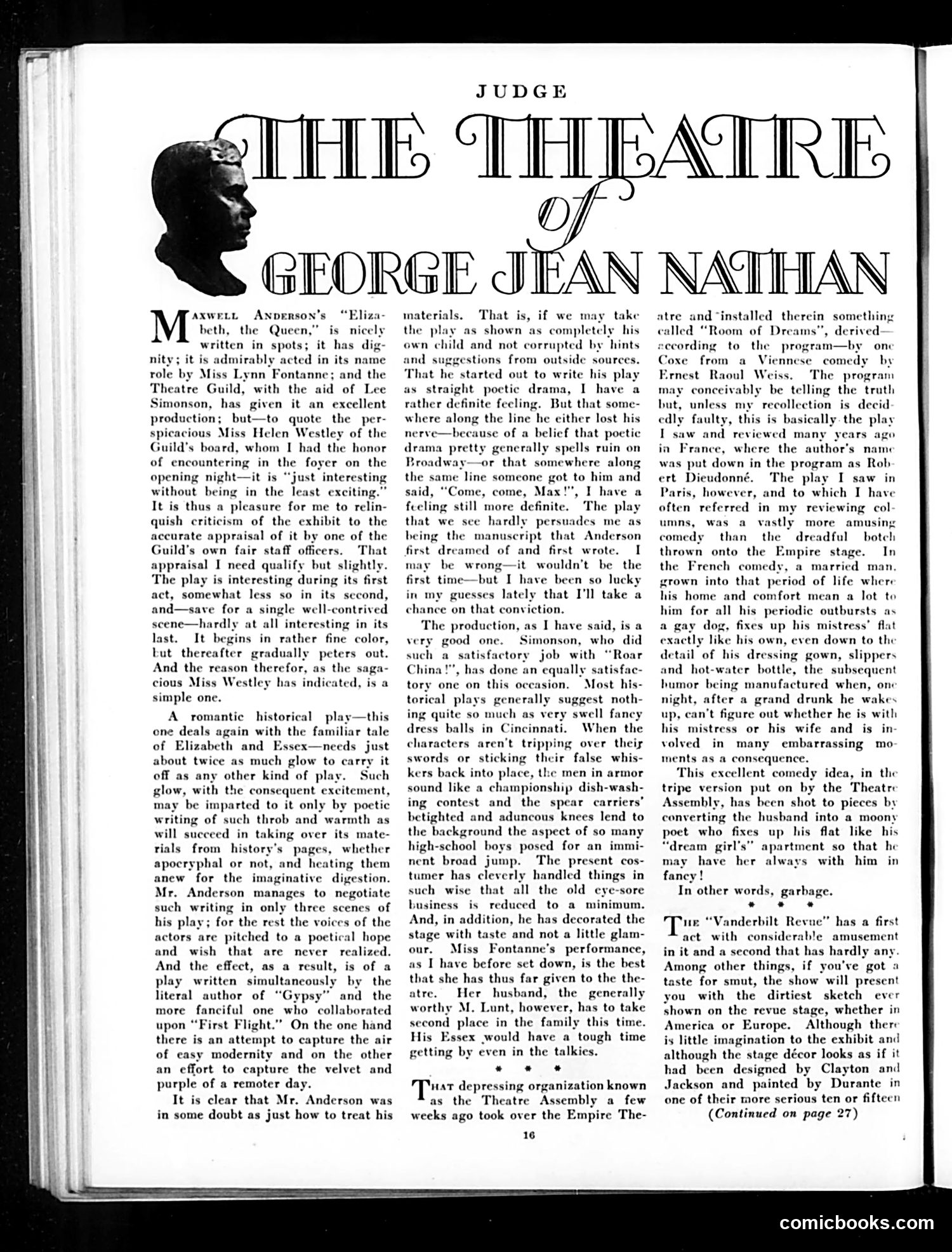
A restored page from Judge, 1930-11-29. Page through the whole issue in the reader above.
📄 Transcribed text from this page (OCR, searchable)
Machine-transcribed from the original scan — historical spelling and the odd misread are preserved.
JUDGE O GEORGE JJ AXWELL 2 written in apota: it nity; it is admirably acted in its name role by Miss Lynn Fontanne; and the Theatre Guild, with the aid of Lee Simonson, has given it an excellent production; but—to quote the per- spicacious Miss Helen Westley of the Guild’s board, whom I had the of encountering in the fo opening night—it is without being in the least exciting.” It is thus a pleasure for me to relin- quish criticism of the exhibit to the accurate appraisal of it by one of the Guild’s own fair staff officers. That appraisal I need qualify but slightly. The play is interesting during its first act, somewhat less so in its second, and—save for a single well-contrived scene—hardly at all interesting in its last. It begins in rather fine color, but thereafter gradually peters out. And the reason therefor. cious Miss Westley hs simple one. honor ron the “just interesting A romantic historical one deals again with the familiar tale of Elizabeth and Essex—needs just about twice as much glow to carry it off as any other kind of play. Such glow, with the consequent excitement, may be imparted to it only by poetic writing of such throb and warmth as will succeed in taking over its mate- rials from history's pages, whether apocryphal or not, and heating them anew for the imaginative dig Mr. Anderson manages to negotiate such writing in only three scenes of his play; for the rest the voices of the actors are pitched to a poetical hope and wish that are never realized. And the effect, as a result, is of a play written simultaneously by the literal author of “Gypsy” and the more fanciful one who collaborated upon “First Flight.” On the one hand there is an attempt to capture the air of easy modernity and on the other an effort to capture the velvet and purple of a remoter day. It is clear that Mr. Anderson was in some doubt as just how to treat his materials. That is, if we may take the p| as shown as completely his own child and not corrupted by hints and suggestions from outside source That he started out to write his play as straight poetic drama, I have a rather definite feeling. But that some- where along the line he either lost his nerve—beca belief that poetic pretty generally spells ruin on ‘or that somewhere along ame line someone got to him and said, “Come, come, Max!", I have a feeling still more definite. The play that we see hardly persuades me as being the manuscript that Anderson first dreamed of and first wrote. I may be wrong—it wouldn't be the first time—but I have been so lucky in my guesses lately that I'll take a chance on that conviction. The production, as I have said, is a very good one. Simonson, who did such a satisfactory job with “Roar China!”, has done an equally satisfac- tory one on this occasion. Most his- torical plays generally suggest noth- ing quite so much as very swell fancy dress balls in Cincinnati. When the characters aren't tripping over theiy swords or sticking their false wh kers back into place, the men in armor sound like a championship dish-wash- ing contest and the spear carriers’ betighted and aduncous knees lend to the background the aspect of so many high-school boys posed for an immi- nent broad jump. The present cos- tumer has cleverly handled things in such wise that all the old cye-sore business is reduced to a minimum. And, in addition, he has decorated the stage with taste and not a little glam- our. Miss Fontanne’s performance, as I have before set down, is the best that she has thus far given to the the- atre. Her husband, the generally worthy M. Lunt, however, has to take second place in the family this time. His Essex would have a tough time getting by even in the talkies. * *# « Te depressing organization known as the Theatre Assembly a few weeks ago took over the Empire The- 16 ARES NACTHIAN atre and “installed therein something ned “Room of Dreams”, derived ording to the program—by on Coxe from a Viennese comedy by Ernest Raoul Weiss. The program may ably be telling the truth but, unless my recollection is decid edly faulty, this is basically. the play nd reviewed many 3 where the author's me s put down in the program as Rob ert Dieudonné. The play I saw in Paris, however, and to which I hav often referred in my reviewing col umns, was a vastly more amusing comedy than the dreadful botel: thrown onto the Empire stage. In the French comedy, a married man. grown into that period of life wher: his home and comfort mean a lot to him for all his periodic outbursts as a gay dog, fixes up his mistress’ flat exactly like his own, even down to the detail of his dressing gown, slippers and hot-water bottle, the subsequent humor being manufactured when, one night, after a grand drunk he wakes up, can’t figure out whether he is with his mistress or his wife and is in volved in many embarrassing mo ments as a consequence. This excellent comedy idea, in the tripe version put on by the Theatr: Assembly, has been shot to pieces by converting the husband into a moony poet who fixes up his flat like his “dream girl's" apartment so that hi may have her always with him in fancy! In other words, garbage. * * « conce! ue “Vanderbilt Revue” has a first act with amusement in it and a second that has hardly any. Among other things, if you've got : taste for smut, the show will present you with the dirtiest sketch ever shown on the revue stage, whether in America or Europe. Although ther: is little gination to the exhibit and although the stage décor looks as if it had been designed by Clayton and Jackson and painted by Durante in one of their more serious ten or fifteen (Continued on page 27) considerable comicbooks.com